2000? Lightweight Pins of Krylov's Fables: Brown, Red, Green.
Each pin, about 1 1/4" wide, has "Krylov's Fables" across its top, with an oval presentation of a fable's scene in brown with a green background. "The Swan, Pike, and Crayfish" seems temporarily lost.
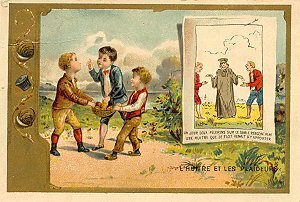
1890? 2 colored French cards picturing La Fontaine's "L'Huitre et les Plaideurs" and "Le Lièvre et les Grenouilles. " They are exactly in the format of the 1900 Liebig series "Favole di La Fontaine." The latter card reduplicates one there. The verso is blank on both of these cards.
Is there any chance that "L'Huitre et les Plaideurs" belongs to one of the two earlier sets (1883 and 1896) of La Fontaine’s fables in the Liebig series? Might Liebig have sold the plates from its cards for use by others? "Le Lièvre et les Grenouilles" even has the title bar across the top in which "Vero Estratto di Carne Liebig" appears in the 1900 series. The colors have dulled on these cards. They are in fair to good condition.
1900 Fables de La Fontaine. Veritable Extrait de Viande Liebig. Six cards, each with an animal scene from a fable of La Fontaine attached with a stick-pin to a human scene of children. Publishers: Liebig Company, Paris. £27.50 from Murray Cards International, Cecil Court, London, April, '06. Extra set in excellent condition for $37.20 from James Longworth, Apopka, FL, through bidstart, August, '11.
This set is, with changed language, exactly like the Italian version I had found earlier. The face of each card includes " Veritable Extrait de Viande Liebig " across its top, the two pictures, one set into the other, a cameo of a key character in the lower right, heads of other fable characters along the left side over a can or jar of Liebig meat extract, and "Fable de La Fontaine" across the center above the title of the particular fable pictured. The back of each card, amid lots of information about Liebig, features an illustration of a courtly character and either a recipe or an explanation of how useful Liebig meat extract is. I have now answered my question asking whether this set appeared in other languages than Italian. Now the question is: "How many languages?" The Italian set mentioned Liebig in Antwerp, while this set places Liebig in Paris.
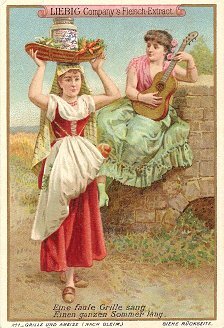
1892 Grille und Ameise (Nach Gleim). Liebig Company's Fleisch Extract. Six numbered cards, each with two to four lines of rhyming German verse on the picture. Lie0625. $49.95 from Kyle DeRoy, Denver, CO, through eBay, Oct., '06
Each scene puts a can or jar of Liebig's meat product in one of the lower corners. The last two cards I had already found advertising Aux Deux Passages in Lyon. As I comment there, I have never before seen the ant dance, supposedly in mockery of the cicada, as the former sends away the latter.
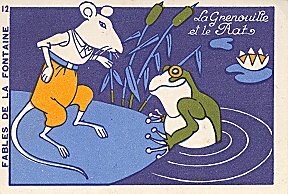
1960? 6 numbered cards from a set of at least 20 by an unknown publisher featuring each one fable of La Fontaine. 2½" x almost 4". Three cards for $18 from Bertrand Cocq, Calonne-Ricouart, France, March, '01. Three cards, one (#20) in poor condition, for $12 from Annick Tilly, Clignancourt, August, '01. Another twelve cards for $60 from Bertrand Cocq, Calonne-Ricouart, France, Sept., '18. Eight more cards, including two non-duplicates, for $1.25 apiece from place-nette-nantes on Ebay, May, '22. #13 "Les deux Coqs" for €6 from chemin-faisant on Ebay, Nov., '24.
These cards are unusual for their very lively and simple color schemes. OF may make the strongest visual statement. "Le Rat retiré du Monde" typifies the simple, even romantic approach to the fables here.
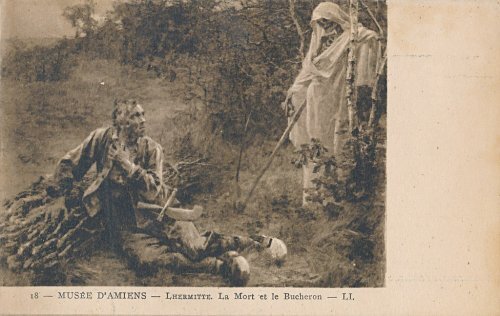
1910? (Léon Augustin) Lhermitte, "Death and the Woodman." Black-and-white photograph of "La Mort et le Bucheron." Musée d'Amiens. #18. "L.L." Paris: Levy and Neurdein Réunis. $8 from Bertrand Cocq, Calonne Ricouart, France, Sept., '18.
Here, I would say, is realistic painting at its best. The fable's elements are there, including the woodsmen's load of collected wood, his wooden shoes, and death's white shroud. The positioning of the photograph on the card is surprising. This card was not addressed or sent through the mail.