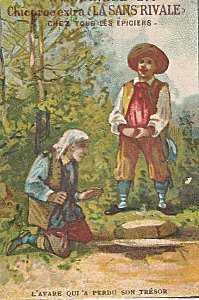
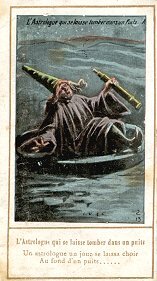
1895? Two cards and twelve additional slips -- plus several duplicates -- of thin paper (not cardboard) stock presenting La Fontaine's fables. One card, cropped, shows "L'Avare qui a perdu son Trésor" and advertises Haquet Chicory (HC) of Lille. The other shows "Le Loup devenu Berger" and advertises, on its verso only, Ed. Le Roy (ELR) of Bayeux, manufacturer of carriages. This latter card was printed by Leopold Verger of Paris.
The cards have the strongest images in this set. They are also my clue to the identity of the papers, which are otherwise unmarked. HC is a curiosity. The card's picture is colorful but sketchy. The witty commentator wears a wide-brimmed hat as he speaks to the kneeling miser. Across the top of the picture is "Demandez la Chicorée extra 'LA SANS RIVALE' chez tous les épiciers." The back is covered with print and a picture of the chicory jar. ELR shows in its "Le Loup devenu Berger" how primitive the image work is here. Its clouds look like they bear a human fingerprint. One of the eight papers repeats this scene, in the same scale but--as is true of all eight--with a slightly larger image area and no border. All the papers except "Le Loup devenu Berger" have a blank verso. The papers are just over 2½ by just under 4". ELR is the same size overall, while HC, cropped, is slightly smaller. Two of them are torn: DLS and "Le Laboureur et ses Enfants." See the same cards presented differently under "Alcide Picard" and, among chocolate and chicoree cards, "Maison Salmon." "Alph. Babotte" also belongs to this group of images.
1890? 11 French cards of La Fontaine fables, nine marked as coming from Léopold Verger & Cie in Paris. 2" x 3½".
These small portrait-formatted cards run a brown framing stripe around a colored illustration. The stripe also frames a few lines from the fable below, sometimes proceeded by the fable's title and sometimes concluding with a reference to La Fontaine and the specific fable. Small italic black print at the top of the illustration gives its French title. Small numerals in the lower right or left may identify a series or a date (e.g., "2 12" and "& 10"). There is also a small signature "LV&C" on many cards. The cards are very similar to those in the set from Chocolat Grondard. Some scenes end up looking quite humorous, like the milkmaid with an elaborate urn on top of her head! The illustration for "The Battle of the Weasels and the Rats" is well done; it suggests the general battle, the holes, and those who could not enter them. Eight of the eleven cards advertise on the back Planteur de Caiffa, apparently a chain of grocery stores. Two advertise "A Saint-Pierre," which seems to sell clothes, hats, and even furniture. The last advertises Pastilles Lucan, which are good for rheumatism and throat problems.The last three bring our total to 25. May we start to ask how many cards there are in this series? They also provide a chance to notice the verso of these diverse cards.
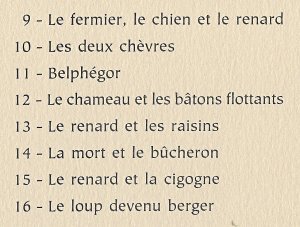
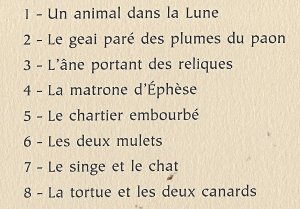
1996? 32 colored woodcuts after watercolors by Henry LeMarié, engraved by hand by Jean Taricco. Printed on Velin de Rives in the studio of Editions d'Art Les Heures Claires in Paris. Beautifully mounted and presented in two elaborate boxes. Signed in pencil? €450 from Plazzart, Paris, Sept, '20.
I have found LeMarié's miniatures delightful since I first saw them. This set is gorgeously presented. They seem to reproduce the illustrations in LeMarié's edition of 1996, over which I have expressed my delight. I wanted to include LeMarié's "Cobbler and Banker" in the Joslyn exhibit, but the art is too small. As I learn more now, I wonder how this kind of colorful work can be done on woodblocks. How many passes does it take on the poor piece of paper? I see this set of prints as an excellent showpiece for the collection. Jean Taricco engraved some 2200 pieces of wood necessary for the reproduction of the aquarelles of Henry LeMarié. Apparently some 30 colors were applied.
1996? 32 colored woodcuts after watercolors by Henry LeMarié, engraved by hand by Jean Taricco. Printed on Velin de Rives in the studio of Editions d'Art Les Heures Claires in Paris. Beautifully mounted and presented in two elaborate boxes. Signed in pencil? €450 from Plazzart, Paris, Sept, '20.
I have found LeMarié's miniatures delightful since I first saw them. This set is gorgeously presented. They seem to reproduce the illustrations in LeMarié's edition of 1996, over which I have expressed my delight. I wanted to include LeMarié's "Cobbler and Banker" in the Joslyn exhibit, but the art is too small. As I learn more now, I wonder how this kind of colorful work can be done on woodblocks. How many passes does it take on the poor piece of paper? I see this set of prints as an excellent showpiece for the collection. Jean Taricco engraved some 2200 pieces of wood necessary for the reproduction of the aquarelles of Henry LeMarié. Apparently some 30 colors were applied.
1996? 32 colored woodcuts after watercolors by Henry LeMarié, engraved by hand by Jean Taricco. Printed on Velin de Rives in the studio of Editions d'Art Les Heures Claires in Paris. Beautifully mounted and presented in two elaborate boxes. Signed in pencil? €450 from Plazzart, Paris, Sept, '20.
I have found LeMarié's miniatures delightful since I first saw them. This set is gorgeously presented. They seem to reproduce the illustrations in LeMarié's edition of 1996, over which I have expressed my delight. I wanted to include LeMarié's "Cobbler and Banker" in the Joslyn exhibit, but the art is too small. As I learn more now, I wonder how this kind of colorful work can be done on woodblocks. How many passes does it take on the poor piece of paper? I see this set of prints as an excellent showpiece for the collection. Jean Taricco engraved some 2200 pieces of wood necessary for the reproduction of the aquarelles of Henry LeMarié. Apparently some 30 colors were applied.