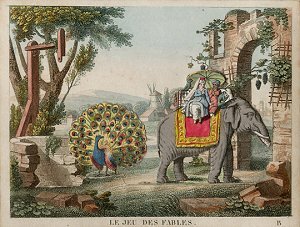
1815? Le Jeu des fables, ou fables de LaFontaine mises en action. Avec figures coloriées et découpées, dessinées et gravées par Lambert ainé. Paris: Lambert. Received in trade from June Clinton, March, '93.
This set includes a small oblong booklet with fifteen of La Fontaine's fables and a concluding set of as many pictures. These latter give the pattern for use of a postcard-sized background-board with several small pocket-like openings for inserting figures--like the peacock and elephant here. There were originally some thirty-three figures, of which seventeen still remain in this set. Four of the scenes can still be reproduced entirely: 1, 2, 8, and 12. The figures are enclosed in a marbled envelope the same size as the booklet. There is a slip-case for the whole ensemble. My favorite private collector gives a date of 1820 and makes the publisher Alph. Giroux.
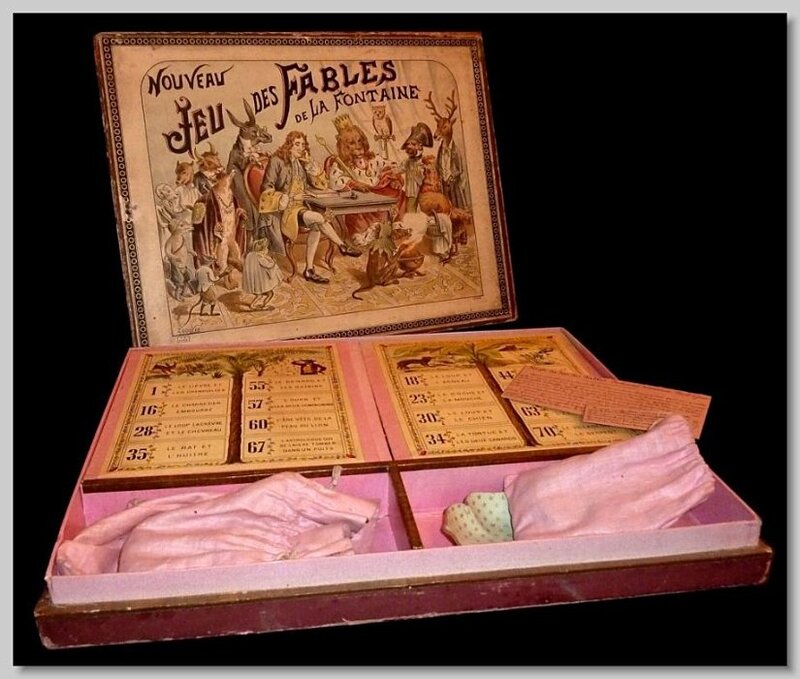
1895 "Le Jeu des Fables." (The game of fables.) Publisher Leon Saussine. Complete with 9 cards 7" x 7½" and 72 tokens. $216 in a French auction purchase mediated by Bertrand Cocq, August, 2020.
This is the most complete presentation of French La Fontaine Lotto games in our collection. The nine cards include each eight fable titles and lottery numbers, with two of them illustrated at the top of the card , with a palm tree separating and arching over them. The 72 "tokens" offer a fable moral with the mention of one or two points "won" or "lost."Apparently, each player received a number of the lovely cards. The paper tokens involve a quotation from the moral of a specific numbered fable, with a gain or loss of one to three points each. Were players challenged perhaps to guess the fable of origin for this short quotation? The instructions I received suggest that the appropriate card holder had only to read the title next to the number to receive the card – and then had to pay or collect. That part of the game remains mysterious to me. It seems likely that the player first to cover all eight of the numbers on one of his cards is the winner.
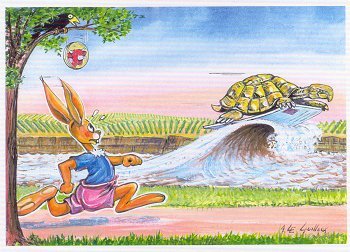
2003 Five cards presenting La Fontaine fables humorously, all designed and signed by André le Guilloux of Louvres. They appear to have been created for various groups or competitions, including "Les Fables de la Fontaine: victimes du progrès" and "Les Fables et le Progrès." Another contains the caption "En Hommage a Jean de la Fontaine." Another is simpler: "Fable de la Fontaine." Yet another appears to have been done for a series sponsored by Crédit Agricole of Strasbourg and to have been presented at the 2e Salon de l'Image et de l'Écrit, as was the series by Claude Coudray on "Le Coq et le Renard." Oversized: over 4" x just less than 6". €12 for the group from the artist at the Paris Post Card Exhibition, Jan., '05.
See my remarks on each card. These cards show a great deal of wit and imagination! I was surprised when the seller started to write on the back of each, and I asked him why he was doing that. He explained that he is the artist and that he was signing them for me!
1962?/90? Le Grande Moose. Volume 5 of "The Adventures of Rocky & Bullwinkle." Burbank, CA: Buena Vista Home Video. $9.95 at Washington Video, Georgetown, Dec., '91.
The "Aesop & Son" portion here is the story of the dumb mule who gets the last laugh on two jokester jackrabbits (5:30). The mule is a water-serving innkeeper in the desert. The jackrabbits run up huge bills with him but manage to get him three times to smoke exploding cigars. When they return from having spent all their riches in Paris, they fall down his well. This section comes about thirty-five minutes into this forty-six minute tape, after and before Rocky and Bullwinkle are depth-charged at sea. I am not aware of an Aesopic original behind the story.