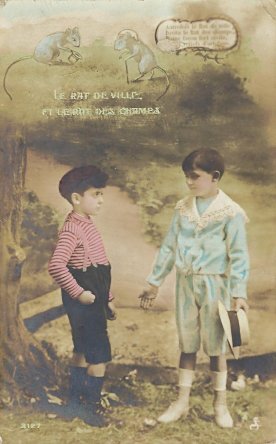
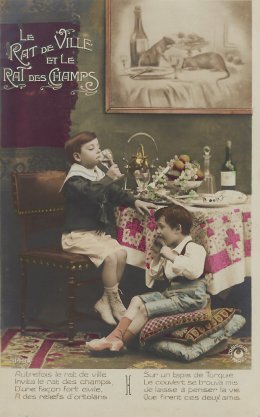
1915? Four card colored-photographic postcard series of TMCM featuring children. "3127." "SE" or "ES" symbol at the lower right on each card. Each card features drawings of the fable in the upper portion, a text "bubble," the fable's title, and a large lower portion of the photographic presentation. Printed in France. $6 each from Bertrand Cocq, Calonne-Ricouart, France, Sept., '20.
My, there was lively competition in the early twentieth century in Paris in producing colored photographic postcard series of fables! The piling on of specifications in that last sentence surprises even me! This set is closest to Chloro-Platine WL and shares the same symbol, "SE," in the lower right corner. As that set has the number 3142 on each card, so this set has 3127. That is a five-card set, apparently complete, and I believe that this four-card set is missing a third card in the middle, especially because those four verses are the only ones left out of the fable on the cards we have. Here, as there, we have lovely coloring distinguishing the two "mice" as they are played by children. How was that coloring done at the printer's? Especially fetching in this presentation, I believe, is the scene of the two mice devouring the city banquet! Now to find that fifth card! All four were sent in 1918 to the same "Cher Cousin Alfred Pepin" (?) in "Secteur 125."
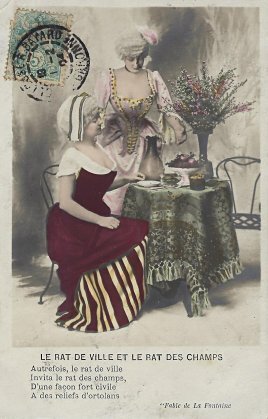
1904 5 postcard series featuring adult women portraying TMCM. Postmarked all to Mademoiselle Brugere. February 1, 1904. $35 for the set from Bertrand Cocq, Calonne Ricouart, France, Sept., '20.
I never want to disagree with Monsieur Cocq, but I wonder if there is not a missing fourth card in a series of six. This set quotes La Fontane but, at that point, excises a few lines of his text. Is there an extra card out there somewhere, to complete this series? As it is, this photographic series presents a strong contrast between the luxuriously dressed city rat and the simpler country rat in her plain red dress.
1910? Two (of apparently five) photographic postcards presenting La Fontaine's TMCM. #3143/1 and #3143/5. Ch. Fontane, Editeur. Paris: Croissant. $12 from Bertrand Cocq, Calonne Ricouart, France, Sept., '20.
Compare this pair with Croissant's similar work on MM and Croissant and Fontane's GA and TH. Here again children carry the roles. Again the first card presents the ornate title. Again we have less colorful images inserted showing the parallel scenes among animals, here rats. Are these cards hand-colored?
Tissot Bonbon tin. "Bonbons Frescomint Rafraichissants." Made in France. Cover features FC with an apparent mint dropping from the crow's beak. About 3" in diameter and ¾" high
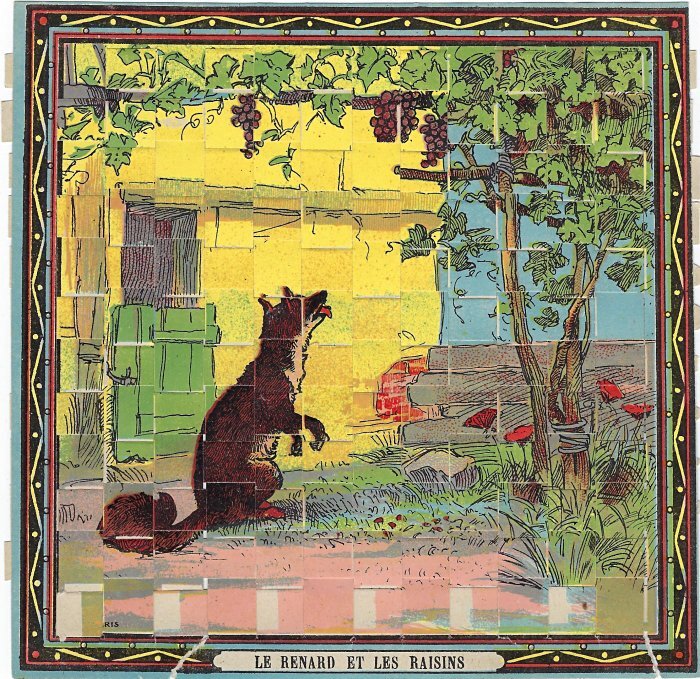
1900? Tissage Imagé. Six completed woven paper images and two not yet completed. About 7" square. CFC 2020.0148.1.1. F.N. Paris. Unknown source.
About six months ago, I catalogued an extraordinary and delicate single piece presenting TH found by Bertrand Cocq, a woven paper picture puzzle formed by weaving twelve strips of paper through a perforated sheet to create a picture. Now six months later, I discover that I had a set of eight of them that I had purchased sometime earlier – who knows where and for how much? – beautifully boxed and called “Tissage Imagé.” I have left the overhanging paper strips on FG so that you can sense how these puzzles work. I also present both the the lovely original box and a sample of what the two portions of "The Horse and the Ass" look like before the second is cut into strips. Seven of the eight fables are from La Fontaine. “The Blind Man and the Lame,” known as a story in antiquity, is best known to the French from Florian’s presentation. I will be so hoping that I can locate the record of when and where I got this set!