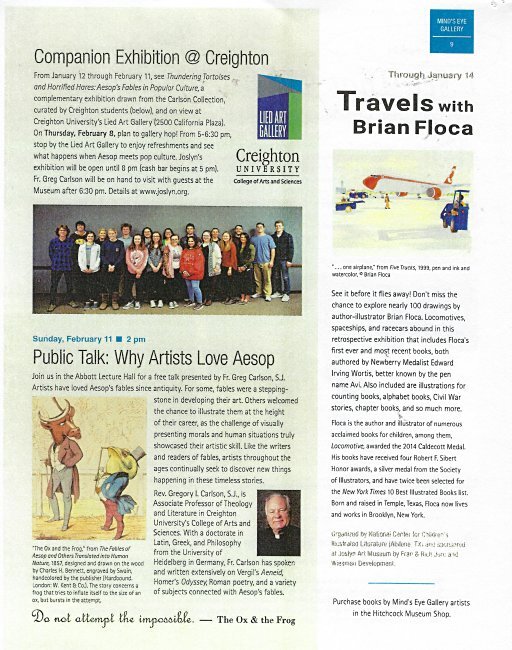
1910? Black-and-white photographic postcard of (Jacob) Jordaens’ “The Satyr and the Peasant.” Brussels Museum. Union Postale Universelle. $6 from Bertrand Cocq, Calonne-Ricouart, France, Sept., ’20.
Compare this card with a similar card below, perhaps a few years later. Does it help the image here to have it set in the upper left with a blank column at the right and a ribbon for print below? Black-and-white representations of paintings seem to us in retrospect, I believe, to be so unfair to what a painting is! We can be grateful that technology came up with colored representations!
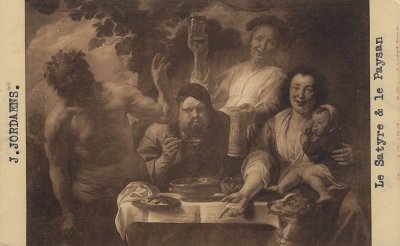
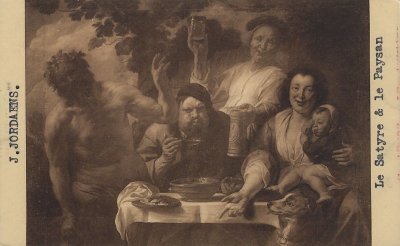
1905? Black-and-white photographic postcard of J(acob) Jordaens’ “The Satyr and the Peasant.” Brussels Museum. “123 LL.” $6 from Bertrand Cocq, Calonne-Ricouart, France, Sept., ’20.
Compare this card with a similar card below, perhaps a few years earlier. Strangely, the typeface elements at a 90 degree angle from the image seem to be typewritten! Black-and-white representations of paintings seem to us in retrospect, I believe, to be so unfair to what a painting is! We can be grateful that technology came up with colored representations!
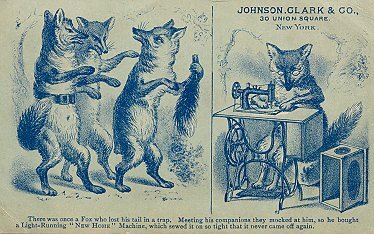
1885? One monochrome card advertising Johnson, Clark & Co. sewing machines with FWT. Two scenes, blank back, text underneath. Three copies, between $7.50 and $12.50, the last from Jeff Carr, Oakland, Spring, '97.
Each of the three cards is done in a different color. The red-ink copy adds "Leavitt & Brant" in Boston. The text (including a dangling participle) confirms the unusual approach to the story: "There was once a Fox who lost his tail in a trap. Meeting his companions they mocked at him, so he bought a Light-Running 'New Home' Machine, which sewed it on so tight that it never came off again." The second scene seems to have the tail already firmly in place while the bespectacled fox now works on a different task at the machine! The other copies are brown and blue. While these cards are not actually a series, they are too much fun together to miss!
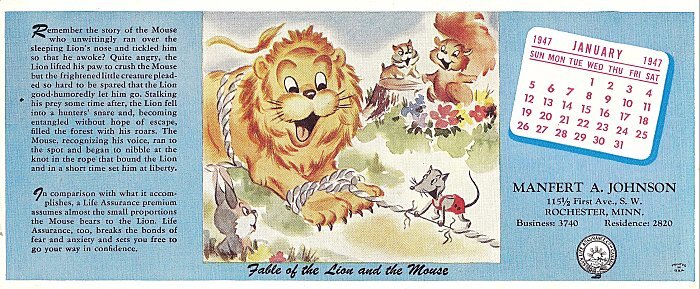
1947 Aesop's Fables. Twelve blotters 9" x 3 ¾" combining text, picture, and a monthly calendar. The blotters advertise insurance from Manfert A. Johnson in Rochester. Printed in the USA. $6.99 from Ronald Krause, Rochester, MN, through eBay, April, '04.
The text in each case has two parts. The first part recounts the particular fable pictured for this month. The second part turns the point somehow to insurance. The central panel naming and illustrating a fable is good, simple, lively full-color work. These "references" may hit a low point when, in November's blotter-calendar, the "Fable of the One-Eyed Doe" is applied to the "John Does" of fact, not fable. December offers not a fable but an account of Aesop surrounded by simple pictures of animals.
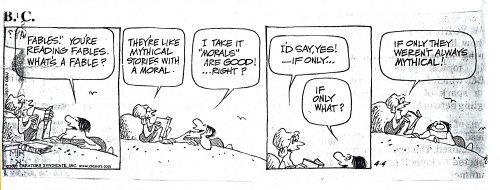
2002 B.C. Johnny Hart. Xerox copy of a four-panel cartoon strip on fables, morals, and “mythical.” Creators Syndicate. Unknown source.
This strip explains why careful critics of fables go crazy when people describe them as “you know, myths, fairy tales….”
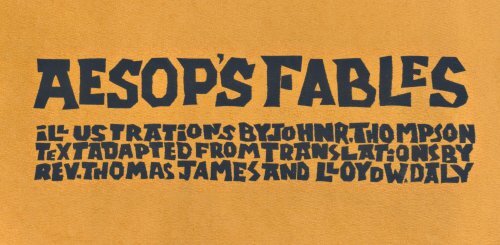
2000? Aesop's Fables. John R. Thompson Signed Artist Proof 10 Print Set with Folder. Linolcuts? $150 from indyfindings through Ebay, Dec., '24.
The seller called this portfolio rare. I am confirming his judgment, in that I cannot find another mention of it on the web. That is why I am unsure whether the excellent prints are linolcuts, woodcuts, or something else. They are dramatic and unusual. Part of their charm is that they write out the fable, whether in Lloyd Daly's or Thomas James' translation. I am delighted to bring this lovely group together with other fable treasures! Thompson died in 2011.