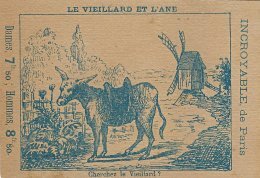
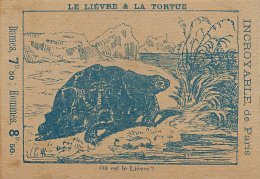
1890? Two monochrome hidden-picture trade cards advertising "Incroyable de Paris" stitched shoes for women and men. 4⅜ x 3". Paris: Imp. F. Hermet. $14 from Bertrand Cocq, Calonne Ricouart, France, Sept., '18.
TH and "The Old Man and the Ass." I think I have found the hidden picture in these; click on the separate link-opener to see it resolved. At first I thought these were most likely stock trade cards, but reflection on the fact that the advertisement takes the complete verso and two parts of the front of either card, I decided that they more a particular creation of Incroyable de Paris. Incroyable offers very inexpensive stitched shoes. Might these contrast with wooden shoes?
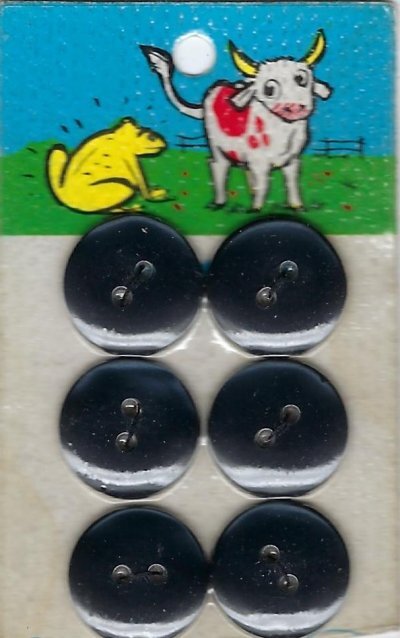
1960? Cards of Iminacre buttons using La Fontaine fable designs. About 2" x 3⅛". Four to six buttons per card.
The surprise with these button cards is that the fable illustration – clearly taken from one of La Fontaine's most beloved fables in each case – has nothing perceptible to do with the buttons! The fable is never named. The verso provides either the lot number, always beginning with "975-22" but then varying for two further digits, or these lot numbers plus a short promotion of the buttons in French and English. While cataloguing these seven cards received from Moriceau Esméralda, I found others at two different places on the web and of course several already purchased by other collectors! The hunt will continue.
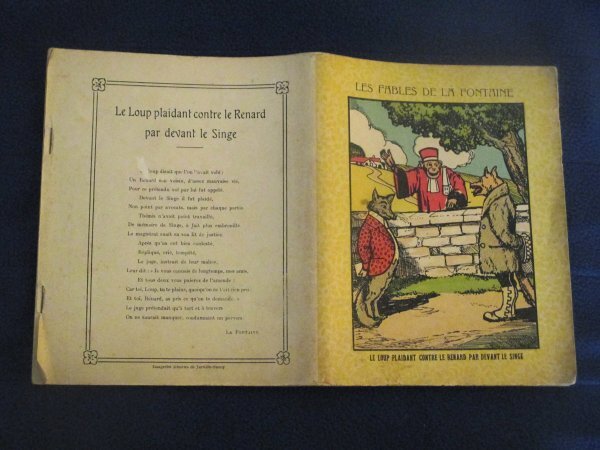
1935? Thirty stapled handbills of La Fontaine’s fables printed by Imageries Réunies de Jarville-Nancy. Heavy paper featuring a framed text on the left half and an image on the right half. Each verso is plain except for a stamped advertisement for Roger Schilling, Coiffeur, in Tours. €40 from Librairie Traits et Caractères, Sens, France, through ABEbooks, April, ’21.
Several things are unusual about this collection. It is understandable that the vendor labelled it as “Imagerie d’Epinal,” since it is definitely in that category; I believe that it may be a competitor to Epinal. The most unusual feature is the stapling together of these thirty handbills. I had been tempted to catalogue it as a book. Lastly, I find the diversity of style and quality surprising. GA reminds me of Paul Colin, who was already famous in 1925. Typical and typically colorful is FS. Surprisingly creative in its composition is DW. Perhaps not as well executed is “The Kite and the Nightingale” – though a quick check finds this very illustration on a trade card posted for the fable as presented on a prominent La Fontaine website! Perhaps also not as skillfully done, though wonderfully conceived, is “The Monkey and the Cat.” These handbills have lasted well these 85 years! Heavy stock. The images seem to be identical with the fifteen that appear in the pamphlet by the same publisher “Fables de La Fontaine, Album No. 2,” for which I have guessed the same date. The vendor dates these about 1905.