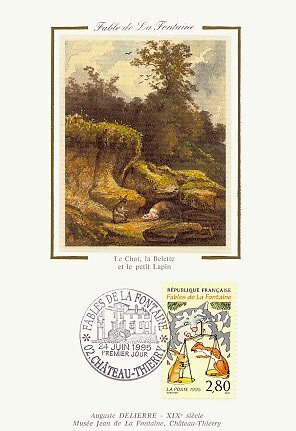
1995 Set of six FDC postcards featuring a first-day postmark, one (or on the first card, three) of the La Fontaine fable stamps issued on June 24, 1995, and a hologram-like reproduction of art, especially by Auguste Delierre. FDC: Paris: Carte Philatélique. $29.50 for the set of six from Alexandre Przopiorski, Lyon, France, April, '99.
"Le Chat, la Belette et le petit Lapin," FC, TH, and WL all feature work of Delierre in a strangely irridescent medium. The illustrations for OF and GA are attributed to "Imagerie de Paris," identified as from the 19th century. The illustration for GA is perhaps the most unusual, with its red mountain and a serpent that is not mentioned in any version of the fable of which I am aware. The illustration for FC is, for my money, a piece of excellent work. Is the monkey often, as here, the judge of the race in TH?
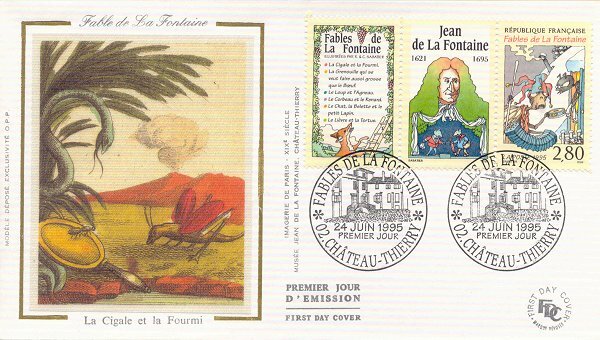
1995 Six (out of six?) FDC envelopes featuring a first-day postmark, one (or on the GA envelope, three) of the La Fontaine fable stamps issued on June 24, 1995, and a hologram-like reproduction of art, especially by Auguste Delierre. FDC: Chateau-Thierry. Set of six for $15 from Loic-in-France through eBay, June, '05. Extras of "Le Chat, la Belette et le petit Lapin," GA, OR, and WL for $9.55 from Gilles Descary, St-Jean-sur-Richelieu, Canada, through eBay, April, '04.
The illustrations on these envelopes are the same as those on the set of "hologram" postcards I catalogued earlier. Thus "Le Chat, la Belette et le petit Lapin," FC, TH, and WL feature work of Delierre in a strangely irridescent medium, while the illustrations for OR and GA, using the same medium, are attributed to "Imagerie de Paris" identified as from the 19th century. The illustration for GA is perhaps the most unusual, with its red mountain and a serpent that is not mentioned in any version of the fable of which I am aware. The verso of each envelope contains three elements: a short quotation from the fable, the first six lines from La Fontaine's verse preface to the fables on their purpose, and an identifying number after "1995/": GA has 39, OF 40, WL 41, FC 42, "Le Chat, la Belette et le petit Lapin" 43, and TH 44. It took just over a year to find the last two in the series after I had found the first four. It took three and a half years to catalogue those last two!
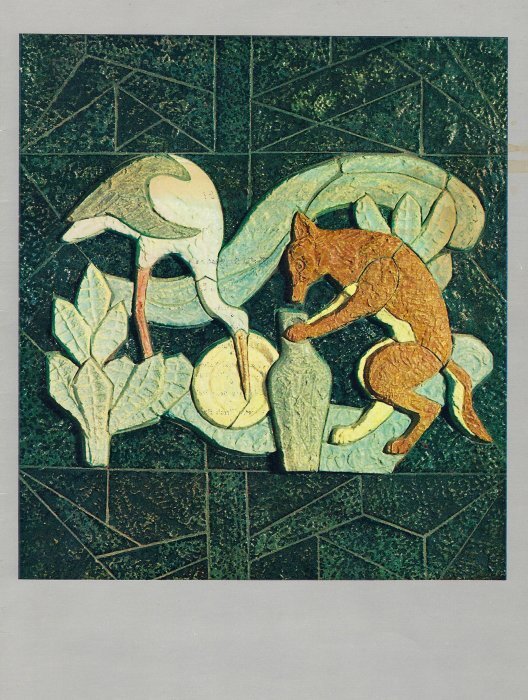
1967 Holland-America Line Menu. Monday, July 17, 1967. S.S. Statendam. Detail of the Ceramic Frieze Picturing Scenes from the Fables of La Fontaine. Nico Nagler. Delft: De Porceleyne Fles. La Fontaine Dining Room of S.S. "Rotterdam." Printed by Jan Lavics, Holland. $9.25 from Tilly's Treasure Chest through Ebay, Jan., '16.
This strongly pictured fable scene makes me wonder what other scenes might have been in the "La Fontaine Dining Room" of the Rotterdam. Some researching online revealed that the Rotterdam still exists as a hotel.
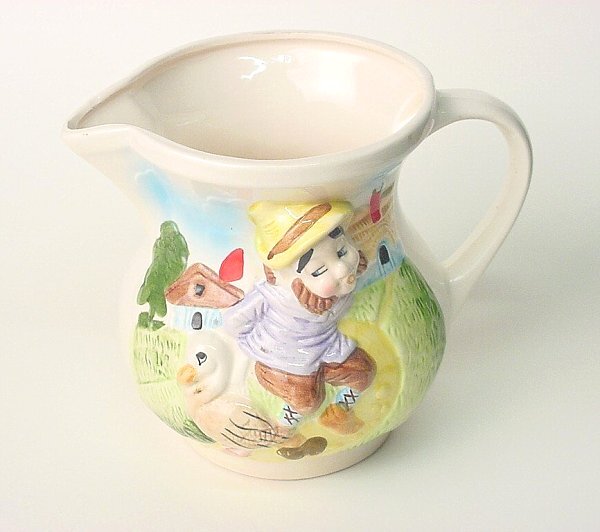
1979 Hoffman pitcher depicting GGE. 3½" diameter base, 5½" diameter at its broadest, 4½" diameter at its top. 6" in height. $18 from Linda Crisafulli, Long Beach, CA, through Ebay, June, '01.
The scene depicted here is exactly the same as that which one finds on the whiskey decanter done by Hoffman at about the same time. The text of the fable is on the opposite side of the pitcher.
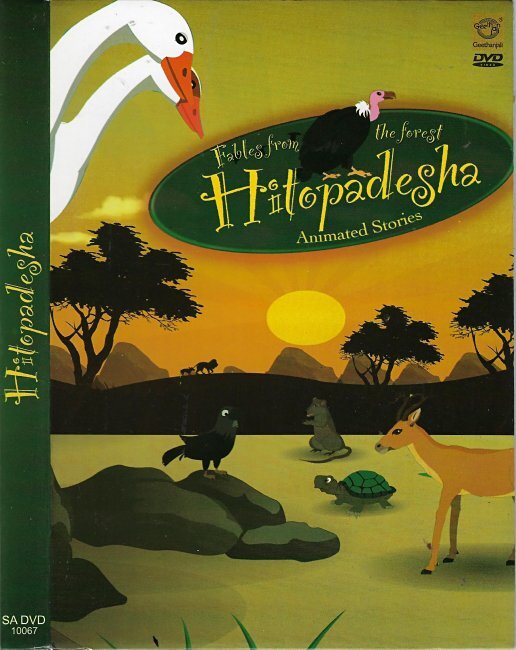
2008 Hitopadesha: Animated Stories: Fables from the forest. DVD. 60 minutes. 8 fables. Super Audio (Madras). Unknown source.
This DVD is done by the same firm that did the DVD "Aesop's Fables: Animated Moral Stories" in the same year. Here are eight stories listed on the jacket and jewel-box. Again, there is rudimentary animation. Particularly with actions like speaking, the animation here seems primitive by comparison with what one sees, for example, in the late "Silly Symphonies." I enjoyed four stories here. "A Friend in Need" picks up the key episode in the cycle of stories of four friends, the liberation of the turtle caught in a net. "The Clever Idea" comes from the fox and saves two crows, who had twice lost their eggs to a serpent. The animator here has particular fun with the snake's movement. In "The Talkative Tortoise," the tortoise himself, not identified as particularly talkative, comes up with the idea. He dies when he responds to people's question "Does he think he can fly?" In "The Lion, the Fox, and the Ass," the fox brings the ass to the old lion twice and eats his ears and his brain as a way of claiming the reward for his part in the capture. He outwits the lion, as he outwitted the ass by promising an eager bride. Good musical background and good, varied voices.