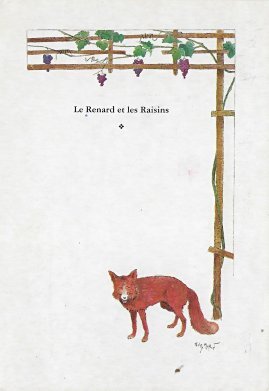
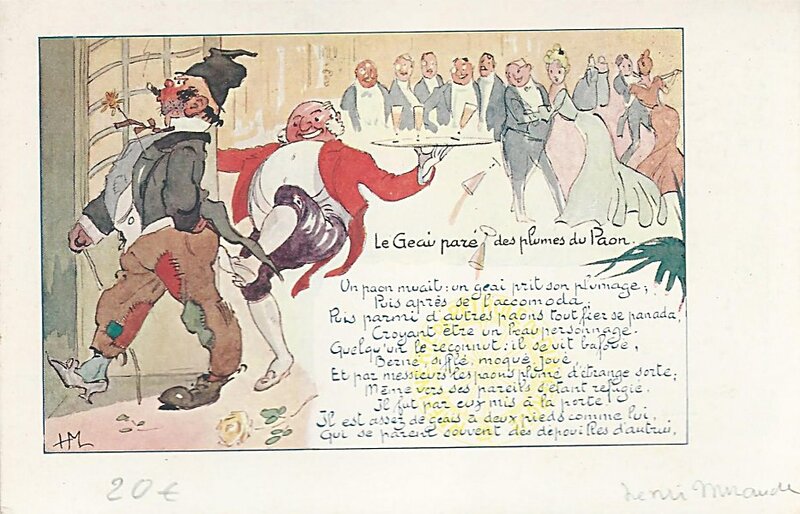
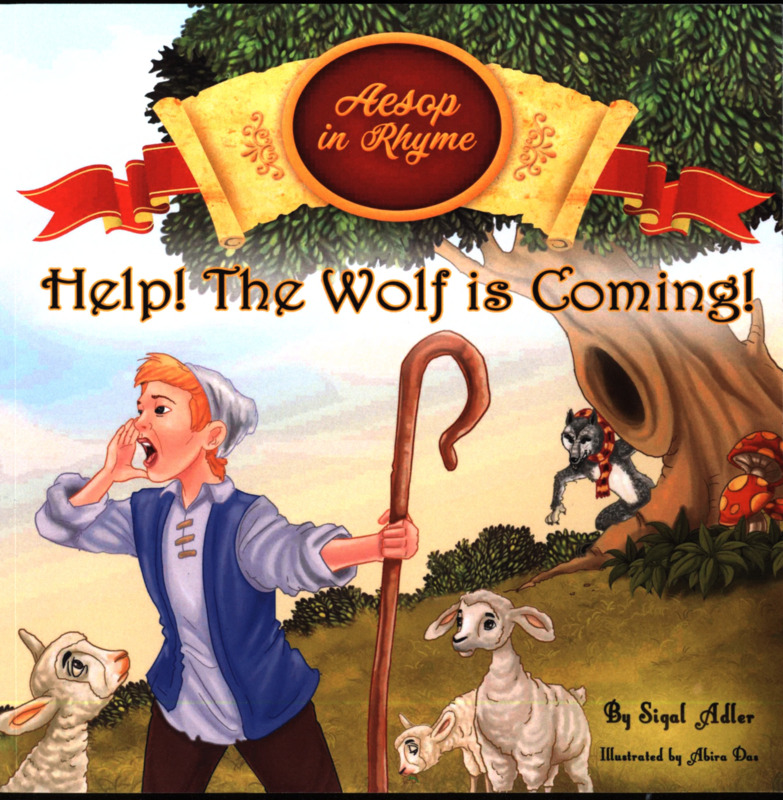
1960? Three fable postcards signed by (Henry) Morin. TT, FG, and WL. $6 each from Bertrand Cocq, Calonne-Ricouart, France, Sept., '20.
Morin published his great book of fables around 1904, and these scenes are presumably taken from there. WL, certainly is, with the white rectangle here used for a title there used for the text of the fable. The double scene of TT is lovely, as is the facial expression of the fox in FG. One wonders how many there might be in this set…. An added lovely feature of these three cards is that an eager sender scribbled a long message extending across all three cards and a first card before these three. And the set was never sent through the mail. There are lots of capitals and exclamation points!
1935? Jean de La Fontaine. Nine landscape format postcards by Henri Mirande. "Etendard" Petrole and "Touriste" Essence Spéciale. E. D. Paris. €8 each from Dominique Delage, St. Ouen, August, '13. Then eight cards from the same series but as "Edition de Montre Zenith," including both LM and "Le Milan et le Rossignol." A last card picture "The Little Fish and the Angler" for $7 from Bertrand Cocq, Calonne Ricouart, France, Sept., '18. Extra of that card for €5 from Simon Rodrigues, June, '22.
I am surprised that I have not before run into any members of this strong set of cards. Of the six listed in French Wikipédia, only "Le Milan et le Rossignol" is not included among these nine. Might it have been a set of ten? The artistry is strong on caricature, and the style might best be characterized as "cartoon." Each image makes room for the handwritten fable or important portions of it. Fables are visually transposed, where necessary, into human terms. Thus the tale of the two mules becomes that of the rich man robbed, while the poor man is untouched. A rich judge holds moneybags where the one contestant has empty pockets and the other wears a nightshirt. A policeman chases the shadow of the gunman who is behind him. A rustic man leaves the groaning table behind but, like the weasel, cannot exit by the door through which he entered. A dinner jacket is not enough to get a street person into a high-society party (BF). A paraplegic rolls on ahead of a wrecked car (TH). A child cannot reach the dried raisins on the shelf. Is that a doctor carting off all the possessions of the man sick in bed? These cards are highly enjoyable! Are they really advertisements for gasoline? Now, with the second set, I have eleven different cards and wonder how many may have been in the set originally. The back of the Zenith cards transforms the first lines of La Fontaine's FC and has a design of the crow holding a Zenith watch in his beak. The last card, bringing the total to twelve, may complete the set.
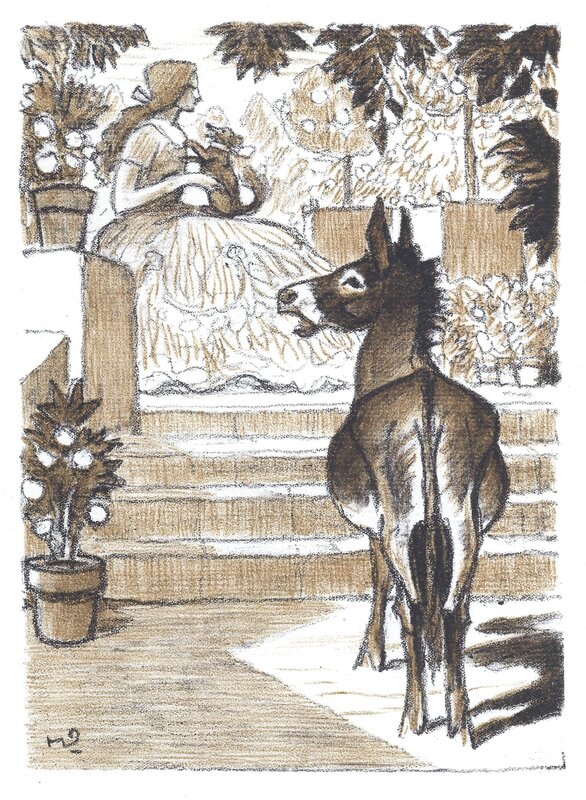
1944 Lithograph of La Fontaine fable “The Ass and Lapdog” by Henri Deluermoz.
This lithograph leapt out as I reviewed the set and compared them with the published version of the portfolio of Deluermoz’s lithographs. The work in this lithograph is finer than that in either the portfolio or the set of illustrations. Might it be the artist’s original conception? It differs, I believe, clearly from the final product. Notice, for example, the object – a ribbon perhaps? – at the back of the woman’s head. This lovely illustration is a surprise gift!
1944 84 lithographs of La Fontaine fable illustrations by Henri Deluermoz. €100 from librairie-raijepointcom through Ebay, July, ’25.
The seller writes “certainement des suites d'une édition de luxe.” That for me touches on the great question of this great acquisition. Is this a set of added “illustrations only”? Or perhaps a test printing for the artist or others? The tailpieces are correctly positioned for their place with relation to the texts. The lithographs are strong. By contrast with the published portfolio already in the collection, the images here are not accompanied by text or page numbers. They are printed on only one side. At what is page 56 in the portfolio, the images move from deft brown ink to much less deft black. Among the full-page illustrations, I appreciate “The Thieves and the Ass” (page 7 in the portfolio). The endpieces are particularly impressive, especially the exploding frog (6); the spider-web in the tree (16); SS (21); WL (24); “Fox and Goat” (38); the monkey adrift (45); and the tethered horse (52). What a terrific addition to our collection! Do not miss the apparently original drawing of "The Ass and the Lapdog" included in the portfolio. It is listed under "Paper" in "Original Art."
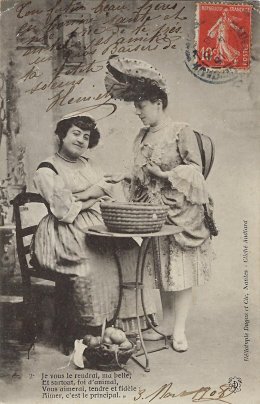
1908? Three numbered black-and-white photographic postcards (out of a series of ?) offering a milder version of GA. Cards 2-4. Nantes: Héliotypie Dugas et Cie. Cliché Audiard. $30 from Bertrand Cocq, Calonne Ricouart, France, Sept., '18.
The ant in this version seems much friendlier. She is sharing food from the start. On Card #3, she asks what the cicada did all summer. The cicada has a hat that is wonderfully outrageous! Her dress seems to depict her as living at a level beyond that of the peasant ant.
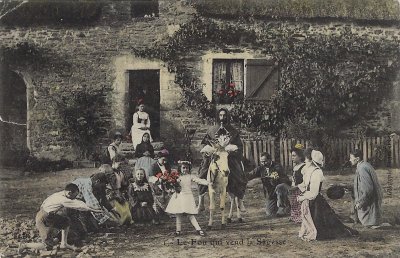
1910? 2 photographic postcards by “Héliotypie Dugas et Cie, Nantes.” “The Worker and His Children” and “The Fool Who Sells Wisdom.” $8 each from Bertrand Cocq, Calonne-Ricouart, France, Sept., ’21.
These cards present “folksy” attempts to portray the fables. The sons of the dying worker are rather advanced in years! A surprise on the “Fool” postcard is the slight coloring of many elements: red flowers, blue garments, pink skirts and headdresses. Were the colors, as I suspect, part of the original publication? If so, why are there not colors on the other card? The application of the fable to the scene is not entirely clear to me. Is the card picturing religious veneration? Is that a matter of a fool selling wisdom? The question is especially pertinent because, in the view of the fable’s wisdom figure, the fool is justified in selling the wisdom of people’s being convicted of foolishness. He is justified because people foolish enough to buy it and can learn from buying it. The verso of both cards is simple and identical.
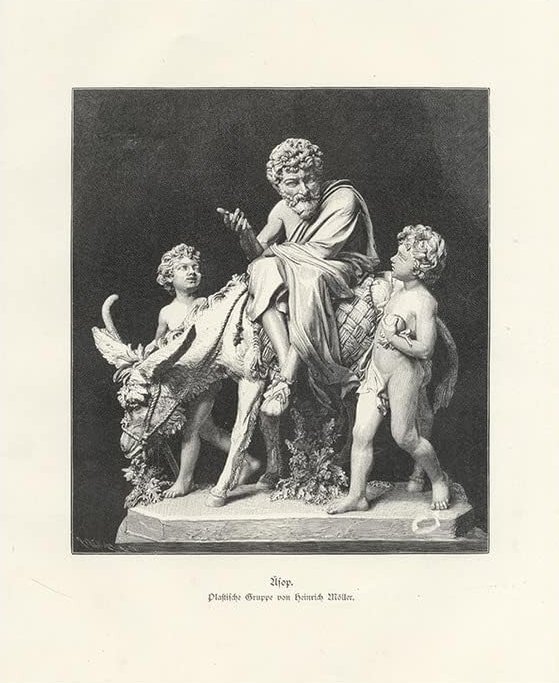
1910? Magazine excerpt featuring a line engraving of Heinrich Möller’s sculpture group of Aesop with two children. Unknown source.
Researching this piece has been fascinating. First of all the attribution here is highly misleading, since Heinrich Müller was a prominent Nazi, while Karl Heinrich Möller died in 1882 after producing this sculpture. Reproductions of this very engraving are available on the web. I feature one below the magazine excerpt.
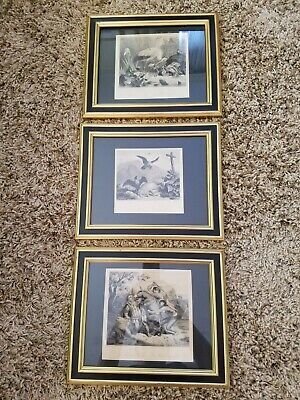
1880? Three framed Renard engravings by Henrich Leutemann. $40 from magnolia.boudoir through Ebay, March, '24.
Two of these three steel engravings are easy to identify and enjoy: FK and "The Ass and the Lapdog." The seller identifies the scenes as coming from La Fontaine. The third image puzzled me. It is identified as "Reynard and Merknau/Reineke und Meiknau." I could not identify who Merknau is until some searching through German sites brought me to "Merkenau" the talkative crow. This illustration faces page 200 in an edition of Reineke composed by Julius Eduard Hartmann and published by Payne in Leipzig. In Canto VII, Merkenau describes to King Noble how he and his wife came upon the apparently dead Reineke. Merkenau's wife came close to his snout to see if there were some sign of life. Reineke snapped off her head!
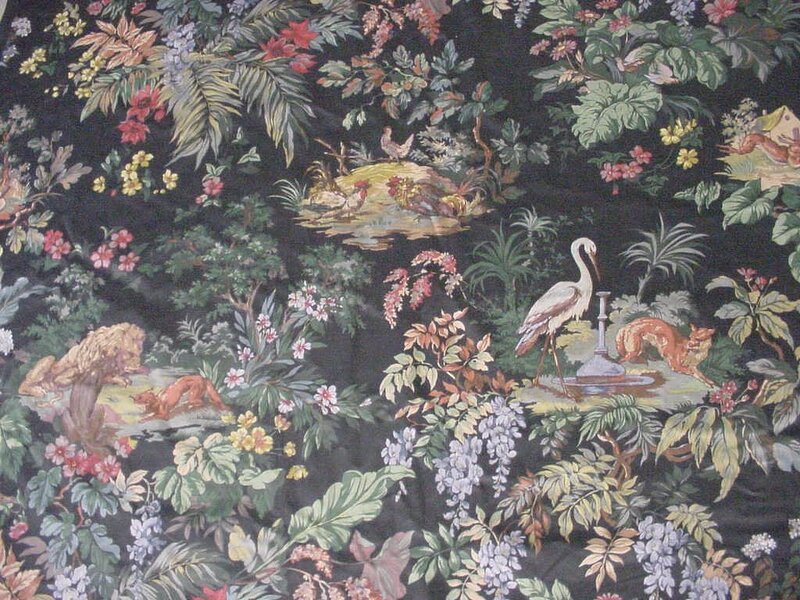
1960? Heavy cotton fabric with several fable scenes among whisteria. 9 yards x 17" x 56" wide.
Rennae is right: this is impressive fabric. The repeating scenes include FS, TH, "Two Cocks," and "The Lion, the Wolf, and the Fox." Click on the upper portion for an overview and on the lower portion for a detail of FS.