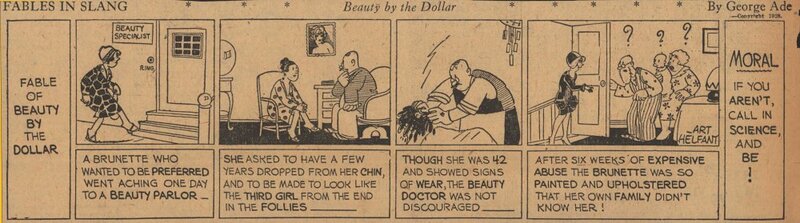
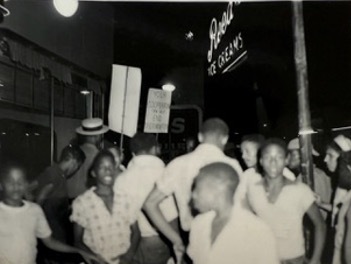
1928 23 "Fables in Slang" comic strips by George Ade. Many signed "Art Helfant." Unknown source.
I have enjoyed books of George Ade's fables. Those were text narratives. These cartoons are fun. They involve gentle social critique. Online commentators note that they present vernacular rather than slang. Ade was an accomplished playwright. Apparently these cartoon strip fables were syndicated nationally. I include them as a strong example of a popular use of the word "fable." Besides, they have their own charm!
1988? Aesop's Fables. Eight cards of black-and-white illustrations reproduced by the Gennadius Library of the American School of Classical Studies at Athens. Gift of Kathryn Thomas, Spring, '88.
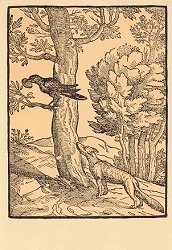
The eight include "Zeus and the Snake" (Venice, 1644), FC (Venice, 1644), FG (London, 1828), "The Woodcutter and Hermes" (Lille, 1809), SW (London, 1828), TH (London, 1828), DLS (Venice, 1819), and "The Stag and the Lion" (London, 1828). With illustrations ranging over almost 200 years and four editions, this little collection gives a nice suggestion of the illustrated fable books you might find in a good classics library.
2018 "Frog and Scorpion." Silhouette art print by GeekyGamerGirls on Etsy. 17" x 11". $21 from GeekyGamerGirls on Etsy, August, '18.
"A scorpion wants to cross a river but cannot swim, so it asks a frog to carry it across. The frog hesitates, afraid that the scorpion might sting it, but the scorpion promises not to, pointing out that it would drown if it killed the frog in the middle of the river. The frog considers this argument sensible and agrees to transport the scorpion. Midway across the river, the scorpion stings the frog anyway, dooming them both. The dying frog asks the scorpion why it stung despite knowing the consequence, to which the scorpion replies: "I am sorry, but I couldn't resist the urge. It's in my nature." Wikipedia, which offers this version, says that the fable is not known in this version until the 20th century.
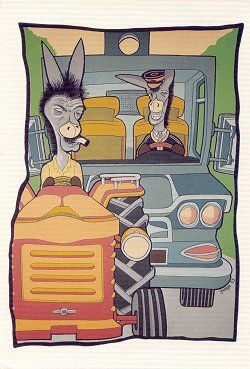
1993 Three cards in a series of Jean de la Fontaine's fables. "Les Deux Mulets," FS, and "Le Singe et le Dauphin." Conseil Général de l'Aisne: Bibliothèque Départementale de Prêt: Association des Amis de la Bibliothèque Départementale de Prêt. All three are marked "Gedge 93." €3 apiece from Gérard Crucy at the Paris Post Card Exhibit, Jan., '05.
These illustrations--lively, colorful, and contemporary--are taken from the Exposition "Quand la Fontaine rime avec le rock." "Les Deux Mulets" is postmarked in 1996, while the other two are postmarked two years later. The former card shows one mule driving a tractor in front of another mule dapperly clad as a chauffeur in a large vehicle. FS has a sporty stork sitting across from a primitive fox with sunglasses on his forehead. The fish-laden beakers are transparent. The monkey in "Le Singe et le Dauphin" looks like a jockey, and the dolphin looks as though he is having a great time! I would love to see more of Gedge's work in this style. The only reference I could find on the web speaks of the exhibit this way: "Les saveurs de La Fontaine remises au goût du jour, mijotées sur les fourneaux de l' illustrateur Gedge et assaisonnées avec quelques épices de Rock and Roll."
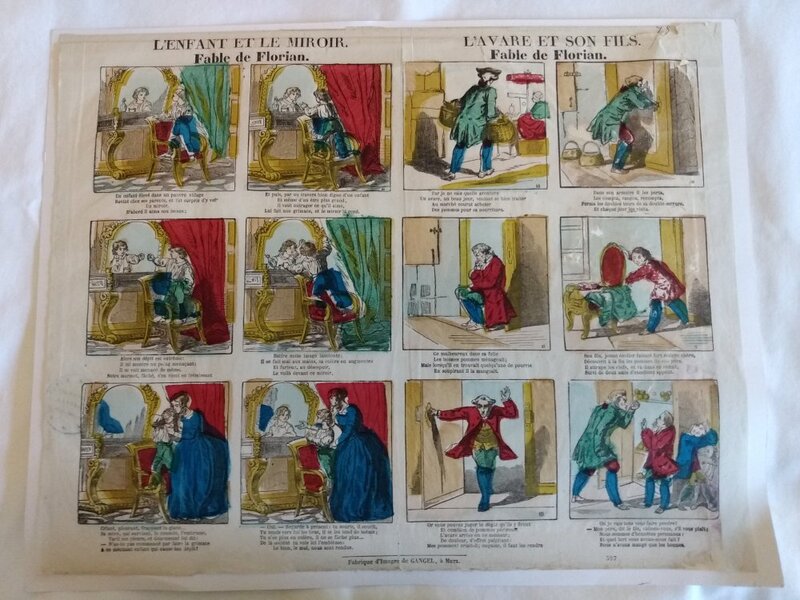
1880? Two fables of Florian. Broadside. "L'Enfant et le Miroir" and "L'Avare et son Fils." 15” x 12.5.” Metz: Gangel. €20 from chcestampnet through Ebay, Jan., '22.
Lively reds and blues render these two fables. The second is among Florian's wittiest: the miser father deserves his smarter talkback son! What will this son become when he becomes the miser?! Because people tend not to know the plots, I will summarize them briefly here. In "The Child and the Looking-Glass," a child first smiles and then grimaces at a mirror, and gets angered by the grimaces he sees. His mother catches him in his rage. "If you smile, it will smile back. Whatever you do, the image will do the same to you." In the second fable, a miser buys apples and locks them away but likes to look at them. Alas, some rot, and those he eats. His famished son gets the key and eats a lot of them with two little friends. "Give them back!" his father demands when he finds them out. Son: "Don't worry, Dad. We're all decent fellows. We leave the bad apples for you to eat; we ate only the healthy ones."
1977 “Gamzat Tsadas: Fables (Russian).” Complete set of seventeen colored cards featuring the fables of Gamzat Tsadas. Artist: C. Asheroorov Ekhepov. 4¼” x 8¾”. $20.17 from RareSoviet on Etsy, Dec., ’20.
“The first national poet of Dagestan.” Islam, the Revolution, creativity. Wrote poems, fairy tales, and fables for children. I can recognize perhaps five of the fables pictured here. I put them first here. The card size is unusual, with title, colored image, and a few lines on the front and a full text in Russian on the verso. Soon enough, we may be able to use OCR technology to make more sense of the texts. Till then, I have to be happy to enjoy the pictures and wonder about the story!
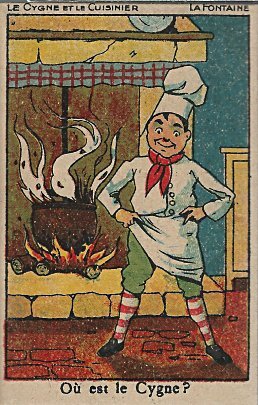
To my surprise, I have found two sets of "guessing game" cards, one multicolored French cards and the other duochrome Dutch cards. The missing figure may not always to be easy to find in these cards! Click on either the picture here or the link below to go to either set.
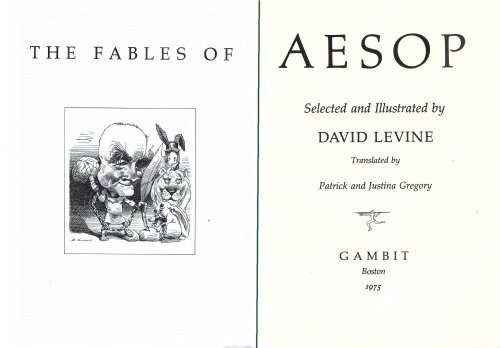
1975 Galleys of “The Fables of Aesop, Selected and Illustrated by David Levine.” Translated by Patrick and Justina Gregory. Boston: Gambit.
Our first galleys! From one of my earliest and most favorite fable books! The set is complete, 8 numbered signatures, each with a progressive mark of its place in the text and all with the number “2082. Notice these markings in the photo below. Each signature has 4 large pages folded in half to produce 16 pages 7” x 9.7”.