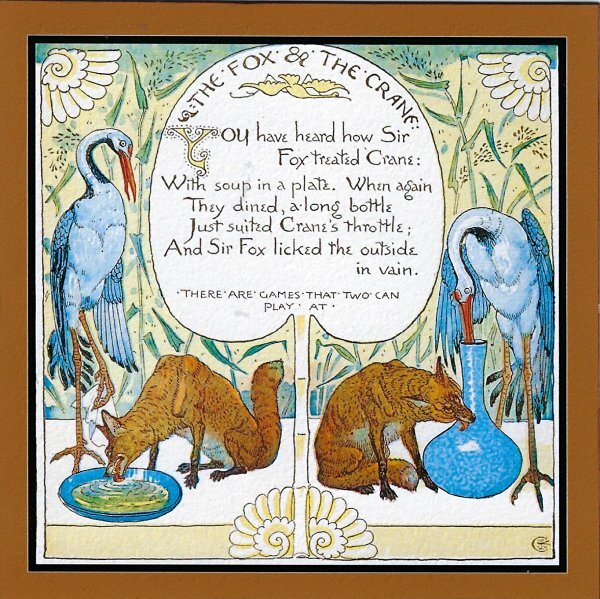
2018 FS Refrigerator magnet. 4½" square. With Walter Crane's illustration of the fable.
The detail in this reproduction is spectacular. Crane's two-panel approach appeals to me as the way to present this fable. As often, W.J. Linton's text is more comment than narrative.
2000? FS pressed glass dish. 5” in diameter. Source unknown.
This is a lovely little piece showing the stork’s revenge. I wondered what category it might belong to – small plate, ringdish, children’s set? I get two strong opinions on the web. Marcike Michl, SG, in a September 2010 listing describes it as a “Kleiner Teller” and guesses a date of about 1900. The best guess of the unknown producer is someone in France or Germany. Google describes it as a “vintage Westmoreland Glass Cup Plate. These small, pressed glass plates were produced by the Westmoreland Glass Company of Grapeville, Pennsylvania, which operated from 1890 to 1984.
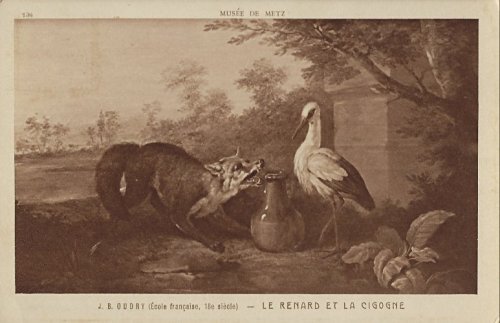
1912? J.B. Oudry, "Le Renard et la Cigogne.: Sepia-and-white photograph of FS painting. Musée de Metz. Metz: E. Prillot, Éditeur. $8 from Bertrand Cocq, Calonne Ricouart, France, Sept., '18.
Oudry is famous for his magnificent tapestry-like illustrations for the significant four-volume edition of the fables of 1755-59. Here he shows off his painter's gifts. The stance and expression of the fox, I would say, suggests the fox's appropriate dissatisfaction with his payback. The scenic background seems to me typical of the Oudry we know from those magnificent illustrations.
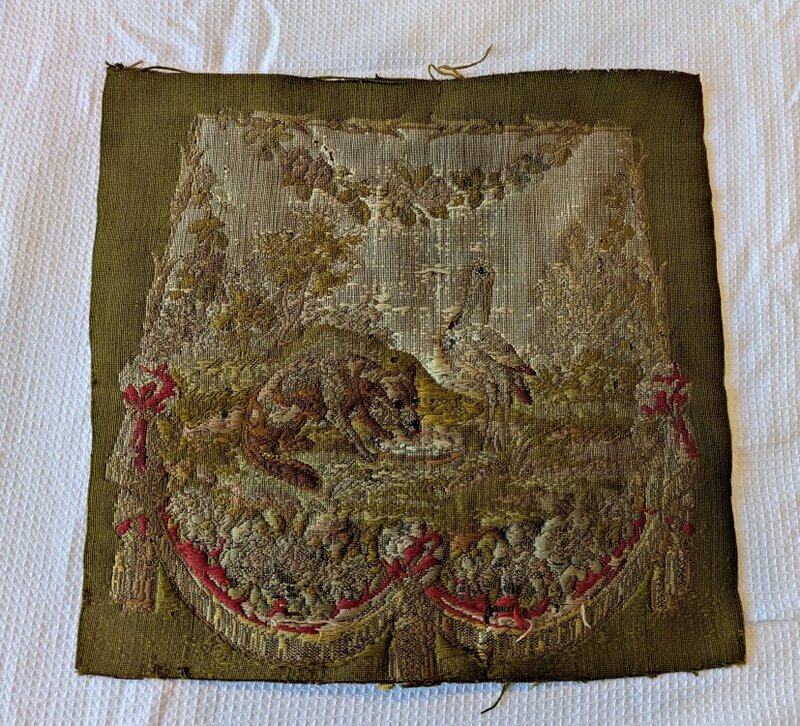
1850? FS Canvas Tapestry. Presumably made in Aubusson, France. 17” x 16.5”. Source unknown.
This well-worn piece still has a recognizable scene, with the fox lapping up his thin soup while the frustrated stork looks on, perhaps already planning some payback. Would a piece like this have covered a chair or pillow? Is it, as I believe, deeply worn?
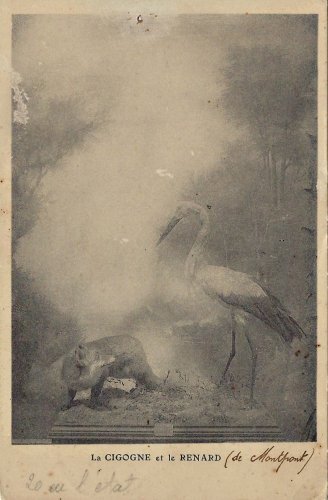
1921 FS Postcard. “de Montfort.” CPAPHIL, perhaps 2018.
Is this a photograph of a sculpture against a photographic background? And is the white cloud part of the original card, or has some of the image rubbed off over time? I can find no other members of the supposed series to which this card belongs. Is the artist here Eugène Montfort (1877 – 1936)?
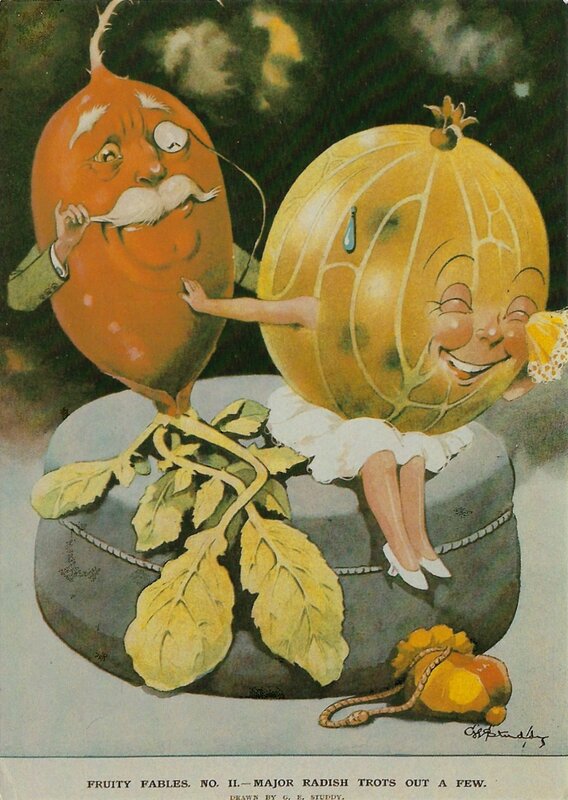
2005 Four reprints of 1936 prints titled "Fruity Fables," from the magazine The Sketch. reprinted by An Englishman in LA, "the most unusual company this side of the 15th century." Each of the four is about 11" x 14". Artist G.E. Studdy. Between $6.99 and $14 each from the reprinters on eBay, July, '05.
As the company's commentary on the prints points out, the "vibrance of the printing and the beauty if its style" make these prints outstanding. There is a sauciness to the approach taken to the fruits.
1982 Three “Fruity Fable” postcards by G.S. Studdy. Reprinted by Camden Graphics, Ltd., London. Printed in England. Copyright Vivienne Kynaston 1982. £11.79 from PostCardFinder, Jan., ’26.
These three come from a series already in this collection under “Prints.” As mentioned there, they first appeared in 1936 in “The Sketch.” How curious, that something done in 1936 would attract reprinters in both England and the USA and, in fact, in different media. As I also mention there, there is a sauciness to the approach taken to the fruits. The language is sometimes so age-bound and colloquial, that I do not know what it means. For example, what might it mean that “Major Radish Trots Out a Few”? That he pays a lot? One card featuring Mr. Spring Onion, is a partial rendition of a design there.
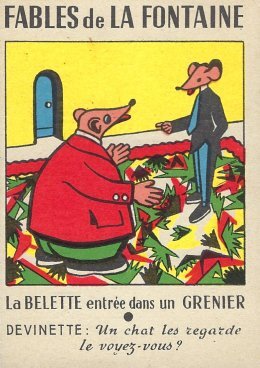
1930? Three colored "hidden picture" trade cards featuring fable titles and pictures with hidden elements. Fructines-Vichy Delicieux Bonbons. One extra of "The Spider and the Lark." $15 from Bertrand Cocq, Calonne Ricouart, France, Sept., '18. Five more cards and three duplicates, all from Pharmacie Bouchez in Amiens, for €6 from chromosetcollections through Ebay, August, '22.
My attempts to solve these three pleasant cards ended with two of three easy successes and one tougher experience. Each card front defines what is hidden in its picture. Thus for WL, we read that the lamb's mother is not far away. Click on the image to see a larger version and on "solution" to see where I believe the solution lies in each case.
1890? One FK button. 1.2" in diameter. Unknown source.
This is our only FK button. The steels surrounding the "King" are the tops of reeds. One of them is missing. The button is crimped slightly. This metal button is stamped through the back. There is no other backing.
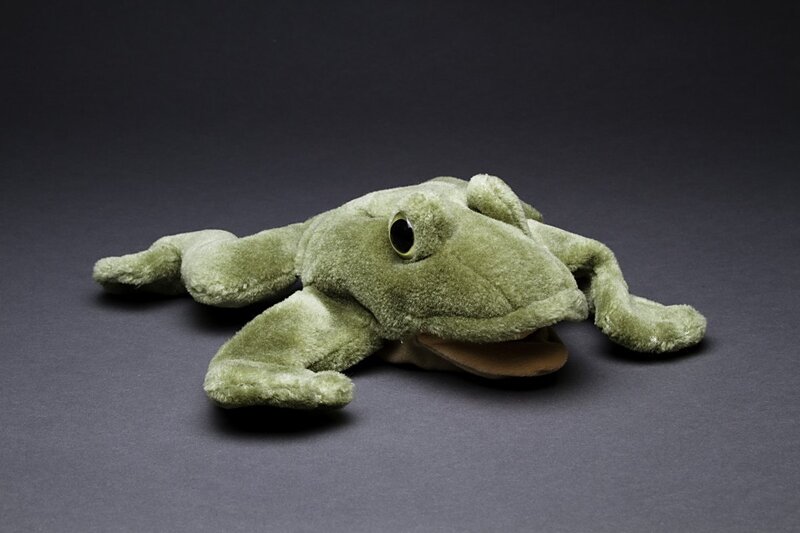
1985? Frog puppet with attached Aesop's fable "Is There A Doctor In the Pond?" Puppets With a Tale: Folktails" series by Folkmanis, Inc., Emeryville, CA. Made in Korea. Gift of Margaret Carlson Lytton, Christmas, '90. Extra exemplar with a detached card from a flea market, August, ’10.
The card attached to this frog in the “Puppets With a Tale” series tells the story of the frog who suddenly announced to the animals that he was a physician. A clever fox retorted “Well, I’m certainly no doctor, but it looks to me like YOU certainly could use one.” He elaborates on the frog’s nervous, jumpy behavior, his sick sounding croaking, crooked legs, and blotched and wrinkled skin. The four paws have patches of Velcro to put legs together. A clever manipulator can get fingers into the upper and lower jaws as well as both front legs.