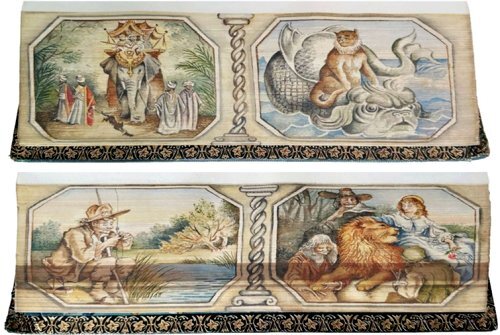
1870? Split-double fore-edge painting on a first edition English translation of La Fontaine's fables.
Here is one of the new stars in our collection! It is a beautiful, heavy (10.5 pounds) edition with slip sheets for the full-page illustrations, heavy paper, and robust binding. Weber Rare Books offered 1870 as their guess as to its date. I presume it is a first English edition. The outstanding feature of this copy lies in its four outstanding fore-edge paintings. I will quote Weber’s description: ‘With a split fore-edge painting, sometimes called a “split-double”, with the volume showing a total of four paintings made after Doré drawings found within the book, 2 being side-by-side on either the left or right-hand fanned edges. Facing one direction (left): “The Little Fish and the Fisherman” [page 238] and “The Lion in Love” [p. 157]; on the other side (facing right): “The Monkey and the Dolphin” [p. 173] and “The Rat and the Elephant” [p. 489].’ I was particularly happy to “land” this book for two reasons. A recent report to Reinert-Alumni Library seemed to suggest that the collection target higher end acquisitions unavailable elsewhere. We are also planning a new layout of collection treasures for visitors emphasizing modes of illustration. What an excellent example of a rare mode of illustration!
Weber notes that the paintings were commissioned by Harrington’s (London), ca. 1990s-2010. The handwriting on the volume, from the artist on staff for the bookshop, has penciled in 29 lines of penciling used to highlight and detail this painting added to the volume. The note begins: “Split Foredge Painting / In four panels.” Commissioned by Harrington’s toward the end of the 20th century.
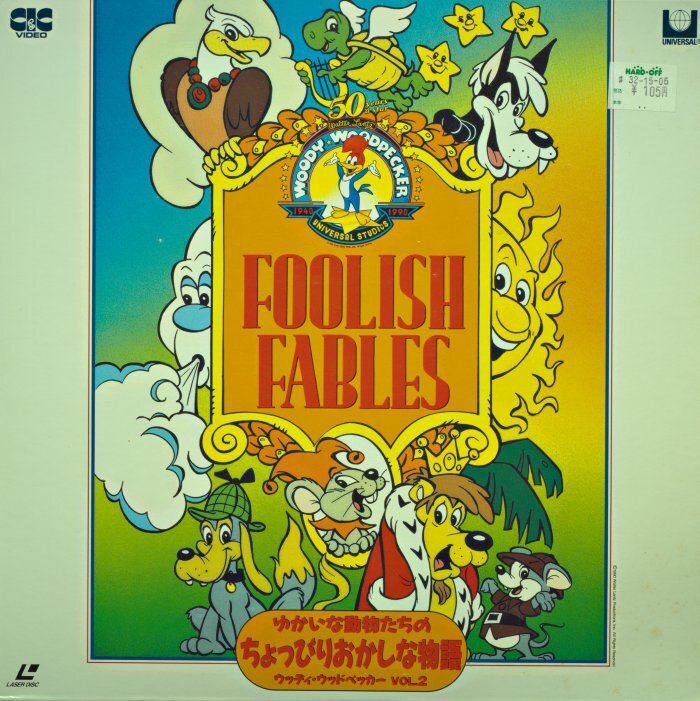
1990 Foolish Fables. Bilingual. 109 minutes. PILA 1038. CIC: Universal City Studios. Made in Japan. Unknown source.
The enclosed page lists the cartoons, and the dust-jacket celebrates Woody Woodpecker. Recognizable fable titles include LM and “Flying Turtle.” One apparent parody is “The Dog That Cried Wolf.”
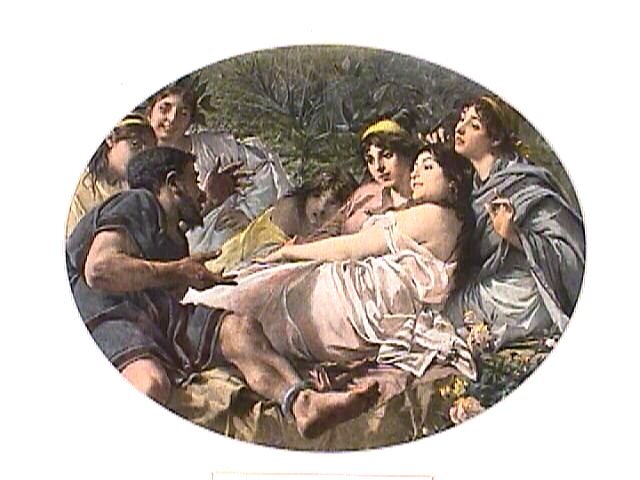
1878 "Aesop Narrating His Fables" by R. Fontana. Published as part of the "Exposition Universelle de 1878" by Gebbie and Barrie. Gravure by Goupil Companie. Hand tinted with watercolors and sold for $35 by David Eisler (Aylesbury, Bucks, England) at Baltimore Antiquarian Fair, August, '91. The scene shows a manacled, bearded Aesop entertaining a group of delighted young women. The same engraving appears as the frontispiece to the Ariel Booklet edition (1848/1890?) of Aesop's Fables with the James text and Tenniel illustrations put out by the Knickerbocker press. Click on the picture to see a fuller version.
1906 Print of R. Fontana's 1878 engraving "Aesop Narrating His Fables." The work was originally published as part of the "Exposition Universelle de 1878." $5 from Stephen P. Ryder, Alexandria, VA, through Ebay, Sept., '99.
This black-and-white reproduction of Fontana's work comes nowhere near the lovely hand-colored version I have listed under "Engravings." Who knows, however, when it will come in handy?!
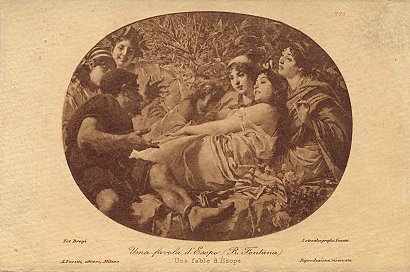
1930? "Una favola d'Esopo/Une fable d Ésope" (R. Fontana). Fot Brogi. Fotocalcografia Fusetti. A. Fusetti, editore, Milano. #773. 20,000 Lire at the Porta Portese flea market, August, '98.
The monchrome oval scene reproduces a larger 1878 engraving I have long enjoyed. Find it here under "Engraving." It shows a manacled, bearded Aesop entertaining a group of delighted young women. The same engraving appears as the frontispiece to the Ariel Booklet edition (1848/1890?) of Aesop's Fables with the James text and Tenniel illustrations put out by the Knickerbocker press.
2006 Foney Fables. 7 cartoons. Warner Brothers: Merrie Melodies. Double D Distribution.
To my surprise, the title cartoon "Foney Fables," second among the seven cartoons here, features several fables. It was directed by Fritz Freleng in 1942. In GA, the cicada answers the ant's critique of being lazy by pulling out a series of war bonds. He will not starve! BW interrupts the series of reinterpreted stories several times. The last time has us encountering not the obnoxious laughing boy but a laughing wolf picking his teeth. The wolf in sheep's clothing meets a second wolf in sheep's clothing already working this herd. The goose who laid golden eggs has converted to aluminum eggs, to help the war effort. By the way, Mother Hubbard's dog turns her in to the authorities. It turns out that she has been hoarding food! Good color.
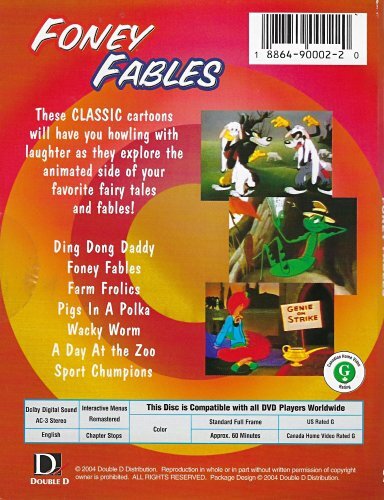
2004 Foney Fables. 7 cartoons. Warner Brothers: Merrie Melodies. Double D Distribution.
Here, more simply packaged is a DVD already in the collection in a larger jewel case with a date of 2006. Since the front cover is identical with the jewel case, I will show the back cover here, appropriately smaller. As I wrote on that version, produced later but viewed earlier by me, to my surprise, the title cartoon "Foney Fables," second among the seven cartoons here, features several fables. It was directed by Fritz Freleng in 1942. In GA, the cicada answers the ant's critique of being lazy by pulling out a series of war bonds. He will not starve! By the way, I noticed this time through that there is no reference at all to music as the grasshopper's activity. He just rests. BW interrupts the series of reinterpreted stories several times. The last time has us encountering not the obnoxious laughing boy but a laughing wolf picking his teeth. The wolf in sheep's clothing meets a second wolf in sheep's clothing already working this herd. The goose who laid golden eggs has converted to aluminum eggs, to help the war effort. By the way, Mother Hubbard's dog turns her in to the authorities. It turns out that she has been hoarding food! Good color.