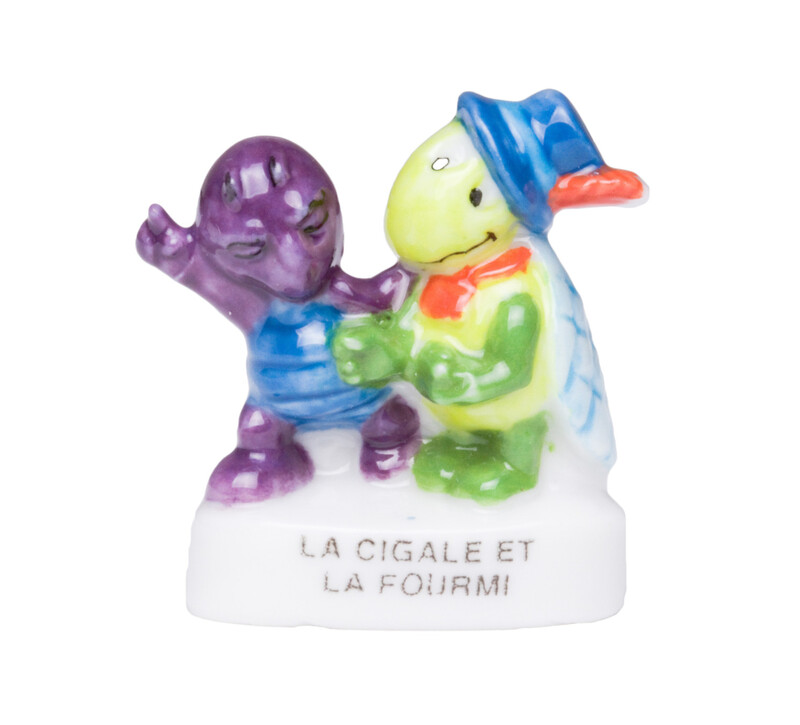
1980 8 different fables illustrated by fèves.
As can happen with such small sculptures, the results are sometimes a little bizarre. The milkmaid is pictured quite differently, for example, from other illustrations of this fable. WL seems to miss the fable quite entirely. WC, by contrast, seems quite successful! Some further investigation reveals that these are eight of the ten feves listed as "Complete Series of 10 Fables Feves" but without FG and LM. These are differently colored: that is where some of the "bizarre" comes into play.
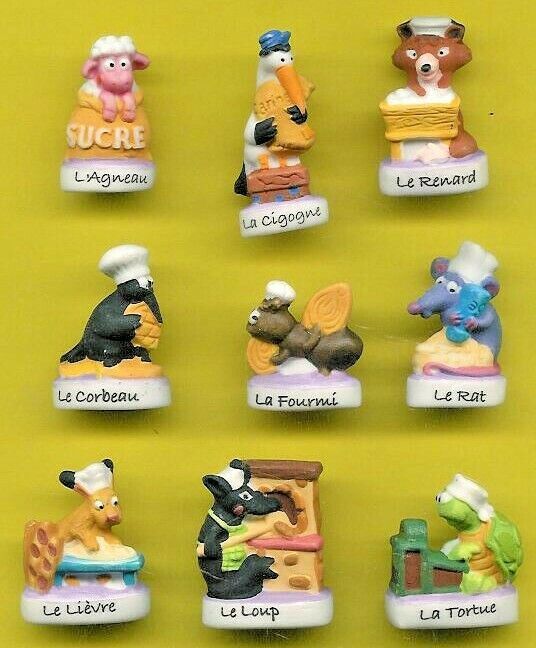
2011 Complete set of nine "Au Fournil" feves.
"Fournil" means bakehouse, and each of these characters is doing something in the process of baking and distributing baked goods. I have seen a cigale in the same format on Fabolie's identified as a feve Bourseau. Cute figurines! Are the nine a complete set?
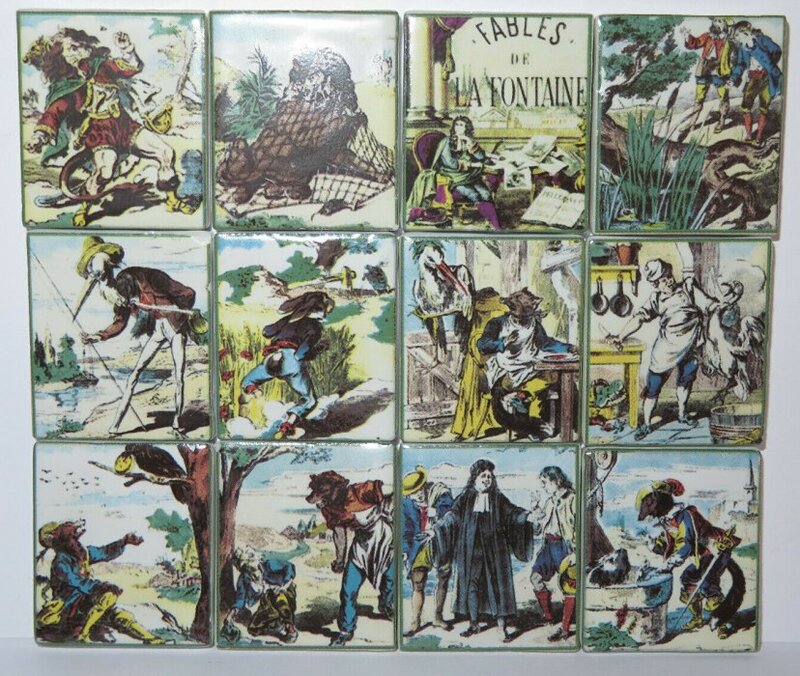
2011 Royal Ceram Les Fables de La Fontaine Fèves Ceramique. Complete set. Between $3.51 and $4.10 for each of the twelve pieces from Genealogos on Ebay, July, '20.
This is a totally surprising set of miniature tiles. "Feves" in French are "fava beans," hidden in king cakes. I am surprised by the number of forms they have taken on. For fables, at least two forms are important: little figurines of well known fable characters and, in this case, miniature tiles of well known illustrations of La Fontaine's fables. These illustrations are in fact taken from Pellerin of Epinal, a long-time publisher in brilliant color of La Fontaine's fables. I was surprised to find this set for sale on Ebay, because I had not been aware of its existence. I am delighted with it! It is hard to know where to list it. I will list it exhaustively under "Tiles" but offer links to it in "feves" and "toys." Fables keep surprising me! I will offer here two overall views and then individual tiles.
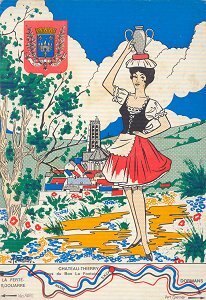
960 "Le Lievre et la Tortue." Ville de Château-Thierry. Imp. Du Centre. Comité des Fêtes de Château-Thierry. About 4" x 6". €4 from Jacky Mabilat, Boutigny sur Essonne, Paris Post Card Exhibition, Jan., '05.
This is an active and colorful oversized postcard. Under the dynamic cartoon of TH is a map of a route from Dormans through Château-Thierry to la Ferté S/Jouarre. At the upper left is the seal, I presume, of the Ville de Château-Thierry. The verso is simple and clean.
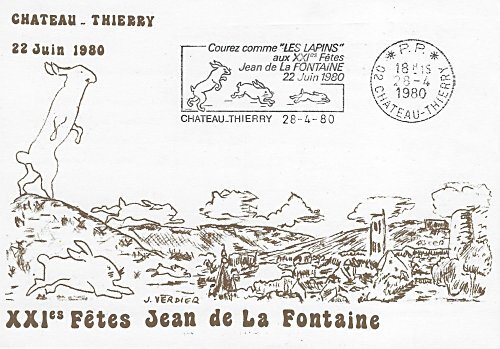
1980 One postcard 4" x 6" advertising "XXIes Fetes Jean de La Fontaine" at Chateau-Thierry, 23 June 1980. Unknown source.
The cancellation reads "Run like the rabbits at the 21st Festival Jean de La Fontaine," and the card itself shows rabbits running across the countryside – perhaps toward Chateau-Thierry? The artist of the card's monochrome illustration is J. Verdier. 500 copies of the postcard seem to have been produced.
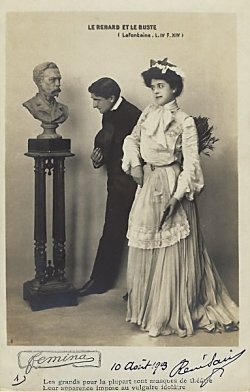
1903 Complete set of seven photographic postcards presenting Jean de La Fontaine's "Le Renard et le Buste." Femina. $70 from Bertrand Cocq, Calonne Ricouart, France, Sept., '18.
The human representation of this fable shows a fascinating way of taking the story. As I walk through these photographic human representations of animal stories, I have the sense that the "director" and the audience both know their animal fables so well that the director is at pains to find something new and creative in the human representation. La Fontaine tells us that most people in high places are no more than theater masks that impress asses. The fox by contrast examines them slowly and from various directions and is led to say what he once said about the hollow bust of a hero: "Nice head but no brains!" The human story here has a gentleman (the ass perhaps?) admiring a bust, while a cleaning woman with feather-duster in hand (the fox, no doubt) examines the bust more closely, tips and turns it, and – apparently -- finishes unsatisfied with what she finds. What does this woman hold in her right hand in Card 6? In La Fontaine's fable, a fox seeing a bust remembers the earlier experience (the experience portrayed in earlier traditional Aesopic fables) of encountering an empty mask, which led the fox back then to say something like "Nice face but no brains!"
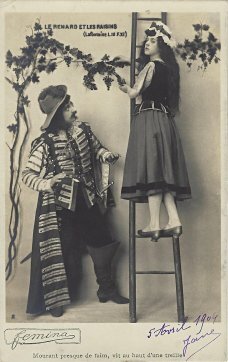
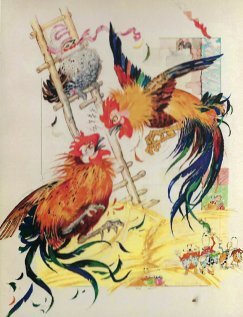
1904? 5 card photographic series by "Femina" presenting FG through two human adults. All five signed and dated in April, 1904. $5 for each card from Bertrand Cocq, Calonne Ricouart, France, Sept., '20.
Do I read this series wrong by understanding it to portray a romantic relationship that does not turn out as the initiator desires – and so he rejects it? Notice that the sender dates his five cards in April on the 5th, 16th (twice), and 25th (twice). Was he trying to suggest something to Mademoiselle M.L. Pouchan in Pau? Did she come down from her ladder? "Femina" has a distinctive cursive signature, clear on each of these cards, for its publications in the early 20th century, apparently between 1901 and 1910. It fascinates me to figure out what a feminist publishing house is communicating by presenting this fable with this interpretation!
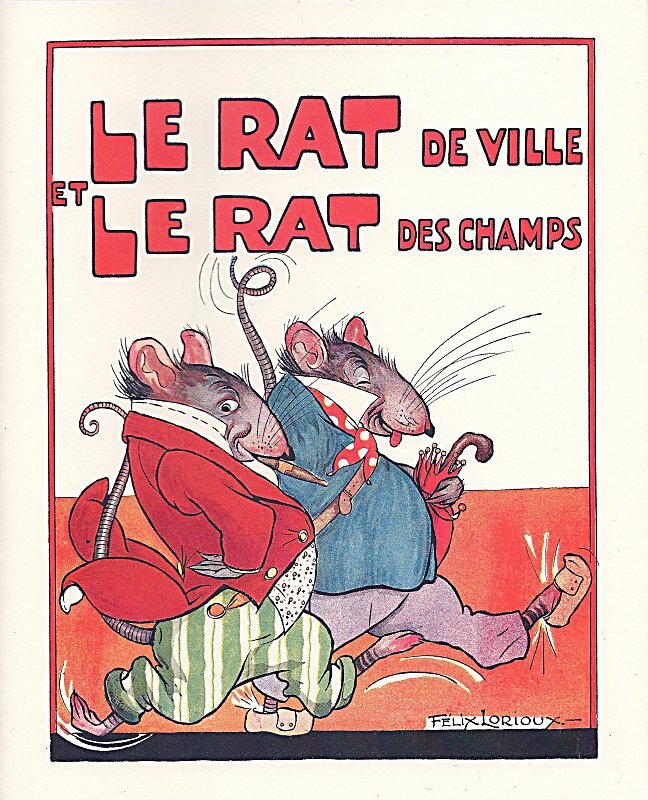
1998 Félix Lorioux Plates. Two from a set of 72 reproductions, 8.5" x 11" each: "Le Rat de Ville et le Rat des Champs" title page and guitar-playing grasshopper from GA. Reproduced from Lorioux' Fables de La Fontaine (Hachette, 1921). Free samples from the whole set sent by Justin M. Jacobs, Jr., President of Fantasy Artworks, Palo Alto, CA.
I was confused, since the accompanying letter calls these (as they were advertised) "bookplate replicas." "Bookplate" here apparently means a plate in a book, not a personal identifier. I am sorry that I cannot invest $432 in reproductions from a book that cost me $50 for a first edition! But I am amazed at what people turn out! GA is matt, while TMCM has glossy paper. Apparently Fantasy Artworks means to prepare these as art to be matted and framed.
2020? Twelve colored postcards of fables by Felix Lorioux. Part of a set of 24 Lorioux postcards. CC-1162. Pixiluv, com.$6.99 from Pixiluv, com., Dec., ’20.
Exceptionally good execution of detail on these twelve scenes from Lorioux and his presentation of fables, including Mother Goose starting the series by reading for the other animals from a book of La Fontaine’s fables and, at the end, walking away with the book under her arm.
1980? Feedsack cloth picturing CP. 32" x 10¾".
This is a lovely long stretch of blue cloth. I wonder if finding it sets me off a new search for fable feedsack cloths! Who would have thought it!