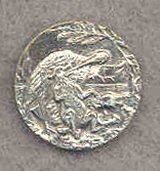
1890? 1 silver WC button, .6" in diameter. Paris: Solidaire Bte SGDG, A P & Cie, Paris.
Identical with the bronze button described just above. Might this button be slightly larger than that? The silver buttons in this series are harder to read than the bronze.
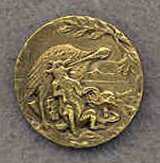
1890? 1 bronze WC button, .6" in diameter. Paris: Solidaire Bte SGDG, A P & Cie, Paris.
Clearly the same scene as the larger Gotbuttons and Goldbarg versions of WC. Thus it is also developed from J.J. Grandville's illustration. The doctor's pan is not so easy to identify here. The stance of the figures is that of Grandville's illustration. The stamped metallic front again seems to have been folded over the back with a self-shank surrounded by the manufacturer information quoted above.
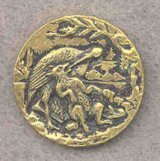
1890? 1 bronze WC button, 7/8" in diameter. Paris: Solidaire Bte SGDG, A P & Cie, Paris.
The same in motif motif as the Gotbuttons larger button with these differences: this is brass, smaller, and marked with "Solidaire Bte SGDG" rather than "Breveté" on the back. The metal of this button shows less relief than that of others I have, and the button is thus considerably brighter. This button has the same construction as that, including the self-shank. This specimen seems to be that presented as #11 on Plate 152 of BBB.
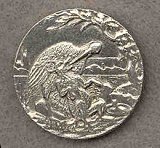
1890? 1 two-piece silver WC button, 1 1/16" in diameter. A P & Cie Breveté, Paris.
Developed from J.J. Grandville's illustration, I believe, because the doctor's pan is visible near the wolf's back paw. The stance of the figures is that of Grandville's illustration. This and the following three buttons from the same manufacturer are remarkably similar despite their different colors and sizes. The stamped metallic front seems to have been folded over the back, which is lifted at its center to form a tunnel-hole, where others have an implanted hook or circle. BBB calls this a "self-shank" (371). Around this raised mound one can read the manufacturer information quoted above.
Produced and adapted by John Hohmann. Designed by Janet Albrecht. Illustrations by Dominick Giustino. Storytelling by Carl Grapentine. NY: Beanstalk Productions.