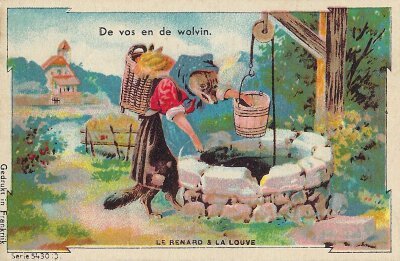
1950? Six cards -- a complete set? -- advertising Chicorei Talpe and picturing events in the Roman de Renard. €10 each from Albert van den Bosch, Antwerp, June, '23.
These cards have the same images as cards in two other sets in our collection: "Chicorei Talpe" and "5430." Like the cards in those sets, these cards have an unusual border shaped on each side by a zagged line. This is a complete set of six, whereas each of those is lacking one of the six. These cards are also formatted differently on their front, each having only "Dierenfabels" to complete the image. Finally, the verso lacks the bold script "Chicorei Talpe" written across the upper text on the verso. The verso of each card also identifies Roeselare as Talpe's home. By contrast with those cards, there is no numbering on these six cards. 4" x 2¾".
1950? Five cards advertising Chicorei Talpe and picturing events in the Roman de Renard. €8 each from Albert van den Bosch, Antwerp, June, '23.
These cards have three identifying characteristics: (1) the "Chicorei Talpe" written across the French text on the verso; (2) the unusual instepped borders, hard to describe but easy to notice; and (3) the "5430" series indicated in the lower left. Here we have five of the -- apparently -- six in the series. The good news for this collection is that we have a set of five cards in a "5430" series under "Fable Card Series." The lacking number there (#1) is present here: "Renard and the Bear." The lacking number here (#5) is present there: "The Horse and the Wolf." There is also a single card in this format under single stock trade cards, picturing the fox and the snake. As I mentioned a propos of "5430," there is very nice chromolithography on these cards. 4" x 2¾". Chicorei Talpe was produced in Roeselare, Belgium.
1950? Seven cards from a set using illustrations from Felix Lorioux advertising Chicoree Williot. Nantes: Imprimerie Moderne. $8 each from Bertrand Cocq, Calonne-Ricouart, France, Sept., '20. FC and an extra of "Weasel in a Granary" for €3 from clajamal through Ebay, April, '22.
Bertrand tells me that the set is rare. I wonder how large it is. The reproduction of these Lorioux scenes, especially for small cards, is exceptional! My favorite remains FG.
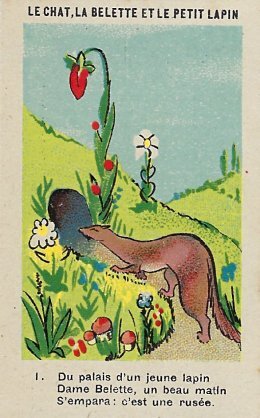
1920? Twelve numbered colored pictorial cards (from a series of 16?) illustrating La Fontaine's fable "Le Chat, la Belette et le Petit Lapin." 2" x 3⅛". Bayon: Chicorée Extra Daniel Voelcker-Coumes.
"Card" is almost too strong a word for these thick-paper, small cards. However, the illustrations are executed in careful, loving, lively fashion. It is unusual to have so many cards devoted to presenting one fable. The fable is among the longer La Fontaine fables. Each card presents one or a few verses on its front, along with the title, number, and illustration. The verso features, in its upper half, a numbered commentary on La Fontaine's fable and, in the lower half, an unchanging advertisement for Daniel Voelcker-Coumes and his Chicorée Extra. Black outlines help to define the main characters in each scene. The sometimes minimal changes from one scene to the next are highly effective, for example, when #6 fills in the rats he threatens against the weasel, rats pictured against the same clouds we saw in #5. The same effect is there as the two litigants draw closer to the judge from #12 to #13. These cards are quite different from Daniel Voelcker-Coumes' other series of double cards.
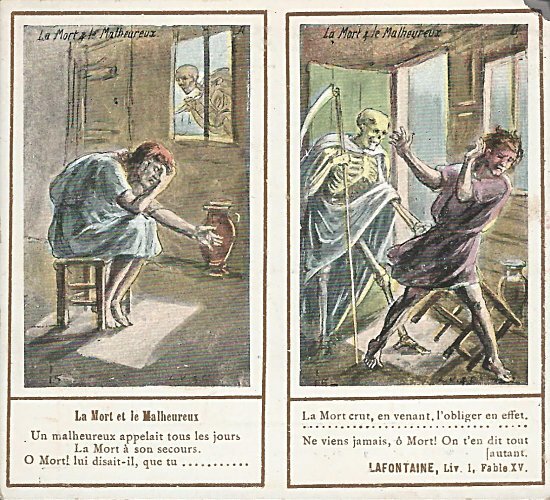
1901? Ten double-cards presenting La Fontaine's fables. Léopold Verger & Cie, Paris.
These cards are doubly curious because they reproduce single cards in the series identified in this collection as "Leopold Verger Small." Thus three cards here pick up one image from that series and add a second image of their own. That is the trick in this presentation: two phases give the story of the fable. The verso of the each card is identical.
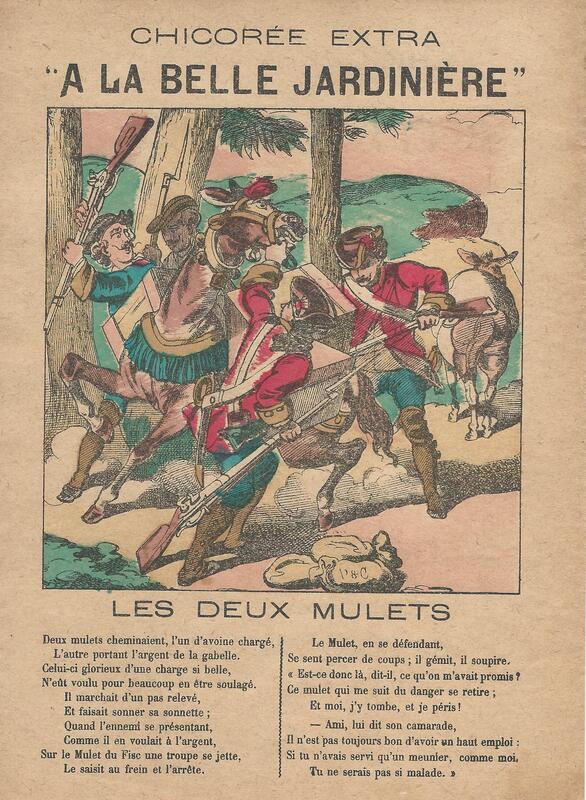
Chicorée Extra "A la belle Jardinière"
1890? 26 thin loose sheets, 8¼" x 6¼", advertising Chicorée Extra "A la belle Jardinière" with colored images on the front side, largely or entirely from Pelerin of Epinal, and with texts of fables from La Fontaine and Florian. Gift of Bertrand Cocq, Calonne-Ricouart, France, August, '15.
These sheets are very slight and fragile. Only DW is landscape; all others are in portrait format. I believe strong Pelerin images here are alongside weaker but traditional images. "Le Coq et le Renard" has the familiar pose of the deceiving fox and much of the zest of Pelerin color. Other famous Pelerin designs include TH and FC. Are GA and GGE as strong? I should not be surprised that I have not run into them before: they are so fragile! This set is in very good condition. Some sheets have two fables. Others have several scenes from one fable.
1890? 10 large (5½" x 7") cards presenting La Fontaine's fables. Text is set into the picture in a rectangle. Advertisers on the verso include Les Grand Magasins du Printemps du Paris and Chicorée Bleu-Argent Arlatte from Cambrai. Printed by Publicité Bascoul-Olmer Vincennes. Extras of four of the cards (DW, FG, GGE, and "The Heron").
The pictures are colorful and impressive traditional scenes. Often they include a second reference, as when DW shows the dog animals meeting in a circle at the upper left, while the bulk of the picture shows a scene of a poor old man (the wolf) conversing with a plump man in uniform (the dog). FG has both a fox and grapes in the foreground and then, slightly set into the background, a courtier looking up to damsels in front of a castle. Other fables, like WL, GGE, and "The Heron," are presented simply in one scene. Besides DW, my favorite among these cards is BF. People point smiling at a dowdy gentleman who stands alone away from the crowd. Other fables as yet unmentioned include FS, GA, MM, and "Le Laboureur et ses Enfants." The verso of the Arlatte exemplars presents no nore than "Chicorée Bleu-Argent Arlatte Cambrai." The Printemps versos all show the same picture of a child with a balloon inscribed "Le Printemps est l'ami des enfants." A curiosity here is that the "Au Camélia" card for DW has the title "Le Chien et le Loup," while other DW cards have the title "Le Loup et le Chien." The illustrations on these cards are identical with those on Paris prize cards.
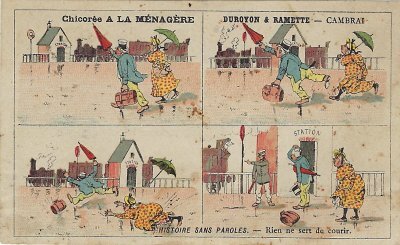
1910? Trade card of Chicorée à la Ménagère. "Rien ne sert de courir." Duroyon & Ramette - Cambrai. "Histoire sans Paroles." $6 from Bertrand Cocq, Nov., '20.
The verso mentions also "Chocolat Inimitable." This couple needed not running but a prompt start in order to get onto this departing train.
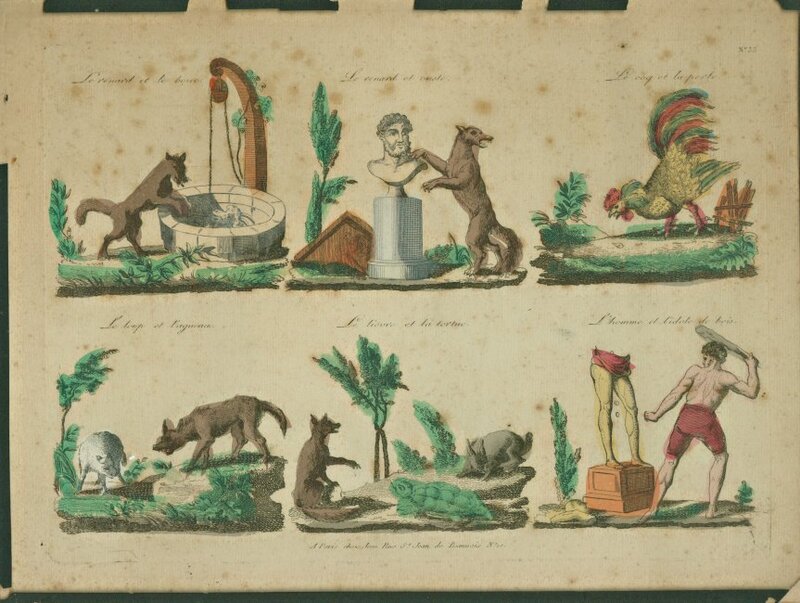
1800? Framed colored lithography of six fable scenes. #33. Dimensions. Paris: Chez Jean Rue St. Jean de Beauvais No. 10. Source unknown.
Framed by the Cousin Brothers in Paris with tape, glass, and a backing. The coloration may be typical of such broadsheet production. It does not adhere closely to the definition of figures. Notice in particular how green is applied to the ever-present foliage. The web has works done by Jean at this address dated to 1810. No. 33 of what?
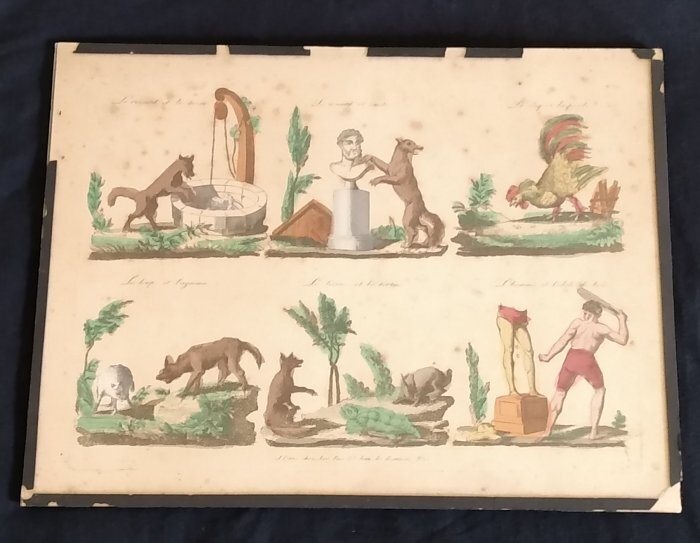
1870? Framed broadside presenting six colored fable scenes. 13" x 9½". Framed by worn tape. Chez Jean, Rue St. Jean de Beauvais #10. No. 33. €10 from guymarie justin through Ebay, April, '22.
I am surprised that this very fragile piece arrived intact. It seems to have five colors: red, pink, yellow, brown, and green. "Fox in the Well"; "Fox and Bust"; CJ; WL; TH; and "The Man with the Wooden Idol." The color seems to be applied to areas rather than to the outlines of difficult objects like bushes
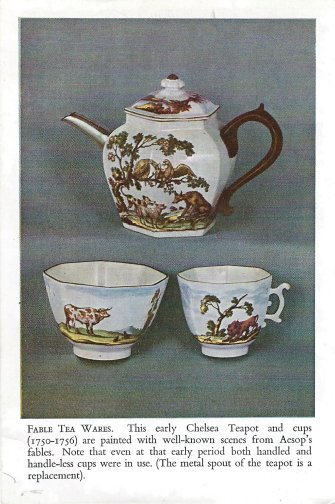
1960? Postcard of Chelsea teapot and teacups. Tea Centre Post Card. €3.99 from HipPostcard, Oct., '24
As the seller writes "A highly specialist undated but circa 60 years ago origin postcard of this collection of 1700s Chelsea pottery with well known scenes from Aesops Fables with with details to accompany. Unused and outstanding condition.
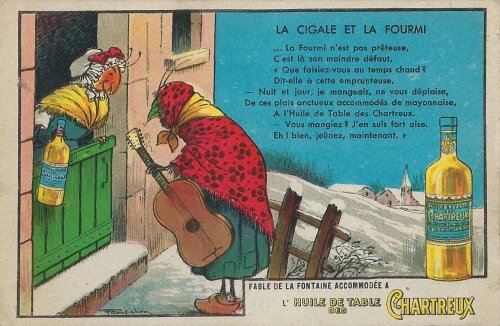
1930? Colored postcard advertising L'Huile de Table des Chartreux through a parody of GA. €15 from Albert van den Bosch, Antwerp, June, '23.
This card challenged this cataloguer because it is both a postcard and an advertisement, a clever advertisement at that! I came down for postcard. The ant asks, as always, what the grasshopper was doing all summer. The answer? "I was eating all sorts of things with L'Huile de Table des Chartreux." The ant's response here: "You were eating? Fine. Now fast." She is hanging onto her bottle of the oil! The artistry is well done, and the color lovely. It looks to me as though there may have been a series of Chartreux advertisements presenting a "fable de la Fontaine accommodée à L'Huile de Table des Chartreux." I would love to find more of them!
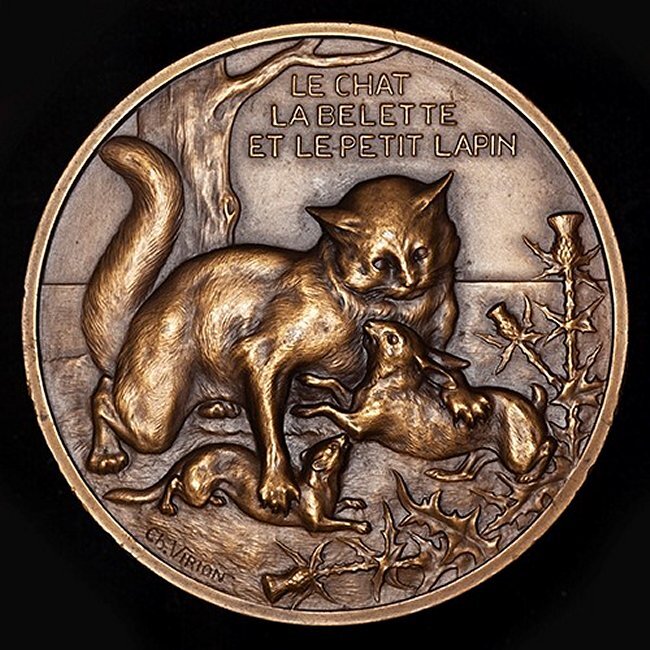
1980? Two 2 1/2" medallions by Charles Virion of La Fontaine fables. "The Cat, the Weasel and the Hare" and "The Animals in the Plague."
These medallions are very similar in format to the large series done by Jean Vernon. One notices the different artist immediately. These two are the only members of the series that I have found online.