Source: Lovallo, J., & Sasse, A. F. (2019, February 18). A biography of Judge Elizabeth Pittman. North Omaha History. https://northomahahistory.com/2019/02/18/a-biography-of-judge-elizabeth-pittman-by-jody-lovallo-and-adam-fletcher-sasse/
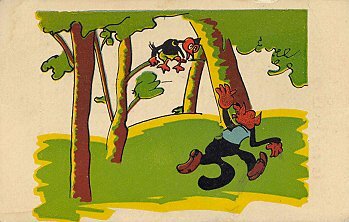
1950? 11 cards each with a simple cartoon illustration of a La Fontaine's fable on one side and the text of the fable on the other. 3" x 4¾". Apparently given as school prizes for attendance or punctuality. 10 Francs apiece from Helen Moncourt on the Quai de la Seine, May, '97.
Simple figures, strong colors, and lively scenes make this a good set for children. My favorite here is TMCM. These rats are having fun! For a copy of MM that landed elsewhere in the collection, see "Individual Fable Cards."
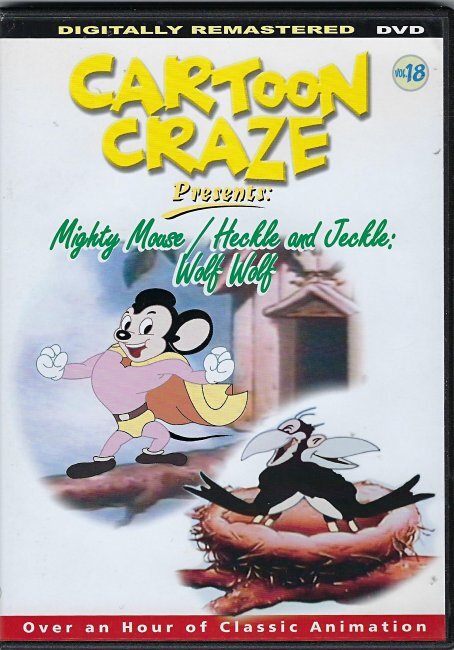
2004 Cartoon Craze, Vol. 18. DVD. Mighty Mouse/Heckle and Jeckle: Wolf Wolf. Digiview Productions. Made in China. 10 cartoons, mostly Paul Terry. Unknown source.
This dvd should not be confused with the several Van Beuren dvd's with similar titles. It offers ten colored cartoons from the 1940's. "Wolf! Wolf!" in 1944 brings together several traditional stories and rhymes, including "Little Bo Peep." I do not find fables involved here or elsewhere in this dvd. This story involves contemporary elements significantly, particularly wartime elements like periscopes and cannon. There is also an emphasize on contemporary jazz, which can lure the lost sheep into the wolves' lair. I also enjoyed "Cheese Burglar" (1946). Though it has nothing to do with fables, it has fun with Herman the Mouse. 62 minutes.
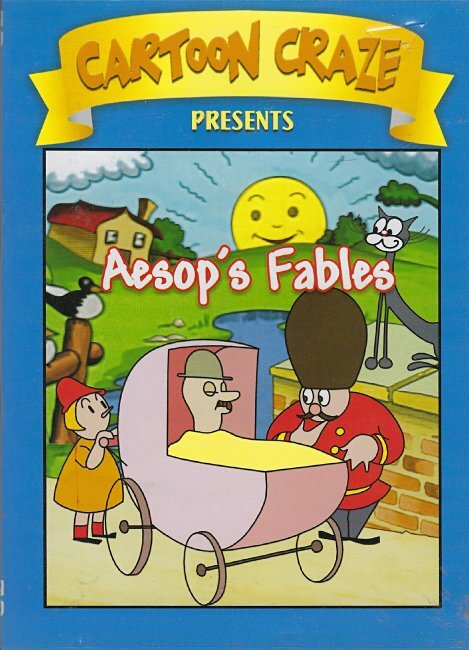
2004 Cartoon Craze. DVD. Taiwan: Digiview Productions.
Here are eight Van Beuren cartoons from about the 1930's, starting with "Close Call," "Dizzy Day," and "A Toytown Tale." As generally is the case with Van Beuren "Aesop's Fables" cartoons, they are not really from traditional Aesopic material. They are described in the cartoons themselves as "sugar coated pills of wisdom." As is true of cartoons more broadly, there may be more going on underneath the cartoon's surface – politically and philosophically – than is immediately apparent.
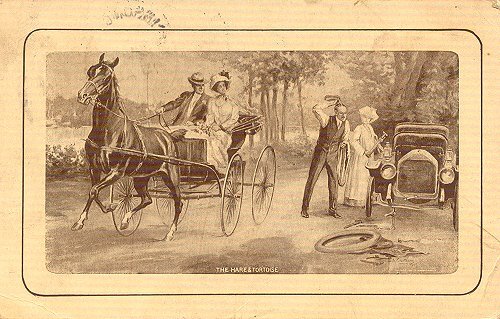
1909? "The Hare & Tortoise." Postcard print by A.F. Carter. "The Pink of Perfection: The Fairman Co. N.Y." Postmarked July 4 at 5 a.m., but apparently without indication of the year, from Gibson, IL. $2 from Lois Carroll, of Peru, IL, through eBay, Feb., '03.
This card reproduces in smaller format the print found under Printed Material - Prints. As I write there, this scene had perhaps already become an old joke by the time this print appeared. The dashing horse-and-buggy glides by the stalled automobile. The frustrated driver of the latter has already removed his coat and is holding a dilapidated innertube in his hand, while the woman holds a pump ready for action. The outer tire lies on the road with some tools. Good fun!
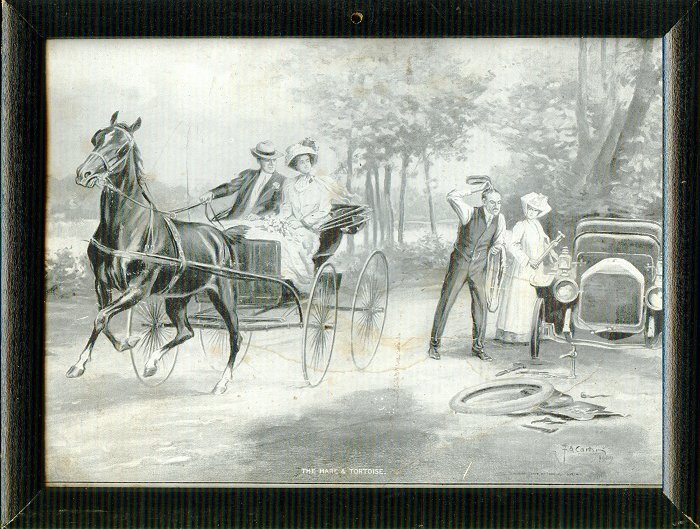
1909 Black-and-white print of F.A. Carter's "The Hare and the Tortoise." Framed. 9" x 7". $4.99 from Joe Lockhart, Easton, ME, through eBay, Dec., '03.
This scene had perhaps already become an old joke by the time this print appeared. The dashing horse-and-buggy glides by the stalled automobile. The frustrated driver of the latter has already removed his coat and is holding a dilapidated innertube in his hand, while the woman holds a pump ready for action. The outer tire lies on the road with some tools. Good fun!
1890? 5 small full-color portrait-formatted cards (plus a cropped duplicate of FS) with block-print titles of La Fontaine's fables. 1½" x 2¼". Advertisers include: Carré, apparently a haberdasher and dealer in notions and successor to Briat with a shop on the Place Hoche aux Soeurs de Charité; A. Pepin, in Lagny, a seller of wines, edibles, coffees, and desserts; E. Carraud in Poitiers, a seller of tapioca, chocolate, and coffee; and Massonneau and Company in Paris.
These may be the smallest cards I have. This is the first time I have seen the frog lying on his back in OF. The wolf drags off the lamb by the hand, while the lamb's other hand carries along his water jug. I am surprised at the quality of definition these cards achieve in their very small format. "Le Singe et le Chat," which advertises Carraud, is shorter, and its lettering is thicker; it may actually belong to a different set. Besides notions, Carré sells bandages and ribbons.
1890? Carr and Co. Juvenile Biscuit Tin. Five numbered scenes from FC with rhyming verses. Carlisle, GB. 3" square by 4⅝". £22 from wickedlady, Yorkshire, UK, through eBay, Nov., '05.
This cookie tin is highly corroded and so hard to read. The cover picture, first in the series, has a mother crow visiting a dairy to find food for her children. She then flies into a tree with a piece of cheese in her beak. The fifth and final scene may be the most dramatic: the fox runs away as the fox flies away. The art is nicely done, even through the darkening and discoloration.
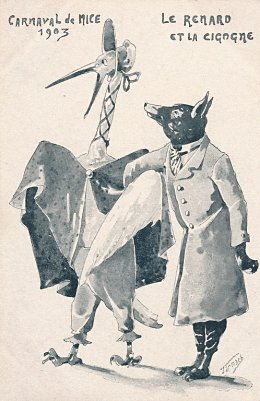
1903 Two black-and-white postcards depicting fables from the Carnaval de Nice of 1903. "Lion and Hare" and FS. Signed (at least one) by "Jarnach." $20 from Bertrand Cocq, Calonne Ricouart, France, Sept., '18.
The fox and stork walk or stand apparently arm in arm, or arm in wing as the case may be. There is a clear male and female distinction between the two. I understand the lion in the second fable to be turning away for better prey, presuming that the hare will be there when he returns. That, of course, does not happen. The svelt hare looks like she is ready for a quick get-away. The lion has something around his belt that looks like "US DIRECTEU." Hmmmm….
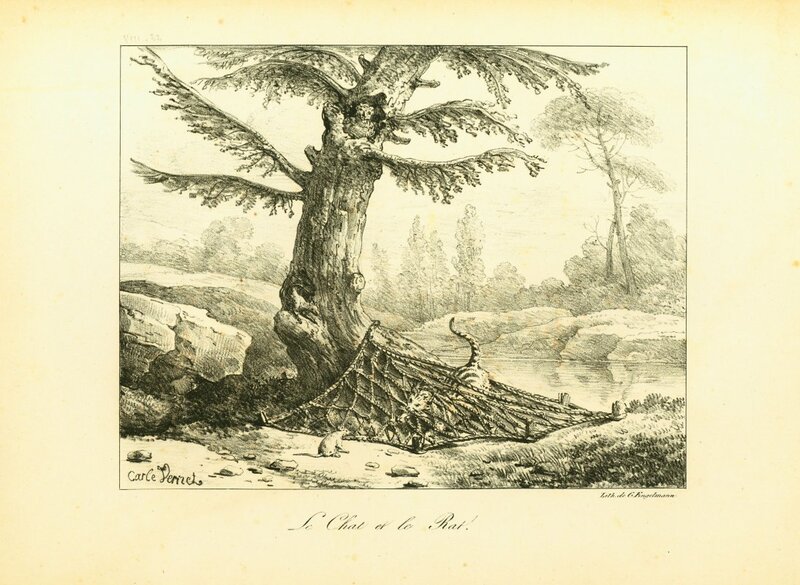
1818? 35 Lithographs by LeComte, Vernet, Engelmann and Mauraisse from about 1817 through 1820. Mostare 14½" x 10½". $80 from jordanb2011 through Ebay, Jan., '21.
Engelmann seems to be the engraver for many of these. I have assigned him authorship for those not signed by LeComte or Vernet. These seem to be pages from a book in our collection, "Fables choisies De La Fontaine ornees de figures lithographiques" from 1818, published by Engelmann.
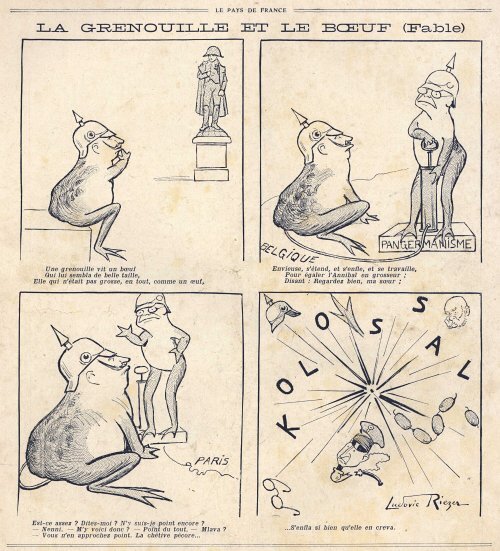
1915 Caricature of two leaders in WWI, dramatized in La Fontaine's OF. Ludovic Rezier. Back cover of "Pays de France," January 14, 1915. €12 from journauxanciens through Ebay, Feb.,' 23.
Some study has not helped me to identify these figures or even what happens between the final two. The pattern follows La Fontaine's OF, but I am unsure how. A military leader looks at Napoleon and -- following the fable -- thinks he is bigger. Soon enough an opponent is inflating him. Is it the left or the right figure that explodes in "colossal" fashion, blown up by Pan-Germanism's pump?
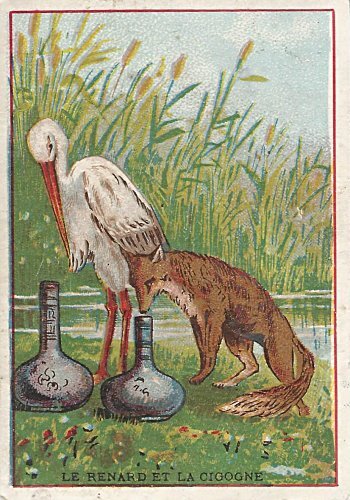
1930? Two cards using images found in several other series but offering a different typeface for the title. 1 FS colored card. No publisher or artist indicated. "Horse and Ass" for €15 from Albert van den Bosch, Jan., '23.
Grouping these two cards together is a sheer guess. Each has only the text of the fable and its title on the verso. The block-print title on the image is larger than the print on the other cards. Two nice looking cards! FS presents a pleasing view of the two animals approaching two tall slim-necked vases. The full text of La Fontaine's FS fable is on the verso. Nothing else is on the verso. It turns out that this card's image is identical with the image -- though not the title font -- on the card in the series by Alcide Picard
1926 “Vendre” full-page advertisement for Carbel. “Montrez-moi patte blanche … ou je n’ouvrirai point!” Sept., ’26. 8.3” x 10.5”. Unknown source.
Carbel was apparently a major manufacturer of carbon and ribbon. “The most important specialized house of Europe.” Here it plays off of the La Fontaine fable where the young goat wisely demands of the wolf caller outside his door that he not only offer his mother’s voice but that he also show “white paw.” Notice the Carbel man made up of various round typewriter ribbons; his chest is in fact a typewriter.