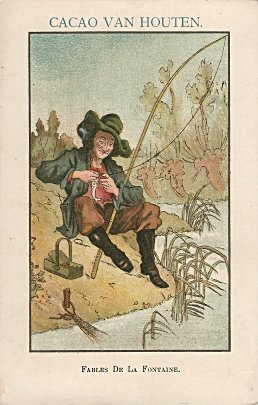
1920? Twelve unusually sturdy cards folded over to make a small brochure advertising Cacao Van Houten (or on FG in English "Van Houten's Cocoa"). 3½" x 5½" closed or 7" x 5½" opened. The cover of each displays a strong colored image of the fable, while the back cover has a uniform art deco picture of a woman in Egyptian dress serving a tray of Van Houten's cocoa. Inside is the text of La Fontaine's fable in French (or, for FC, in English). The back figure of a woman serving cocoa seems to be an art deco piece. The English text inside FC is Wright's rhyming 1841 translation, unacknowledged. €56 for the eight French brochures from Brie Comte Robert at the Paris Post Card Exhibition, Jan., '05. $8.50 for the English FC from Lonnieonthelake through eBay, Dec., '03. Three last cards for $15 each from Giorgio Mariotti, Torino, IL, March, '15.
This may be the only folding trade card I have found. The advertisement-illustration itself is engaging. When the printing is carefully done, as in GA and MM, the illustrations are excellent! Others, like FG and FC, seem less well executed. Who knows how many cards were in these sets, and how many different language sets were produced! The fables represented here include FC, FG, FS, GA, GGE, MM, TH, TMCM, and WC.
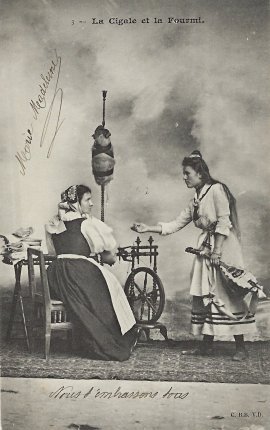
As I first catalogued a large number of cards that Bertrand Cocq had found for me, I scanned and commented on two cards from a set with the mark "C. B.B. V.D." Later in my cataloguing, I found together three cards from a similar set, also with the mark ""C. B.B. V.D." To my surprise, not only are the cards differently formatted but also differently numbered, so that this second set starts with a phase not in the first set, something like the cicada dealing with a carnival barker. Enjoy noticing the little differences. The verso in this set has the same information but different typeface.
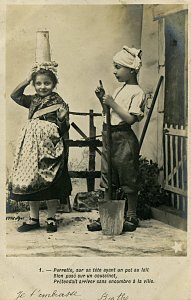
1903 "Perrette." Ten black-and-white photographic postcards depicting MM. All sent by "Berthe" to "Alice Bardot" in Nievre (?). €50 from Bernard Riconti, St. Ouen, August, 2013.
The approach of these cards is similar to those Bergeret phototypes, "Bébé Fabulist," and "Perrette Montrut, presumably from the same period. These include the appropriate verses of the fable with each picture. As with them, the message goes on the picture side of the postcard. The verso is entirely for stamp and address. Each card is signed by "Berthe" and several have endearing messages. The scene is portrayed entirely by children. The "pot" of milk has a curious tall shape here, something between a butter churn and a coffee pot. The fourth through seventh pictures use a rather primitive way to indicate Perrette's dreaming: an image of the appropriate future animal is pasted into the picture. The eighth picture may be the most curious, as the picture composer works to make the pot seem to be falling and spilling.
1970? Buvard offert par Semelflex, a maker of shoes. With a trace-the-dots painting of La Fontaine's shoemaker from "The Shoemaker and the Financier." Premiere Serie C: Bottillon d'Enfant. Mesmer Pub. Imp. Sézanne. 5¼" x 8¼". $5 from Mme Denise Debuigne, Rennes, France, May, '02.
Green, red, and black highlight the face of a man and a child's shoe. When—as here—someone connects the dots, the delightful shoemaker appears, with his pipe in one hand and his hammer in the other. The blotter's invitation is well phrased: "Trace a line in the sequence of 1, 2, 3, 4, 5, etc… and you will designate the shoemaker whom La Fontaine let sing from morning until evening."
2019 Business Card of Erlesenes Bookshop in Vienna.
Visiting this bookshop was one of the most refreshing of my fable-seeking adventures. I noticed online an unusual volume that they were offering: "A Bölcs Esopusnak" in Hungarian from 1943. I found their bookshop -- it was not easy -- and was immediately struck by the FG symbol at the doorway. This bookshop is a search for the exquisite grapes of literature! Their advertising is consistent with their brand, and so I have three bookmarks as well as this three business card. There is also an incident connected with my visit there. The manager could not find the book and at last remembered that it might be in the "Lager," since she had worked on the volume. She found it! Victory! The exquisite possessed!
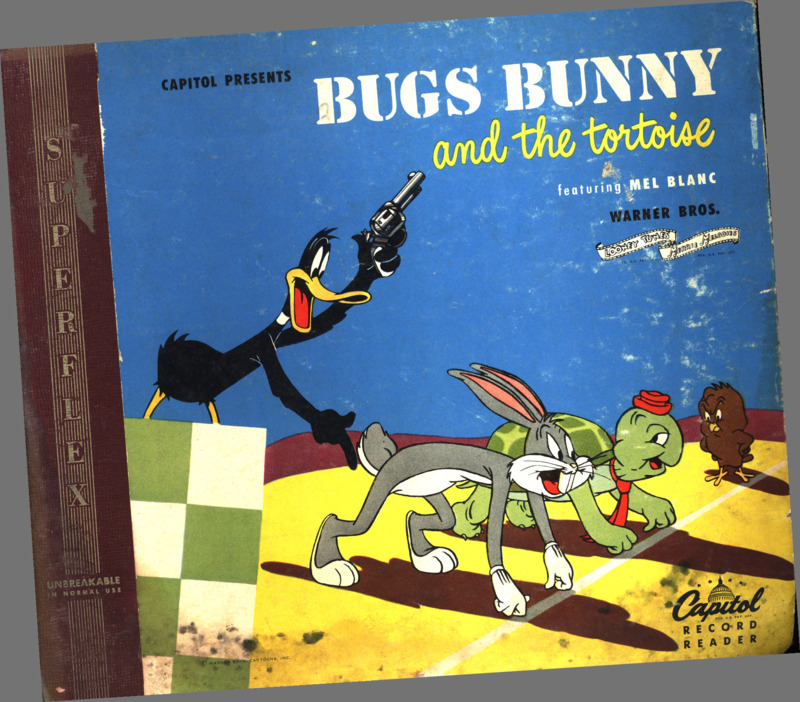
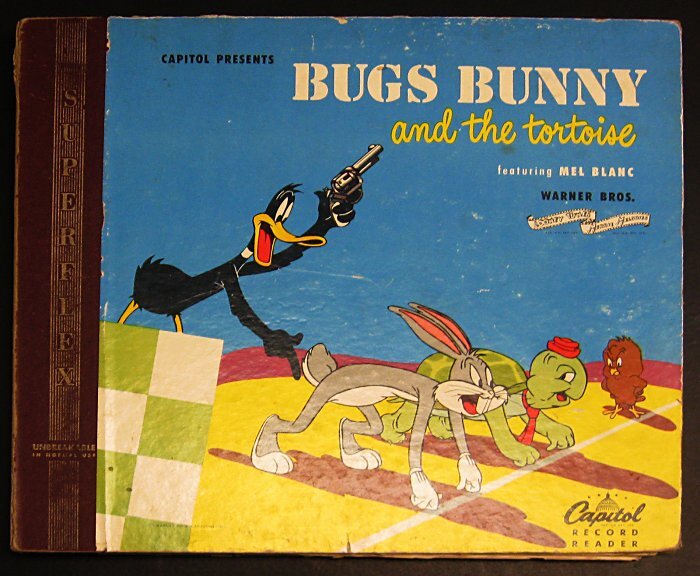
1947? Bugs Bunny and the Tortoise. Mel Blanc. Canvas-bound. Warner Brothers.
I found this album during a chance visit to an antiques store as I walked back to the hotel from a lovely train ride in Duluth. I have remarked in several cases, including Disney and Random House presentations of TH, that the rabbit resembles Bugs Bunny. Well, here is Bugs Bunny himself in Capitol Records and Warner Brothers' "Looney Tunes and Merry Melodies" presenting the famous race. Elmer Fudd is, both visually and on the 78 rpm records, our host and narrator. The book, pasted into the cardboard jacket, has 20 double-sided pages, numbered to allow viewers to see a pair of facing pages with every portion of the two records. Bugs trips over a book of TH. Bugs goes directly to the end of the book to see by how much the hare beat the tortoise. He is angered by the result, even more when a tortoise offers to bet him on a race together. Daffy Duck serves as announcer for the race out and back again. After establishing an early lead, Bugs opines that the hare in the book probably knocked himself out. Bugs tries to avoid that by taking a rest. In the meantime, he puts a young duck into the water even though that duck does not want to get wet. Fun goes further when Bugs passes the tortoise, and the tortoise asks a taxi to follow Bugs. Only the taxi does not take the tortoise with him! Bugs walks into a trap, set for chickens by Henery the Hawk. A carrot farm proves to be Bugs' undoing. His stomach bulges as he sleeps against a tree. When the tortoise comes by, Bugs surprises him with the alarm clock he has set. The tortoise air mails himself by having a couple of air mail stamps slapped onto himself. Bugs wins by an ear. After a close finish, Elmer declares that "Bugs Bunny won by a hare!" Apparently first done in 1947 and republished in 1975. I cannot find any date information on either the printed material or the record. Researching this lovely find led me to finding better preserved copies online, and I have ordered one for the collection.