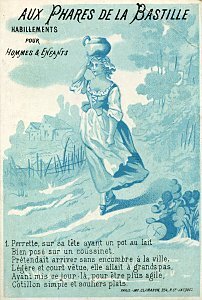
1890? 5 cards presenting La Fontaine's MM. The cards follow the fable's text up to a natural break preceding a reflection ("Do not all of us daydream?") by La Fontaine. Perhaps there is another card or two in the series, but I doubt it. Paris: Imp. Clamaron, Rue St. Jacques.
The pictures are monochromatic blue-and-white, with five or six lines per card at the bottom. The text and picture are not coordinated. In the text, for example, Perette is still thinking about cows when the picture already shows the milk fallen. The whole series ends with the line "They call it 'The Pot of Milk.'" This set is identical in picture with a set listed under "Clamaron," which remains the printer. But each card in this set is stamped "Aux Phares de la Bastille: Habillements pour Hommes & Enfants." A fuller advertisement for this shop is on each verso. These cards, by contrast with those, are numbered.
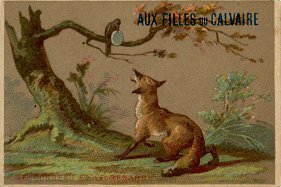
1900? One fable-illustrated stock trade card of FC advertising "Aux Filles du Calvaire: Grands Magasins." 2½" x 3¾".
This card is identical with that in the WMF set with these exceptions: it prints "Aus Filles du Calvaire" and "Le Corbeau et le Renard" on the picture side; it uses half the text side for advertising; on the lower half of the text page it gives the fable's title again and just six of its lines. This card is slightly smaller than its equivalent in the WMF set. Though the same image is used, a smaller portion of it is printed.
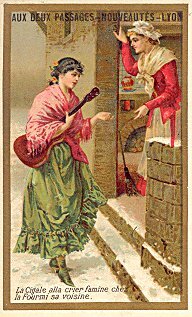
1895? 2 full-color cards illustrating La Fontaine's GA with human figures as actors. Just over 2 ½" by 4 1/8". Both backs are blank.
The texts do not follow La Fontaine exactly. This is the first time, I believe, that I have seen the ant dance in any form. The "Aux Deux Passages" is in Lyon and sells "nouveautés." Though I presume that there are six or seven cards in the set, these two complement each other nicely. In the first scene, the cicada approaches the ant; in the second scene, the ant dismisses the cicada. The artist here works with a very traditional approach to the fable: young woman visits matron. I find the artistry very good. The folds of the "cicada" skirt in the first picture, and the vigor of the dance (and the rejection) is telling in the second.
Now, in late 2008, I discover that these two pictures are identical with the last two in Liebig's 1892 "Grille und Ameise" series. My comments turned out to be right on the mark, and the dating seems quite close too!
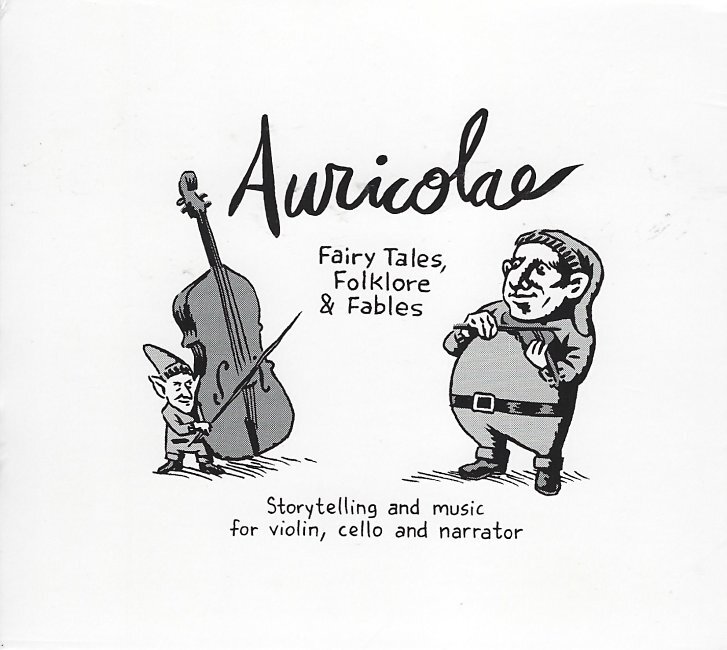
2009 Auricolae: Fairy Tales Folklore & Fables. Storytelling and music for violin, cello and narrator. Artistic Director and narrator David Yang.
Here is a delightful rendition of six stories, the second of them with three different endings. Alas, I do not find a tale that I would call a fable among them. They are: "Ferdinand the Bull"; "The Rascally Rogue of the Beanstalk"; Rogue Endings A, B, C; "Rumpelstilskin"; "Adventure at Granny's"; "Prince Rooster"; "Three Little Pigs." The stories are well told, with excellent musical complements.
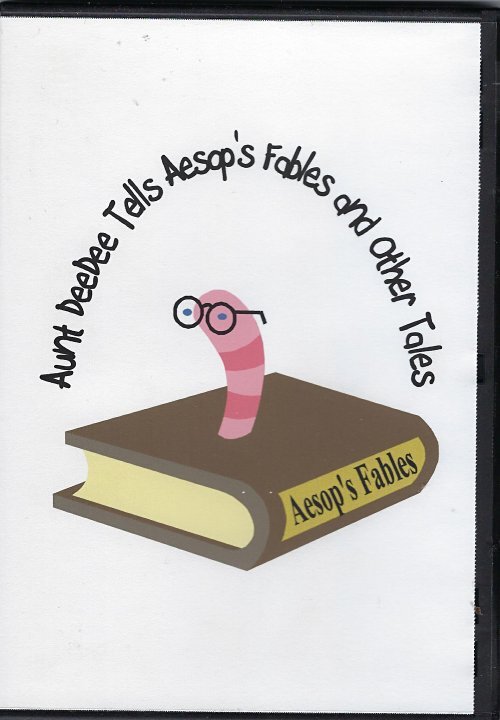
2008? Aunt DeeDee Tells Aesop's Fables and Other Tales. DVD. Debbie Deane. Down Memory Lane.
This DVD offers vigorous tellings of eight Aesop's fables along with two others. The fables are GA; BW; TMCM; FG; GGE; LM; SW; and TH. The two other tales are "The Old Hag's Long Leather Bag" and "The Little Old Lady and Her Pig." The stories are accompanied by a wild proliferation of images of various sorts. The tellings are vigorous and include a variety of voices, all presumably from Deane. There is a written moral at the end of each fable followed by a vocalized slide "The end." The first day's cry in BW brings his mother and sister. The next cry brings men and boys with pitchforks. In TMCM, the city cousin drives a car with a windup key in its trunk. The cat attacks once, and the country mouse says good-bye. Here is one more evidence of how much people love Aesop's stories and keep them alive with their lively presentations.