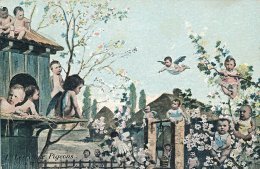
1905?? Four numbered (hand?-) colored photographic postcards of babies in scenes of La Fontaine fables. Paris: Aqua Photo: L.V. & Cie. $48 from Bertrand Cocq, Calonne Ricouart, France, Sept., '18.
These cards are among the most unusual things I have found illustrating fables. About the taste displayed here, I can only say that there must be something special about French sensibilities. The approach here is to have two children act out a scene from a well-known fable. That occurs regularly enough in both painted and photographed postcard portrayals of fables. The special, surprising addition here is to people the scene with maniy baby pictures. I honestly do not "get it"! But I am delighted to include these displays of it in this collection. Might these four constitute the whole series? In "Two Doves," at least two of them fly. In GA, the "ant" section wears pink and the "cicada" sectin wears light blue. In FC, many of the babies are winged. In WL, one wears a lambskin and another a wolf's pelt. Might part of the fun of these cards be an early experience of placing cropped photographs within larger photographs?
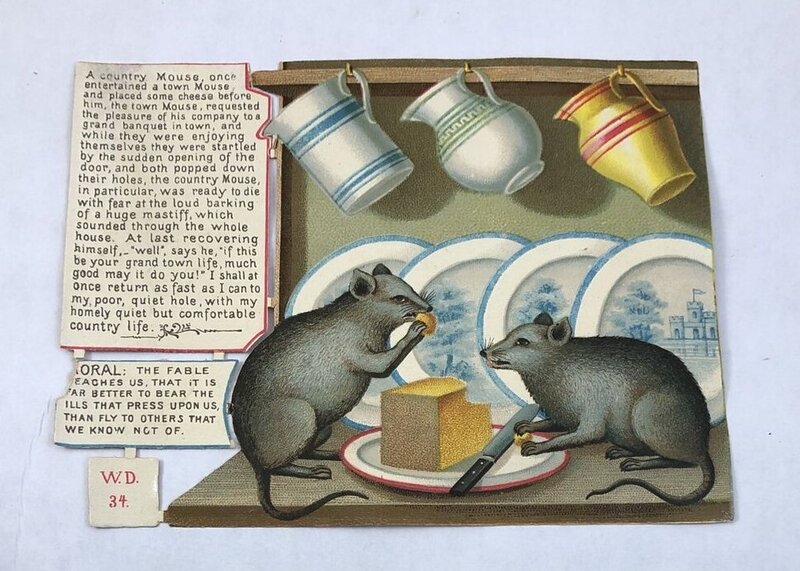
1900? Antique Victorian Die Cut Paper Art Fable Set of 12. $100 from Chickadeepick through Ebay, March, '23.
These fragile papers are exquisite! Many seem to work out to a standard rectangular size. Numbers mark them as part of a series with at least 45 members, but there is a chance that the set includes only these twelve cuts of fables. With the exception of one (#38?) that is lacking its number, the set is complete from #34 through #45. I will present them here in numerical order. The delicacy and exactness of the printing, coloring, and cutting are remarkable!
2000? 3D Aesop’s Fables Posters. 1” x 11” x 15”. $19.26 from Daniel Laury, Dec,, 2005.
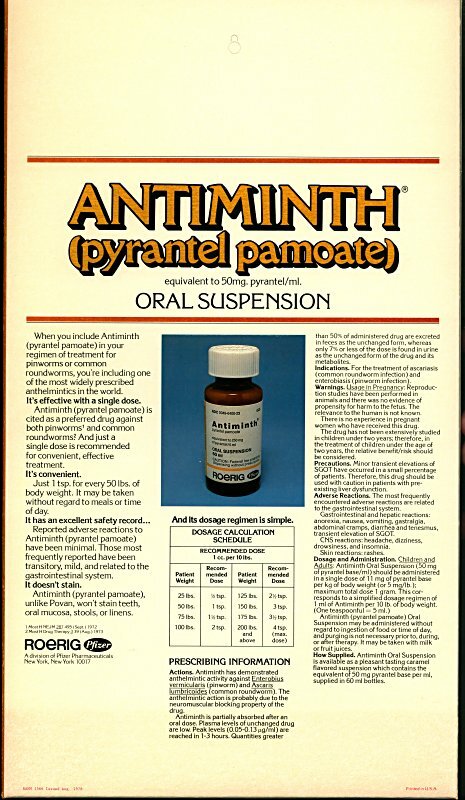
Three advertisements for the drug Antiminth which is used to treat pinworm infections. The advertisements are pop up posters meant to be hung on a wall. Each features one of 3 different fables. The fables featured are the Boy and the Lion, the Ant and the Grasshopper, and the Boy Who Cried Wolf. The images accompanying each fable appear to have originally been created with pieces of felt, then photographed and reprinted on cardboard. Captions below the images tell the story of the respective fable. Behind each pop-up folder is an advertisement for the medication. Each advertisement came with a letter from the company addressed to the doctor. The letters give a witty description that leads into the selling of the drug, and how the moral of the story relates to health.
“Dear Doctor: We are pleased to send you the fifth 3-dimensional wall unit in our six-part series, Aesop’s fables. It is based on the famous story of “The Boy Who Cried Wolf”, which teaches us that nobody believes a liar, even when he is telling the truth. Those who are philosophically minded might say that there is more to the story than meets the eye. Was the boy who cried wolf merely playful…”