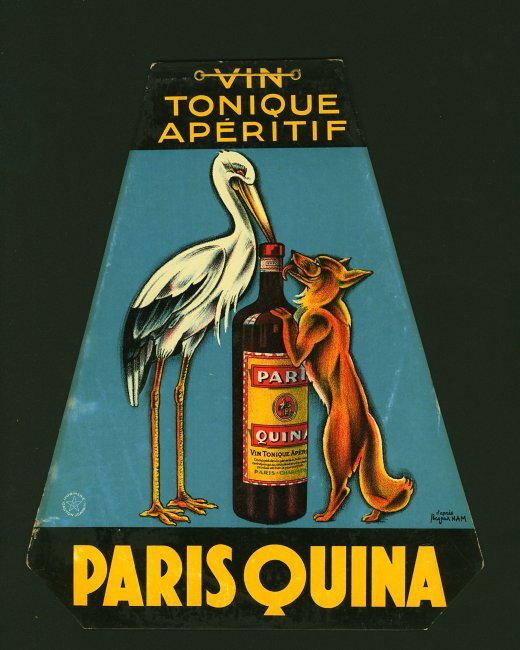
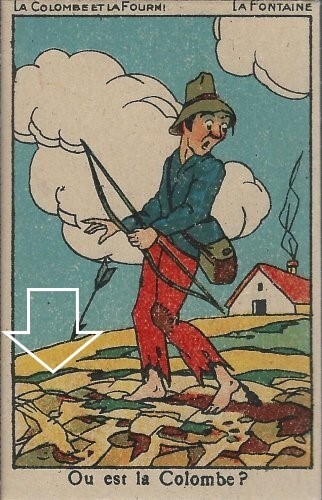
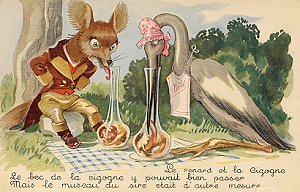
I have found twelve cards done, perhaps in several different series, by Achille Mauzan. They are clever cards! Click on any card to see it enlarged and read a comment.
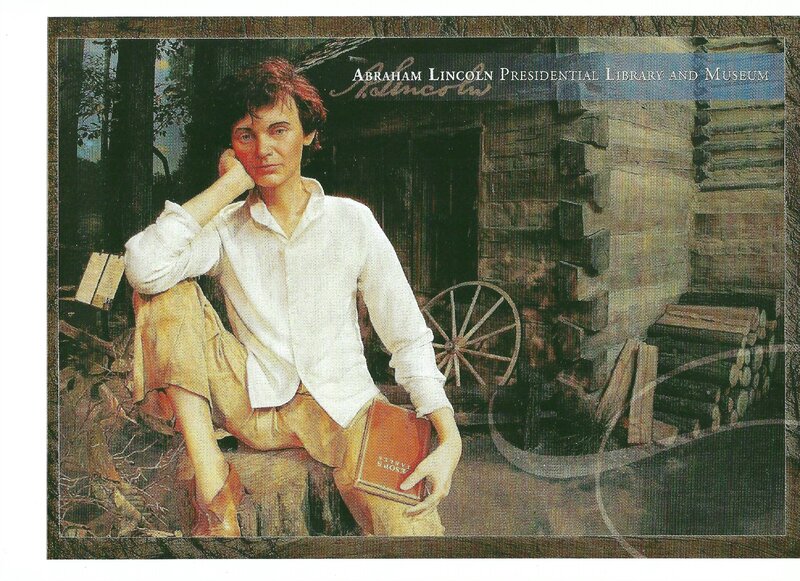
2000? Photograph of a section of an exhibit of Abraham Lincoln as a young man. Abraham Lincoln Presidential Library and Museum, Springfield, IL. 8.5” x 11”. Unknown source.
I was delighted when I first saw this picture that Abe is holding a copy of Aesop’s fables. Good for you, Abe! I will show below a view of the whole scene from which this portion is selected.
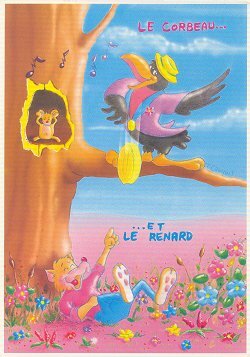
1996? Two cards in a series of Jean de la Fontaine's fables. TMCM and FC. Abeille-Cartes. Paris: Editions Lyna. Postmarked from Fresnes en Woevre, Meuse, in October of 1996 and from Presles, Val d'Oise, in June of 1997, respectively. €1.50 apiece from Gérard Crucy at the Paris Post Card Exhibit, Jan., '05.
The verso of these two postcards presents a number (2244/1 and 2244/2, respectively), a title, and a boxed version of La Fontaine's fable text at the upper left. The lively images on the picture side of the card are heavy on pastels, flowers, dressed animals, and block-letter titles. In FC the rapidly falling cheese leaves a visible trail; a mouse in an open portion of the tree trunk holds his ears against the crow's bad music, while the fox laughs below. In TMCM, the country mouse offers a cheese wrapped with a bow to his coverall-clad friend in a rustic hammock. Both pictures seem devoted to making their fables cute.
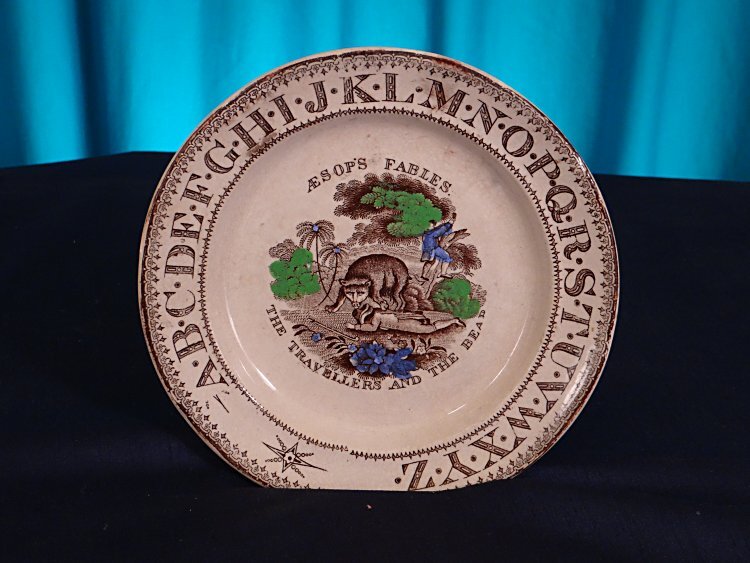
1880? One ABC plate 7¼" in diameter. Various patterns encircle the alphabet displayed on the plate's rim. On its inner circle in capitals are "Æsop's Fables" above and "The Travellers and the Bear" below a pleasing design of a bear sniffing at the head of man on the ground while his mate climbs a nearby tree. $42.50 from Fletcher Art and Antiques, Warren, Maine, through eBay, Oct., '10.
There are three areas of green leaves on trees and an area of blue flowers on the ground. The absentee friend climbing the tree is also colored blue. Is it surprising that neither the bear nor the prostrate man has color? The bear suffers from the regular problem of having a human face imposed onto an animal frame. The word "Bear" in the title is clipped in its last two letters.
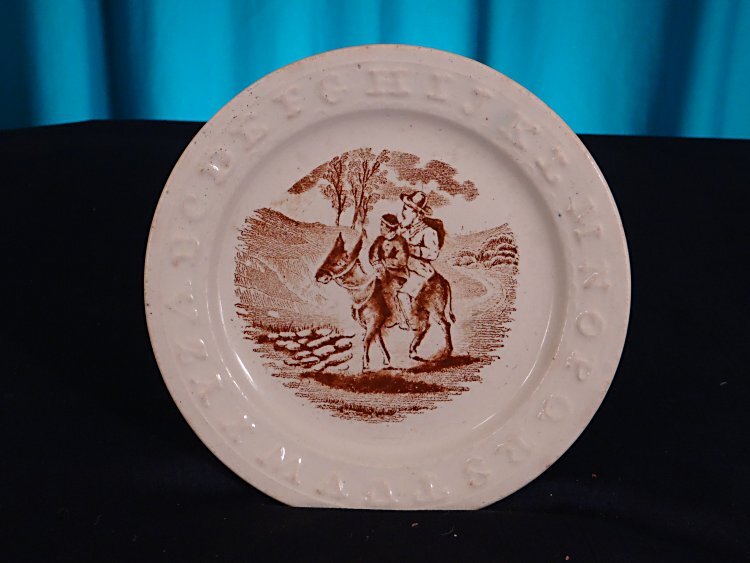
1900? One ABC plate 6¾" in diameter. The alphabet is embossed on the plate's rim. In its inner circle is a presentation of MSA in brown and white. A seal on the back of the plate is illegible except for its ending: "Sons, England." $55 from Sally Gilbert, Rochester, NY, through eBay, Sept., '02.
The plate presents the phase in this story in which both father and son ride on the ass. Clouds, trees, fields, rocks, and a path are visible. I am surprised that this motif would be taken up on a child's alphabet plate.
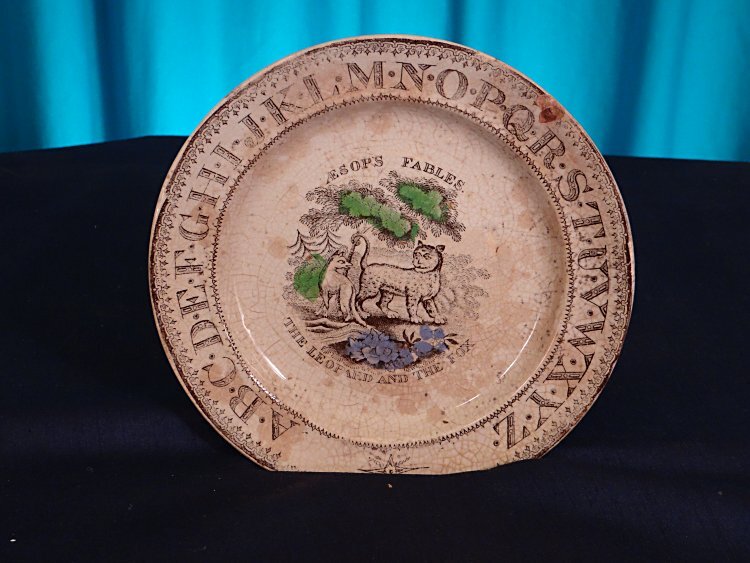
1880? One ABC plate 7⅜" in diameter. Various patterns encircle the alphabet displayed on the plate's rim. On its inner circle in capitals are "Æsop's Fables" above and "The Leopard and the Fox" below a simple design of a fox looking back at a leopard away from whom he walks. $15 from Robin Jorgensen, Greeley, Co, Sept., '10.
A curious feature of this ABC plate is that there are three areas of green leaves and an area of blue flowers, but otherwise there is no color. Neither animal has any color. The leopard suffers from the regular problem of having a human face imposed onto an animal frame.
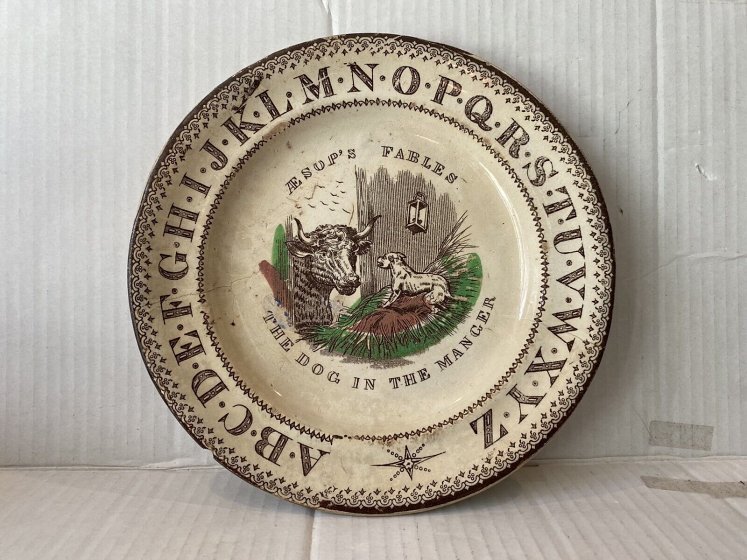
1880? One ABC plate 8" in diameter. Various patterns encircle the alphabet displayed on the plate's rim. On its inner circle in capitals are "Æsop's Fables" above and "The Dog in the Manger." $19.99 from stepback-n-thyme through Ebay, Oct., '22.
The plate features a strong design of a steer coming through a barn door and finding an aggressive dog ready to defend his place on the hay. Green and brown coloring. There may have been a trademark on the verso. If so, it has been almost all rubbed off. There is one clear crack and one small chip.
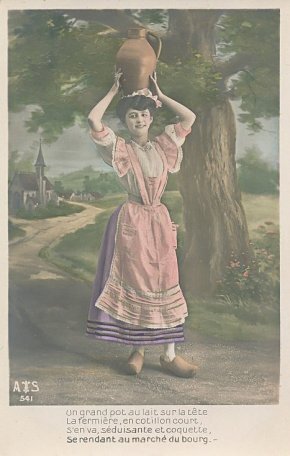
1910? Complete set of 5 colored photographic postcards of the story of Perrette and the pot of milk. A&S editions #541. $60 from Bertrand Cocq, Calonne Ricouart, France, Sept., '18.
This is an unusual set in that it takes its own tangent off of La Fontaine's famous fable. As I understand the text, Perrette – first named in the fourth of five cards -- a "fermière, séduisante et coquette," is on her way to market with a large pot of milk on her head. On the way she dreams of a "corsage" that will be paid for by the milk she will sell. Alas, a false step destroys her charming projects! Perrette is weeping when a young, good looking man comes up and consoles her. As they sit close together in his wheelbarrow, she hears her heart tremor and follows a new dream of happiness. The cards do a good job of highlighting her pink apron and his blue-and-white striped shirt.
1890? 3 cards with a picture side showing a small animal scene and a larger parallel human scene. Almost 3" x just over 4¼".
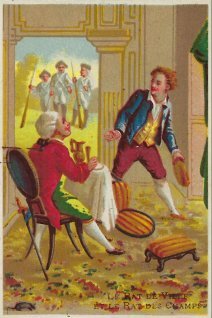
These are smaller-scale reproductions of four of the cards I have labeled as from Bouillon, Rivoyre et Cie. As there, the human scenes are provocative, as when a man of the road speaks with a well-dressed man in DW. One of the more suggestive fable cards I have seen is FC, in which a well dressed man is no doubt flattering a lovely shepherdess. I cannot construe what is happening in "Le Cheval & le Loup" beyond that a smirking young man is kicking a kneeling older man in the face. The verso of FC is blank. DW has "Aux Grand Marchés de Russie" on its picture side, and so it has advertising for the same firm on its verso. "Le Cheval & le Loup" advertises François Gianella in Dijon: "Spécialité de Chaussures in tous Genres." The printer of the latter card is A. Pitron, while L. Michel printed DW. Both are on the Boulevard des Italiens in Paris. "Le Cheval et le Loup" has been slightly cropped. TMCM has been cleverly transposed to the home of an aristocrat as he is about to be visited by armed soldiers.
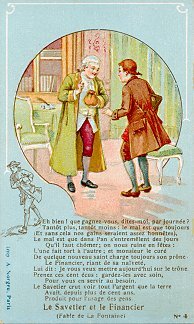
1890? 2 French cards of La Fontaine's fable "Le Savetier et le Financier." 2½" x slightly more than 4". Imp. A. Norgeu, Paris.
These small portrait-formatted cards seem identical with those from Chocolat Poulain Orange except for the omission of all advertising and the change of background color from green to blue. Thus there is near the top of the card a circular illustration in full color. Beneath that is a brown-on-blue design. Two elements finish the downward movement of the card: ten and fourteen lines of the fable, respectively, and, in the bottom right, the numbers 4 and 5. Note that I have numbers 3 and 6 from this set in the Chocolat Poulain Orange series. The illustrations show the cobbler receiving the money from the financier and digging a hole in his cellar. The backs of the cards are blank .