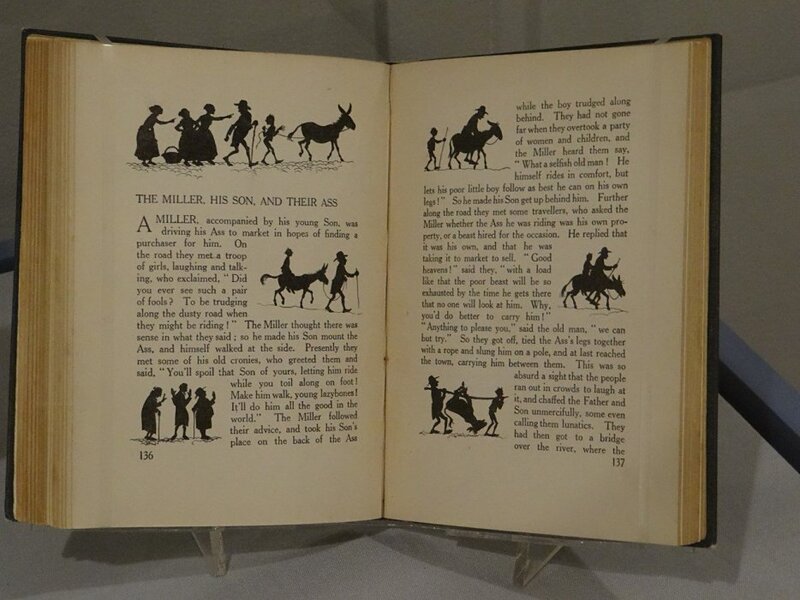
2022 "The North Wind and the Sun." Paired A5 art prints. $30.72 from Wodlingtown, Plymouth, UK, through Etsy, July, '22.
Wodlingtown advertises "Weirdo black and white illustrations for weirdo people." In this case, I think anyone who likes fables is a weirdo! This pair is well executed. The contrast of the two prints is stark and significant. I hope they do more fables!
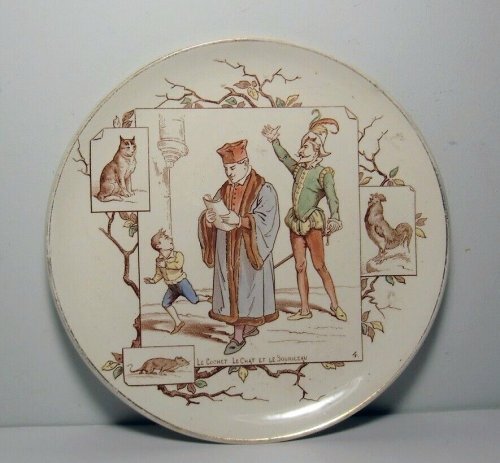
1900? Faience plate 8" in diameter showing two scenes depicting "The Mouse, Cat, and Rooster." Numbered "4." A mark on the back seems to combine the letters "M" and "C" and says "déposé Fables Terre de Fer." $17.50 from thegreenloft through Ebay, June, '22.
This plate features a central framed and colored illustration of human characters, with three monochrome frames around it presenting the three animal figures of the fable. Apparently, the naïve child runs from the loud soldier, who might protect him, and trusts the judge. The judge, it turns out, is a devouring cat.
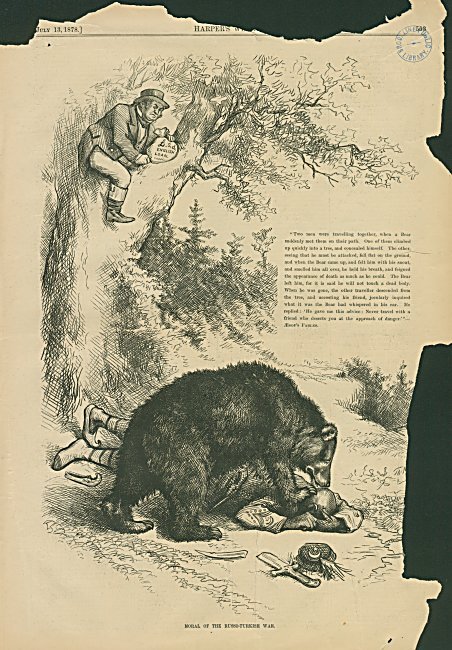
1878 “Moral of the Russo-Turkish War.” Full-page cartoon in Harper’s Weekly, July 13, 1878. Page 553. Unknown source.
Do I have my history right that the Ottoman gentlemen with a loan from Great Britain is avoiding danger and has left his Turkish ally to suffer at the hands of the Russian bear? For me, the upshot of this strong cartoon is: readers of Harper’s in 1878 knew this fable of “The Bear and the Two Travelers.” Life has changed since then!
1991 "The Mice's Thanksgiving." The Broadway Local Theater. American Radio Company. Garrison Keillor narrator. November, 1991. Recorded by Rev. Edward W. Bodnar, S.J. 10:15.
A great rendition of TMCM. The voices and vocal effects are excellent. Some great wit. An uptown express sewer carries the mice during TV commercials! The "Voice of Reason" and the "country mouse" are especially good characters. Keillor is a great narrator. "It's not the city but me, isn't it?" "You're the mousiest guy I ever knew." A trap gets Randy, and with a punishing pun Keillor has him buried in a mausoleum.
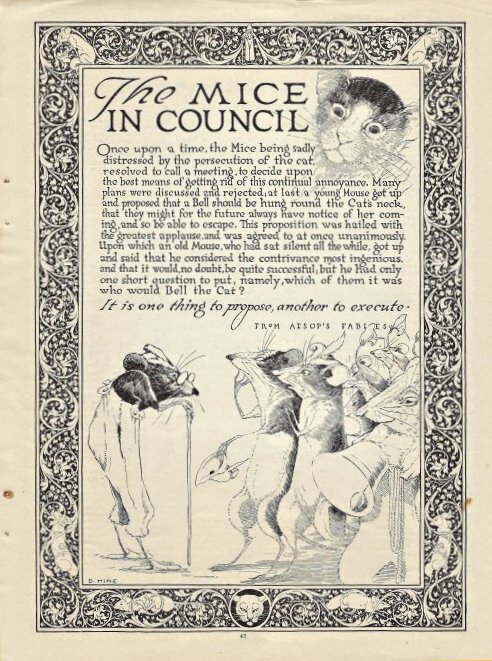
1920? BC. 8.5"x11" page (47) from an unknown magazine or encyclopedia presenting "The Mice in Council," illustrated by D. Hine.
An elaborate broad margin-design of cat and mice surrounds a title balanced by an image of the cat looking down, a half-page of text, and an image of one mouse wearing spectacles speaking to a group of mice, one of whom holds a bell. The text, including moral, seems lifted verbatim from James. The article on the back of the page gives women advice on how to test textiles.
1920? "The Grasshopper and the Ant" print. By A.B. Frost. 7” x 9.5”. $3.74 from Steven Moraweic, Oct., '03.
This print of GA shows the scene familiar from numerous French prints but offers, rather than a young woman artist and a mother, two Blacks, one warmly dressed and carrying food and drink, the other a musician asking for help.
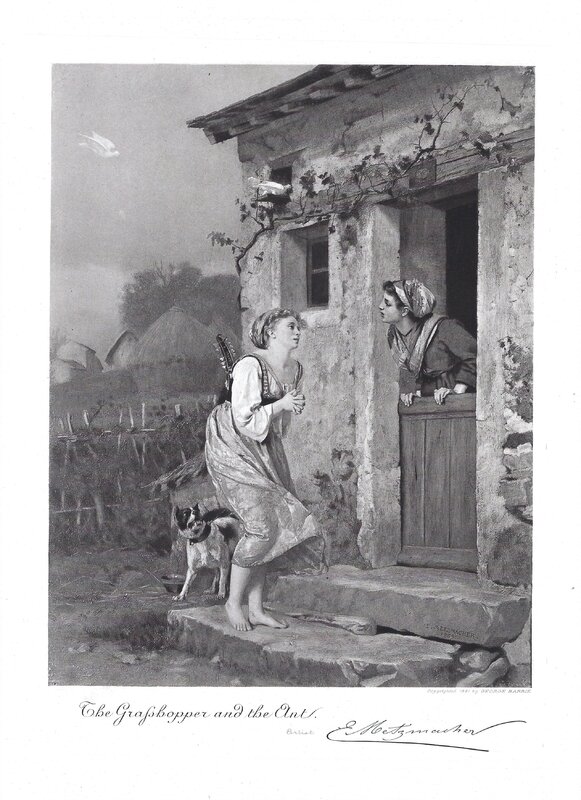
1881 "The Grasshopper and the Ant." Print of an original painting titled “The Grasshopper and the Ant” by E(mile Pierre) Metzmacher. Copyright 1881 by George Barrie. 9” x 12”. From martin2001@martin2001. Unknown cost and date.
This smaller version has differences from the larger copy below. The printer includes his name and date. The typeface and formatting for the title under the image are different. Though I found this at a different time and am cataloguing it at a different time, I still agree with the comments on the larger copy catalogued first.
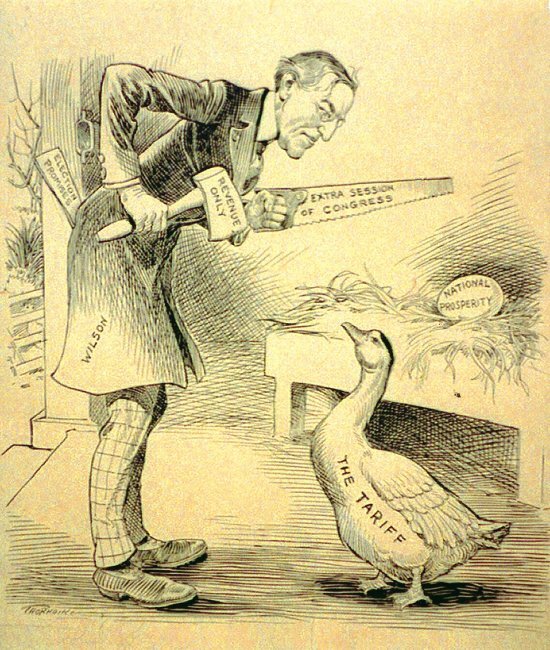
1917? "The goose that lays the golden egg." Political cartoon by R. Thorndike. Los Angeles Times. $10 from Old Photos Online through Ebay, May, '23.
Woodrow Wilson, armed with a saw, is jeopardizing continued national prosperity by attacking the tariff. Will he use his hammer to knock the goose cold or to smash the latest egg? In the meantime, his election promises are stuffed into his back pocket. Might this cartoon have appeared in the times at the time of either the 1913 or 1917 election?
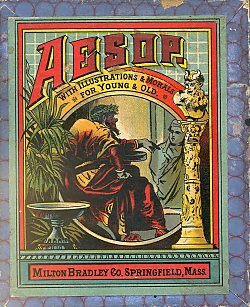
1940? "The Game of Aesop." Boxed as "Aesop" from Milton Bradley Company. Seventeen pairs of cards (text and illustration, respectively), lettered alike A through Q, and one odd card with a picture of Aesop. Springfield, MA: Milton Bradley Co.
These cards are identical in print and image with those from the Artcraft (?) "The Game of Aesop" with several modifications. Here the backing of each card is orange-brown, and the ink used for both text and image is brown. And this set comes in a beautiful, if very well used, box giving the game the simpler name "Aesop."