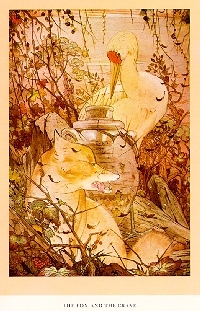
1909 "Le Renard et le Héron" from Detmold's Fables d'Esope (1909). Purchased as a gift by Deborah Ruck on January 14, 1990 from a stall on the bank of the Seine near Notre Dame, Paris. The print is an offprint, rather than a page taken from a book. Mounted and labelled.
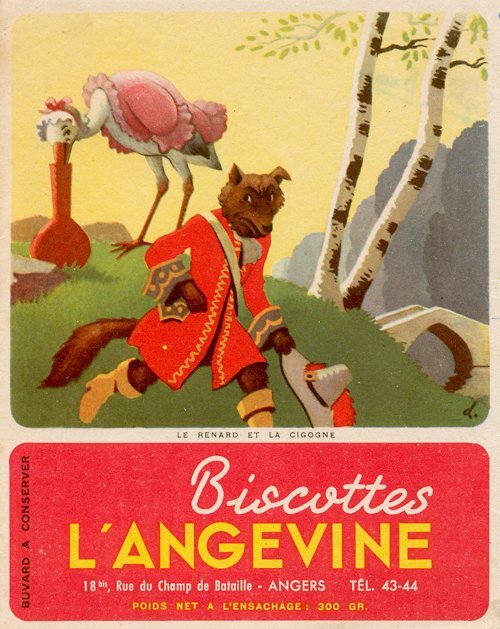
1950? "Le Renard et la Cigogne." Biscottes L'Angevine. Angers. 5¼" x 6¾". $5 from Mme Denise Debuigne, Rennes, France, May, '02.
The upper three quarters of this colorful blotter are a simple illustration. The fox dressed in courtly garb strides away disgruntled from the feminine stork with her beak in a vase. This blotter seems to have doubled as the label for the package, since the blotter gives a net weight at the time of their packaging.
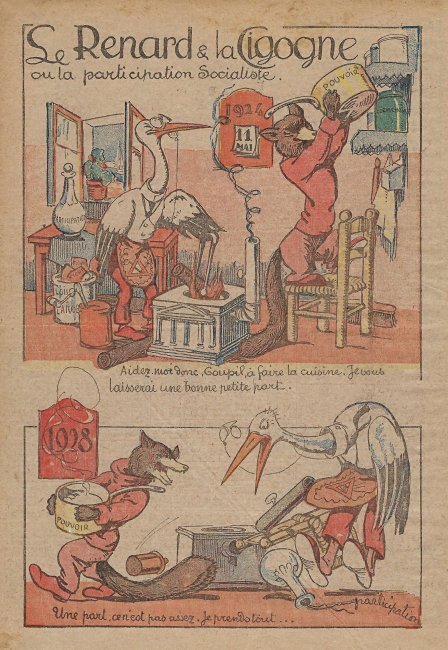
1927 "Le Renard & la Cigogne ou la participation Socialiste." Franc Maconnerie? Which journal unknown. $8.24 from LeGrand Ythier, Ouzouer sur Loire, France, through Ebay, July, '20.
From what I can see, this delightful duochrome cartoon presents 1924 – in fact, May 11, 1924 – as a promise of great cooking together between the fox and the stork. "Help me to make the meal, Goupil. I'll leave you a nice little part." I gather that is the voice of the fox Renard. The pot is labeled "power." Then in 1928, the fox makes off with the whole pot. "One part, that is not enough. I take it all." In the meantime, what comes dribbling out of the stork's famous vase is "participation." So "Socialist promises end up being totalitarian"?
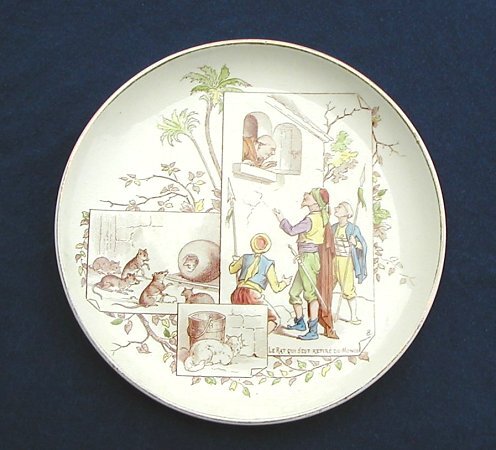
1900? Faience plate 8" in diameter showing three scenes depicting "Le Rat qui s'est Retiré du Monde." Numbered "8." A mark on the back seems to combine the letters "M" and "C" and says "déposé Fables Terre de Fer." $45 from Daria Edwards, NY, Feb., '00.
This sad story is of the religious hermit-rat who moves into a cheese to live and turns down his fellows when they, under attack, come asking for help (La Fontaine VII 3). He offers them a blessing and says that he, separated from such worldly concerns, will give nothing more. Here a colored panel shows three human soldiers appealing to a monk who leans out of his home's window as they appeal to him. The smaller monochrome panels show the animal scene, complete with its large ball of cheese, and also the enemy: the cat waiting at a hole for any rat who emerges.
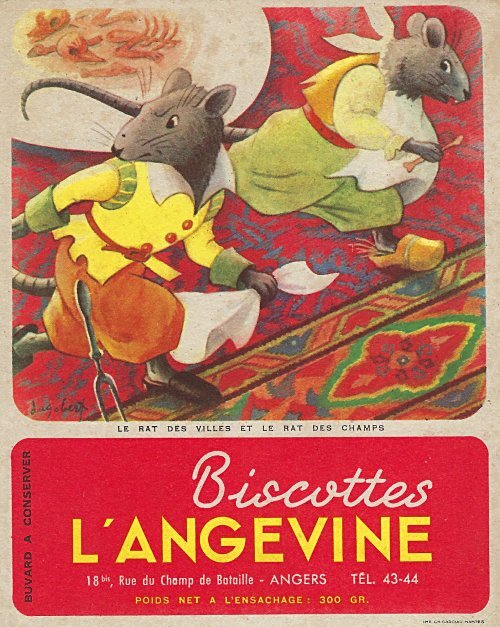
1950? "Le Rat des Villes et le Rat des Champs." Biscottes L'Angevine. Angers. 5¼" x 6¾". Artist: Dagobert. Printed in Nantes. €1 from French Vintage Shop, Paris, through eBay, Feb., '13.
This blotter is one of the best executed of the set. Both mice take off in a hurry. The country mouse in the upper right has simple garb and wooden shoes. The luxurious carpet is beautifully done. The title of this fable is usually given "Le Rat de Ville et le Rat des Champs."
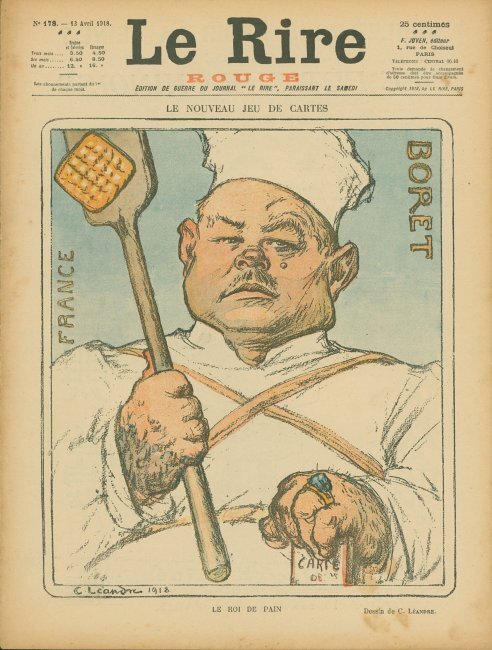
1918 "Le Nouveau Jeu de Cartes." Boret: Le Roi de Pain. Cover of Le Rire Rouge, Édition de Guerre. €10 at Clignancourt, July, '23.
I purchased this copy wondering if it was a parody on Florian's "Le Chateaux des Cartes." I doubt that now. But one never knows..... Boret was the Minister of Food Control in the late days of World War I. He is thus the "King of Bread."
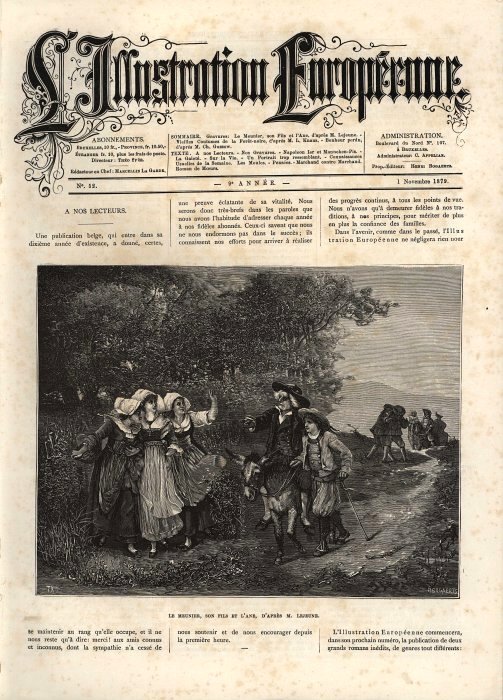
1879 "Le Meunier, son Fils et l'Ane, d'apres M. Lejeune." L'Illustration Europeenne, November 1, 1879. 9th year, Number 52. Front cover. 10¼" x 14".
This rendition of MSA seems very familiar. A group of women criticize the adult miller for making his son walk beside his mount. The son is here propped up with a stick. The following page quotes a 16th century version of the fable, concluding with "Ne nous en chaille, mais faisons toujours ce qui'il est bon de faire." The article then asks "Ne trouvez-vous pas cette conclusion superior a celle de La Fontaine?" La Fontaine's miller decides to please himself.
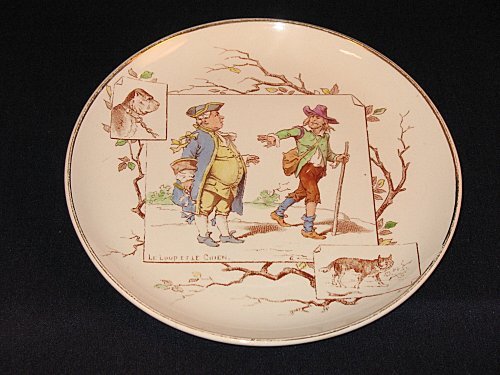
1900? Faience plate 8" in diameter showing three scenes depicting "Le Loup et le Chien." Numbered "6." A mark on the back seems to combine the letters "M" and "C" and says "déposé Fables Terre de Fer." $9.99 from Antiques Gallery, St. Cloud, MN, through eBay, Feb., '03.
The smaller pictures on the upper left and lower right picture the chained dog and the departing wolf, respectively. The central picture portrays a thin, poorly clad man with his stick and satchel taking his leave from a rotund man in a uniform of service. The latter carries a set of keys. La Fontaine's fable says that this wolf ran away and is running still!
1960? "Le loup et l'agneau." Dauré Apéritif Naturel. 5" x 7¾". $5 from Mme Denise Debuigne, Rennes, France, Feb., '02. Extra copy in only good condition from Dany Wolfs, Roeselare, Belgium, May, '01.
Red ink on a cream background. This fable builds on La Fontaine's WL. Here the wolf proclaims to the lamb as the latter scampers away: "You are lucky that I have not yet taken my Dauré this morning!" Is the point that water comes only after a Dauré aperitif opens the way for it?
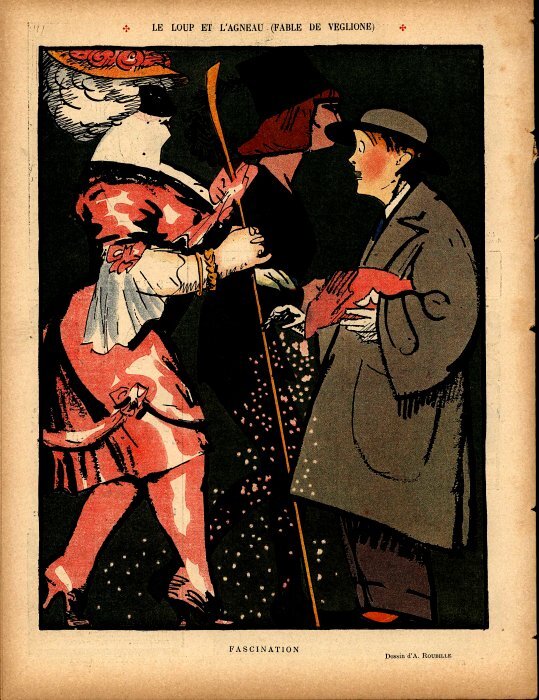
1911 "Le Loup et l'Agneau (Fable de Veglione): Fascination." A. Roubille. Le Rire No. 428, April 15, 1911. 9" x 12". €10 at Clignancourt, July, '19.
Is the wolf in pink about to devour the fascinated male lamb in gray?
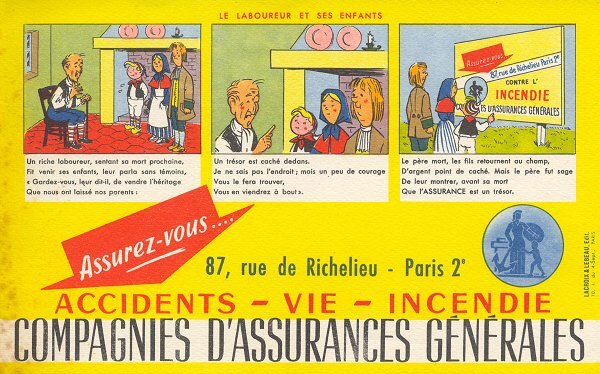
1955? "Le Laboureur et ses Enfants." Compagnies d'Assurances Générales, Paris. 8¼" x 5". Paris: LaCroix & LeBeau, Edit. $5 from Mme Denise Debuigne, Rennes, France, August, '02.
The story of "Le Laboureur et ses Enfants" is presented in full color in three quadrants across the top of this lively yellow blotter. The first two scenes quote La Fontaine and are true to his version. The third scene shows the children facing a billboard sign advertising insurance from Compagnies d'Assurances Générales. The father had been wise enough, the advertisement's text says, to show them that insurance is a treasure. The turning of the fable into an advertisement is clever enough.
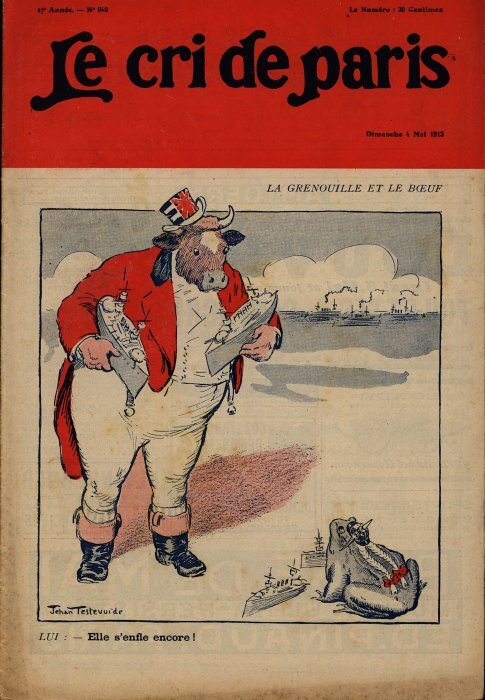
1913 "Le Grenouille et le Boeuf." Jehan Testevuide. Front cover. Le Cri de Paris No. 849, May 4, 1913. 8¼" x 11¾". €10 at Clignancourt, July, '19.
England holding its ships looks at the little frog and finds him blowing himself up with ships. Is England even giving ships to the frog? Is that the famed British fleet in the background? A little online research suggests that Testevuide did several covers for "Le Cri de Paris."
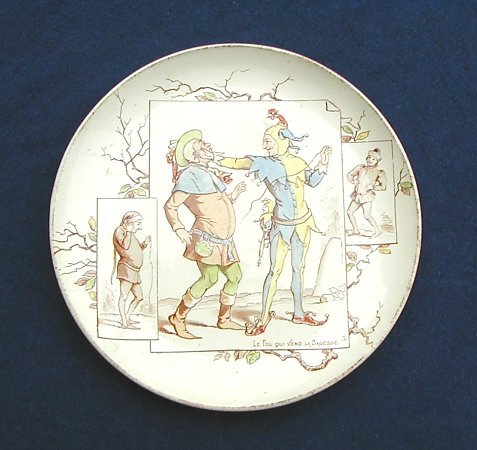
1900? Faience plate 8" in diameter showing three scenes depicting "Le Fou qui Vend la Sagesse." Numbered "3." A mark on the back seems to combine the letters "M" and "C" and says "déposé Fables Terre de Fer." $45 from Daria Edwards, NY, Feb., '00. Click on the image to see it enlarged.
The madman offers wisdom for a price, and gives those who pay a slap and a piece of thread two ells long. In this strange and wonderful story (La Fontaine IX 8), the first result is that we should not try to make sense of this act – or of anything else that fools say or do! The second result occurs in the story when one fellow, embarrassed by the blow and thread, goes to find a wise man, who tells him immediately that these things are symbols: "Stay this length of thread away from all madmen, or you'll get similar 'caresses.' You were not fooled; that madman does sell wisdom." The plate effectively presents both objects of trade, the slap and the thread. Monochrome characters in the panels at left and right are pondering the string and laughing, respectively.
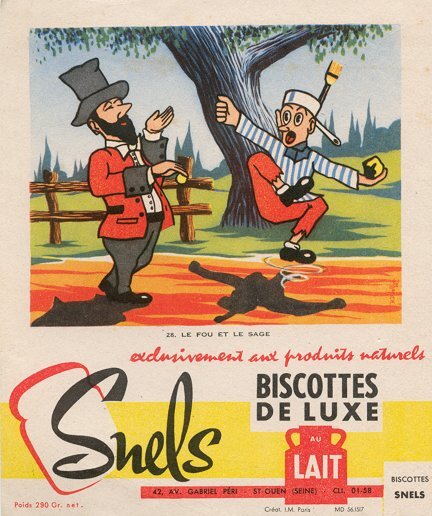
1958? "Le Fou et le Sage." #28 from Snels Biscottes de Luxe au Lait. 5¾" x 6¾". St. Ouen (Seine). Créat. I.M., Paris. $5 from Mme Denise Debuigne, Rennes, France, May, '02.
A large colored cartoon dominates this blotter. La Fontaine XII 2 is, in Spector's edition, "Un Fou et un Sage," whereas this blotter has "Le Fou et le Sage." This is clearly the fable, a replay of Aesop's rewarding the fool who threw a stone at him and then encouraging him to throw one at a richer man for a bigger reward. Here the well-dressed man has, I gather, a coin in his hand, while the fool has a large rock that he is ready to hurl. The latter is marked as a fool, I think, by the cooking pan he wears for a hat.
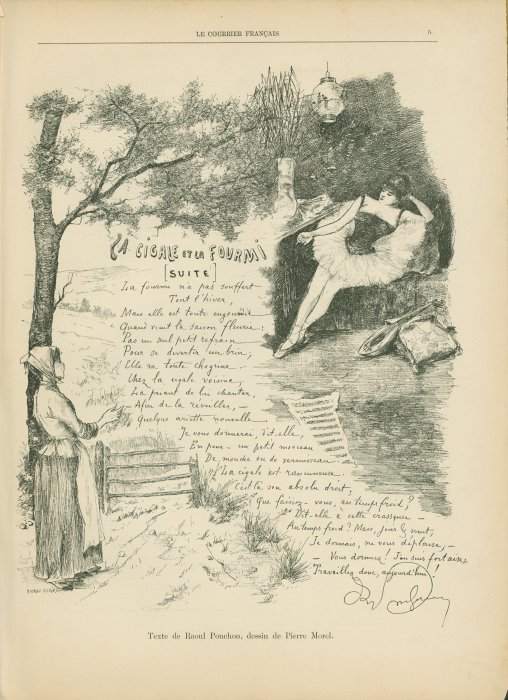
1886 "Le Courrier Français," July 25, 1886: La Cigale et la Fourmi (Suite). $10 from journauxanciens through Ebay, Feb., '24.
In a text by Raoul Ponchon with an illustration by Pierre Morel, the situation is now at the end of winter and the beginning of spring. The ant comes to the Cicada to offer to pay for a song. The cicada, rightfully resentful, asks what the ant did all winter. "I slept!" The cicada answers "Then work now!" Page 5 of the 8-page magazine, 11½" x 15¼". The cover cartoon has a more obscure reference to FK.
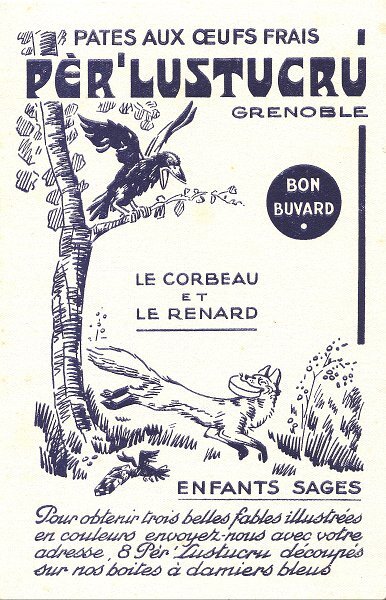
1965? "Le Corbeau et le Renard" blue and white blotter. "Bon Buvard." 5¼" x 8¼". Pates aux Oeufs Frais Pèr' Lustucru. Grenoble. Paris: E.G.F.P. $5 from Mme Denise Debuigne, Rennes, France, May, '03.
The blotter shows the fox running away with a large cheese in his mouth. The text on this blotter is a further advertisement: "Enfants Sages. Pour obtenir trios belles fables illustreés en couleurs envoyez-nous avec votre adresse, 8 Pèr' Lustucru découpés sur nos boites à damiers bleus."
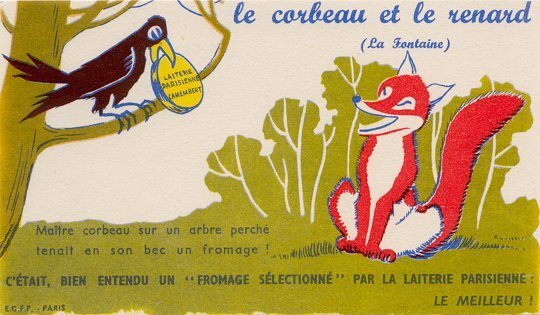
1965? "le corbeau et le renard" (La Fontaine)" colored blotter. 7¼" x 4¼". La Laiterie Parisienne. Paris: E.G.F.P. $5 from Mme Denise Debuigne, Rennes, France, May, '02.
The blotter quotes the first two lines of La Fontaine's fable: "Master Crow perched on a tree held in his beak a cheese" and then adds "It was, of course, a 'Fromage Sélectionné' from The Parisienne Dairy. The best!" The illustration in green, brown, yellow, and orange is striking.
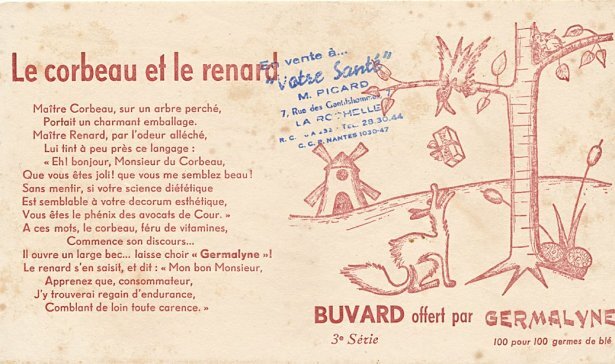
1960? "Le corbeau et le renard." Buvard offert par Germalyne. 5" x 8½". 3e Série. $6 from Bertrand Cocq, Calonne Ricouart, France, Sept., '18.
Red ink on a cream background. This blotter, like the does not just present a La Fontaine fable. It builds on the fable of FC to offer a new point. The crow is carrying not a "fromage" but an "emballage." The fox speaks not of the crow's possible singing voice but about his "science diététique." The crow lets his package of Germalyne fall, and the fox knows that it will help make up whatever he might be lacking in endurance. This advertisement also announces "100 pour 100 germes de blé."
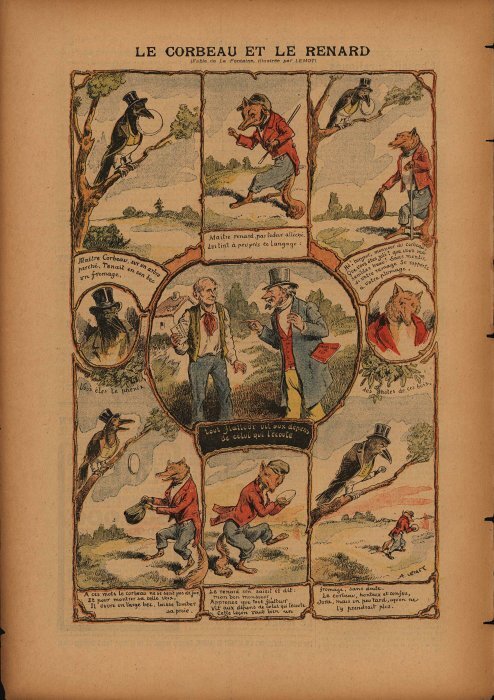
1906 "Le Corbeau et le Renard." (Achille) Lemot. La Croix Illustree. 7th year, No. 312. December 16, 1906. Back cover. 10" x 14".
This large illustration tells the fable, with La Fontaine's verse, through three top and three bottom cartoon panels. At the center, flanked by the fable's two animals, are two men. The fox on the right is perhaps cajoling the rustic to vote as the fox wants. This human fox has in his pocket the book "Profession of Faith: Citizens." The rustic holds a flier "Bulletin de Vote."
1906 "Le Corbeau et le Renard." A(chille) Lemot. La Croix Illustrée 7th year, No 312, December 16, 1906. 10" x 14". €10 at Clignancourt, July, '19.
Three panels at top and three at bottom present La Fontaine's fable, complete with his verses. In the center, flanked by the two animals, is a panel of two humans. Is that a fox on the right wheedling a vote out of an unsuspecting rustic on the left?
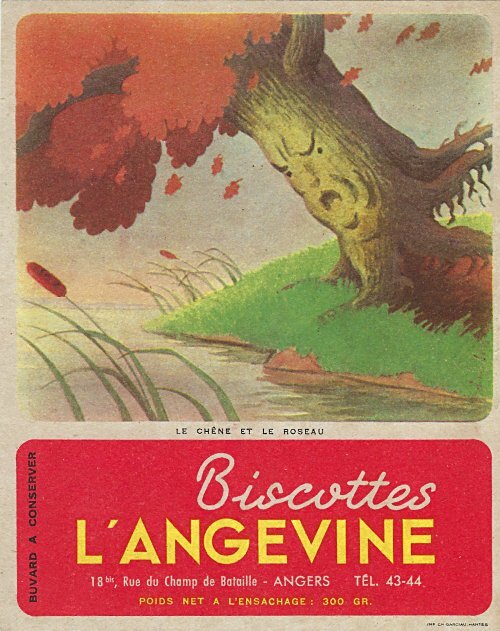
1950? "Le Chêne et le Roseau." Biscottes L'Angevine. Angers. 5¼" x 6¾". Printed in Nantes. €1 from French Vintage Shop, Paris, through eBay, Feb., '13.
Just the oak is personified in this blotter, which is less sharply done than others in the set. The oak looks down angry and surprised at his uprooting. Two different sets of reeds bend with the wind.
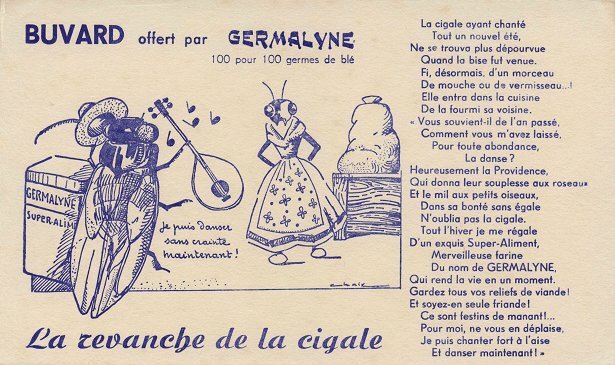
1950? "La revanche de la cigale." Buvard offert par Germalyne. 5" x 8½". $5 from Mme Denise Debuigne, Rennes, France, Feb., '02.Three extra copies, one rendered in green, from Denise Debuigne, Rennes, France, August, '07.
Blue ink on a cream background. This blotter does not just present a La Fontaine fable. It builds on the fable of GA to offer a new point. This cicada comes back one year later and gets her revenge. She claims now, in verse, to be ready for the tough winter--because she has Germalyne food supplement! "Now I can dance without fear!" she proclaims. The advertisement announces "100 pour 100 germes de blé." Might that mean that each of a one hundred pills contains the equivalent of one hundred grains of wheat?