A Year At Georgetown
By now, I had held a variety of academic and Jesuit administrative positions, and the direction of my future work as a Jesuit priest at age 50 was open to several avenues: academic administration, academic teaching, and administration within the Jesuit order. Georgetown University was a partner in some of the conversations led in 1991-92 to Georgetown inviting me to occupy the "Jesuit Chair," a position reserved for a visiting Jesuit to teach courses fo rone year and to give a major public lecture.
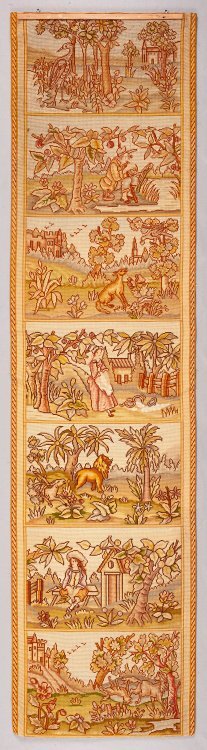
I visited New Orleans several times in the 80's and 90's. There I visited, among other antique stores, Wirthmore Antiques, specializing in French antiques. I noticed a tapestry, about 18 inches across and perhaps ten feet long, made up of presentations of La Fontaine's fables. I asked the owner, Gay Wirth, if she knew that these were fables of La Fontaine, and I identified the fables pictured there. Were the tapestries, I asked, for sale? "No," she answered. "They are, for now, part of our décor. But I will be happy to get in touch with you when we change the décor." I was happy to look forward to that day!
Several years later, I was back and pointed to the tapestry. Ms. Wirth replied that it was "being saved for a priest from Chicago." In a happy interchange, I let her know that I was that priest and that I was from Omaha. Time went on, and I heard nothing. Then, in 2018, I happened to be visiting the same old friend who had suggested that I make a list of my fable books. In the midst of our enjoyable visit, I wondered whatever had happened to Wirthmore Antiques. It turned out that they were still in business but had moved. I called, and Ms. Wirth was delighted that I did. "Oh, Father, we had lost your name. We still have the tapestry. Could you come tomorrow?" I came, and she laid out that beautiful tapestry that I had loved at first sight. As I was about to ask its price, she volunteered that she had checked out the fable collection the night before on the web and wanted to give us the tapestry! What a great gift! On the train ride home, when I went to visit the dining car, I carried the tapestry, nicely bundled at the antique store, on my shoulder. I would not let it out of my sight.
The Jesuit Community supported this position generously, including the costs of producing a new printed catalogue for the occasion and throwing a large party for the public lecture. The event arrangers, to my surprise, insisted that my lecture be a full hour long. This was a great opportunity to put together all sorts of investigations into fables and to present, with the help of Georgetown's excellent professional media team, a worthy slide lecture to a large gathering. Georgetown gave the collection one more "boost." The Classics Department invited me to teach a course on fables! What a delight! That course would be the first of many.
Collector's Comment: I am first of all a priest and, secondly, a teacher. Fable collecting touches particularly on the teacher in me. My experience at a Jesuit high school helped shape both the priest and the teacher, the latter particularly in its debate and public-speaking extracurriculars. From the earliest days of engaging fables, I have dreamed of being a speaker who could give people something wholesome and worthy of reflection by telling them good stories. The Georgetown year allowed me to give serious time, effort, and resources to collecting fables and teaching about them. Those efforts have resulted in many courses and many speaking engagements since. Collectors face the question "Why am I collecting these things?" As a collector, my first answer would be " Because they are so fascinating!" And a further answer? Others might develop collections in hopes that others would vistit and enjoy them. I have thought more of engaging people with good stories. From formal scholarly presentations to informal storytelling in student dormitories or parish halls, wherever I have gone, I have enjoyed engaging people with fables! And I am delighted that people of all sorts have asked me to do just that. From student residence halls to Puget Sound University to a high school in Heidelberg to an Omaha Dentists' Club (more formally the "St. Apollonia Guild"), I have enjoyed engaging people in stories like those which Aesop once told. When I teach a course these days on the gospels, I start with an Aesopic fable, to help students see the many ways a fable - specifically "The Grasshopper and the Ant" - can be told and viewed. So it is with the gospels. We need to attend to context, shape of narrative, and the story's focus.
A year at Georgetown in Washington, D.C., also brought the opportunity to get to know the many neighborhood used bookshops around the area. My collecting has happened to coincide with the last days of many of these stores. I miss them! I met many veteran used book sellers who treasured books and sought them out for customers. Changing economic circumstances and the growth of the online market have made life hard or impossible for these many dealers that I came to know in Washington and various places around the world. I mention one in particular in a sidebar on a strange episode of "a lost book."
Insert scan of "The Fox and the Rooster."
Being in a metropolitan center like Washington also brought me to wonderful used book fairs in Silver Spring and Baltimore. What a treat! I found one of my first big finds at the Silver Spring fair. I had read in Anne Stevenson Hobbs' Aesop of the Japanese edition done by Pierre Barboutau in 1894. Bartleby's Books from DC has the two volumes at the Silver Spring fair. The price was beyond my normal means but I pleaded with the seller not to sell while I managed to put together the money to buy them. I travelled to their shop several days later with the money in my hot little hand. What an exciting experience!
At the same fair, I found a first edition of Gustave Doré's splendid and massive edition of La Fontaine's fables, typically dark, as Doré is. The volume had just been rebound by loving bibliophiles at Blue Mountain Books in Catskill, NY. My experience is that booksellers are happy to sell their books - and even to lower prices - to those who will make the books accessible to others. They give me and this collection a "break," and I appreciate it!