Calendars
I have found various calendars and sets of calendars.
-
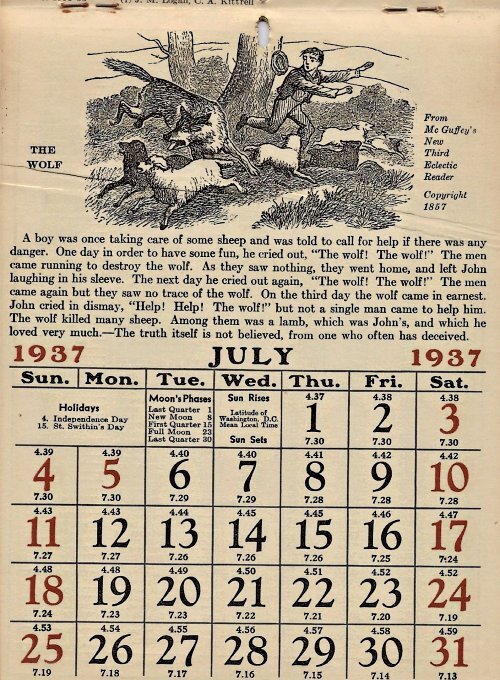 Untitled calendar, 19371937 Untitled calendar. McGuffey's Eclectic Reader. 4.7" x 6.4". There is one fable here, from McGuffey's "New Third Eclectic Reader" of 1857, namely BW. The stories and illustrations are all from McGuffey. A curious thing about this kind of calendar is the material that is put on the verso of the calendar pages: postal rates; eclipses; legal holidays; governments of the world and their heads -- and on and on the surprising list goes. I wonder how I ever found this calendar!
-
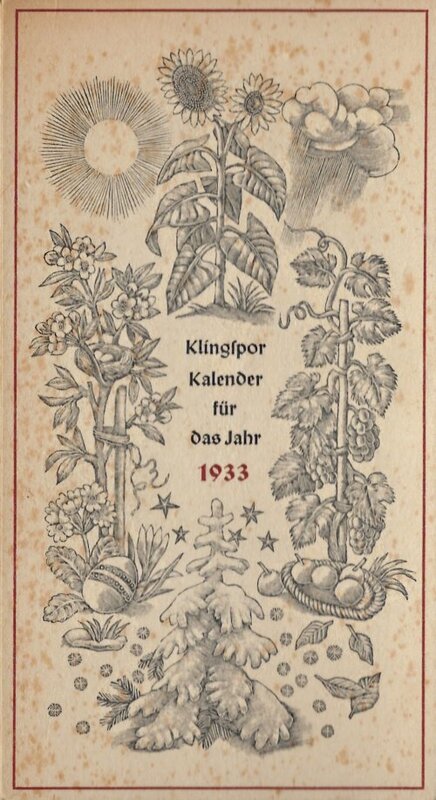 Klingspor Kalendar 19331933 Ein Kalender für das Jahr 1933. Mit Fabeln nach Aesop und Anderen (Cover: Klingspor Kalendar für das Jahr 1933). Gedruckt und herausgegeben von Gebr. Klingspor. Holzstiche von Willi Harwerth. Hardbound. Offenbach am Main. This is one of the happiest finds of my twenty-five years of collecting. I first knew of this book from Anne Stevenson Hobbs' book on books in the Victoria and Albert Museum. I had it in my hands when I visited the museum. I presumed that I would never have a chance at finding a copy for the collection. Germany after 1933 was not a good place for preserving ephemera like a calendar. I was amazed when the book came up on eBay and more amazed when no one bid against me! This hardbound book about 4" x 7" begins with a page for each month (2-13). Each page has a bird illustration at the top appropriate to the season. What follows is the liturgical calendar of saints and Sundays, with the Sundays printed in red, and phases of the moon noted. There follow then nineteen pages of fables, about one to a page, each with an illustration (14-32). Hobbs chooses well when she selects the woodcuts of "Der schöpfende Hirsch" (16) and "Der Fuchs und die Schwalbe" (23) for her book. They are exquisite. Her version of the former is colored, while none of the woodcuts here are colored. FC (18) and FK (26) are presented with figures situated at the top and bottom of the page, respectively, with text in between. BF (22) is another excellent woodcut. The woodcut for "Der Bauch und die Glieder" (29) is appropriately macabre. What a treasure! Formerly in the collection of Carl and Margaret Rollins.
-
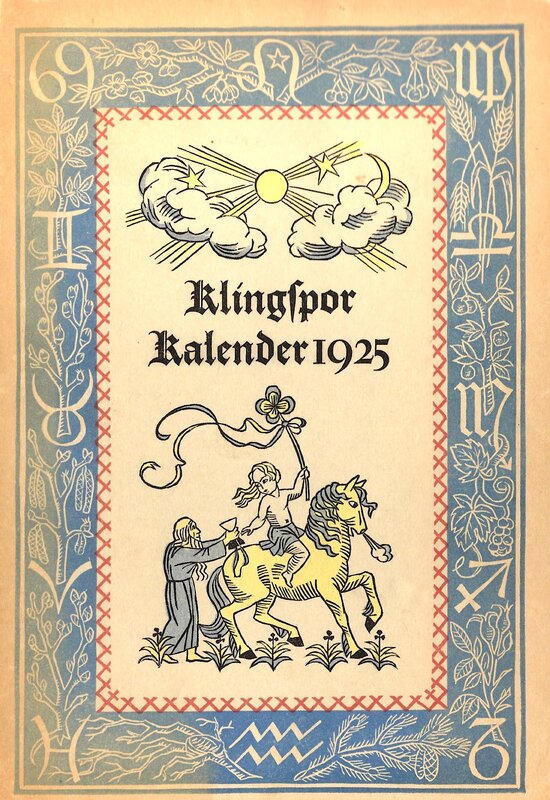 Klingspor Kalendar 19251925 Kalender für das Jahr 1925 (Cover: Klingspor Kalender 1925). Gedruckt und herausgegeben von Gebr. Klingspor. Holzstiche von Willi Harwerth. Hardbound. Offenbach am Main: Gedruckt und herausgegeben von Gebr. Klingspor. €12 from Antiquariaat Engel, Stuttgart, August, '09. This book represents one of the best finds of an extended stay in Europe. During a one-day trip to Stuttgart, Ursula Kuhn and I headed for the bookshops on Alexanderstrasse. I soon recognized the territory and remembered Antiquariaat Engel and its place above a store for new books. No one was there to help. I found little, and checked "Neue Eingänge" before I left, knowing that chances of finding something were very small. Out popped this Klingspor Kalender. I recognized it immediately because of the 1933 calendar featured in Anne Hobbs' Fables, a calendar I found by luck on eBay five years ago. This hardbound book is slightly larger than the 1933 edition, about 5½" x7¾." It begins with poems on the four seasons and then offers a page for each month. Each month has an astronomical sign at the top. Each month features four or five small figures representing saints or feasts. Do not miss Salome on October 24th! The Sundays are printed in red, and phases of the moon noted. There follow then two pages of fables: Lessing's "Der Besitzer des Bogens," Ernst's "Eine harmlose Geschichte," and Luther's "Gewalt" or LS. Then come seven verse selections, all either fables or very close to fables. The first is Pfeffel's good story of the grainfield where only one stalk raises its head. That is the stalk without fruit; all the others are bowed down by their good fruit. One of the seven, of anonymous authorship, is even titled "Eine Fabel." When King Lion locks up the bear who had censored people's writing, he found that making everyone into writers only produced confusion. "Let the bear go free!" The images are exquisite. Here they are all colored, by contrast with the copy I have from 1933. What a find! Formerly in the possession of Joachim Butterling.
-
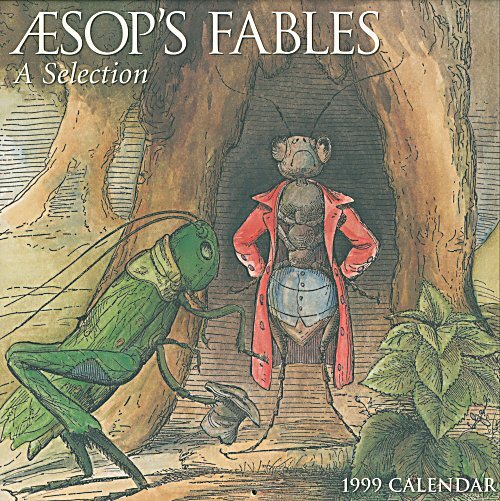 Aesop's Fables 1999 Calendar1998 Aesop's Fables 1999 Calendar. Arthur Rackham, Milo Winter, Charles Folkard, and Charles Henry Bennet (sic: Bennett). Printed in Hong Kong. NY: Dorset Press. Gift of Margaret Carlson Lytton, Nov., '98. Extra copies a gift of Julie Stringer, Feb., '99 and for $5.98 from Barnes and Noble, Milwaukee, Dec., '98. Each month presents a full-page picture. The page hanging below it includes within the grid of the month's days a title, moral, attribution of the picture, and text of the fable. The selections are, in order: "Venus and the Cat" (Rackham), "Jupiter, the Lion, and the Elephant" (Rackham), "The Cat, the Rooster, and the Young Mouse" (Winter), "The Fox and the Monkey" (Folkard), "TH" (Folkard), OF--but without any mention of an ox!--(Folkard), GA (Bennet[sic: Bennett]), LM (Winter), "The Owl and the Grasshopper" (Folkard), "The Satyr and the Man" (Folkard), "The Trees and the Axe" (Rackham), and TMCM (Folkard). All twelve illustrations are arranged on the back cover.
-
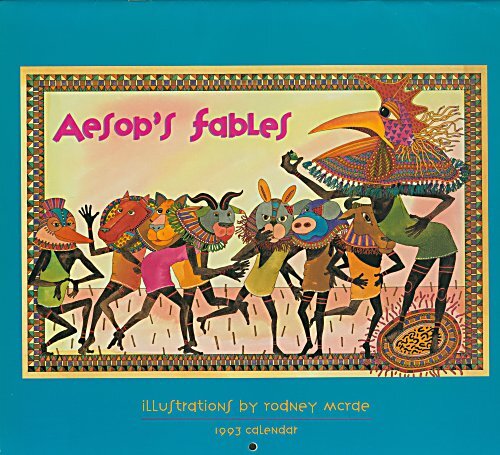 Aesop's Fables: 1993 Calendar1993 Aesop's Fables: 1993 Calendar. Illustrations by Rodney McRae. Printed in Korea. Petaluma, CA: Pomegranate Calendars & Books. Gift of Roseanne FitzGerald, Dec., '92. Extra copy gift of Mary Keane, Feb., '93. What a great find! The calendar is based on the book Aesop's Fables by McRae, first published in Australia in 1990. The twelve fable illustrations, conveniently brought together on the back cover, are lively and colorful. The back cover's blurb is right to speak of McRae's folk-art style as exciting. It is! Part of the excitement is that there are really many folk-art styles here. I enjoy particularly April's Mycenean "The Heifer and the Ox" and August's "The Farmer and the Fox" from Africa.
-
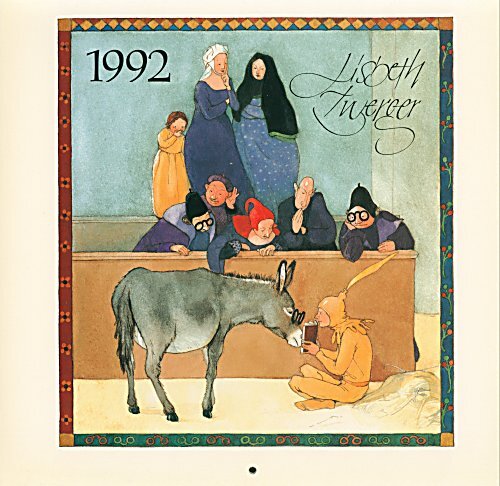 1992 Lisbeth Zwerger Calendar1992 1992 Lisbeth Zwerger Calendar. Saxonville, MA: Picture Book Studio. Printed in Italy. Salzburg: ©1991 Neugebauer Press. Chronological survey of Zwerger's work, including FG from Aesop's Fables (1989) as the September illustration.
-
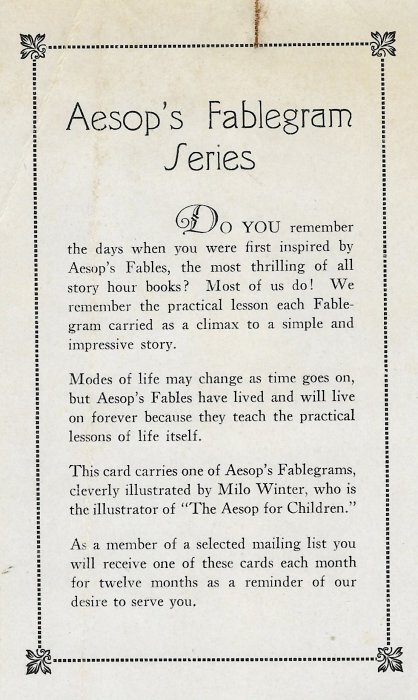 (Aesop's) Fablegram Series1929 (Aesop's) Fablegram Series. Twelve monthly calendars for 1930 featuring maxims and Milo Winter illustrations. 4¾" x 10". St. Paul, MN, and Sault Ste. Marie, Ontario: Brown & Bigelow. $100 from bisboutique on Ebay, May, '24. These are colorful presentations of animal scenes with aphorisms drawn from or like those of Aesop. The illustrations are true Milo Winter, often quite cute and often presenting a fable in different characters and circumstances from the usual. Brown and Bigelow styles themselves as "Specialists in Direct Mail Advertising." Aesop is acknowledged in this set only on the introduction card. One wonders if the card belonged to a different series. Might there have been a first series of Aesop's Fablegrams that was followed by a series of "clever animal scenes with pithy sayings."
-
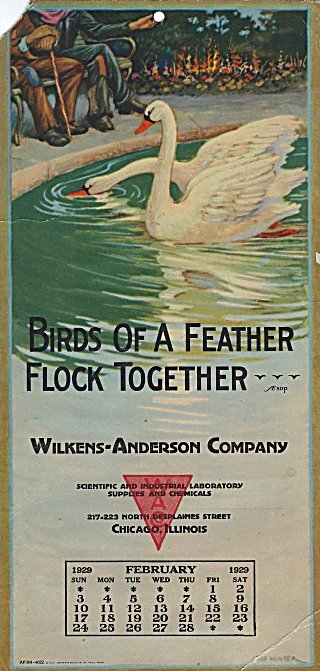 February, 1929 calendar1928? February, 1929 calendar with a maxim from Aesop and a Milo Winter illustration. Advertisement for Wilkens-Anderson Company, Chicago, IL. 4¾" x 10". St. Paul, MN, and Sault Ste. Marie, Ontario: Brown & Bigelow. $7 from Sandyscottage through Ebay, Jan., '25. I am particularly happy to add this calendar to the collection since it repeats one already in the collection as February for the year before! The conclusion seems to be that Brown & Bigelow had designs ready to go that were not tied to a specific year. Fascinating! As is true generally for the Brown & Bigelow series, it is not clear, to me at least, which fable is presented or alluded to here.
-
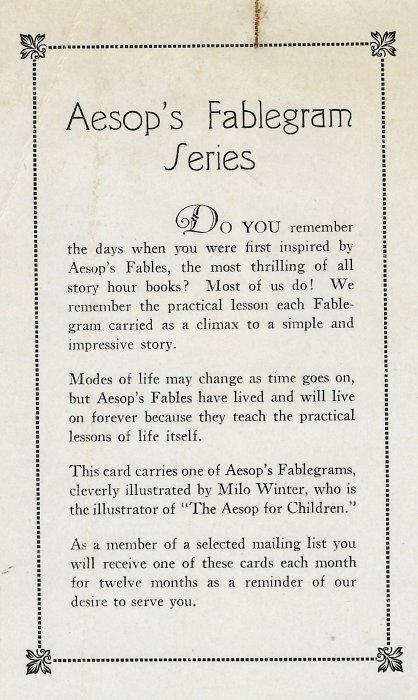 Aesop's Fablegram Series1927? Aesop's Fablegram Series. Twelve monthly calendars for 1928 featuring maxims from Aesop's fables and Milo Winter illustrations. 4¾" x 10". St. Paul, MN, and Sault Ste. Marie, Ontario: Brown & Bigelow. $100 from bisboutique on Ebay, May, '24. These are colorful presentations of animal scenes with aphorisms attributed to Aesop. The illustrations are true Milo Winter, regularly charming. Sometimes a fable's original scene and characters appear, as in WL (March) TH (November). Others create scenes to illustrate standard Aesopic morals, as when September features a straw held before a cart-pulling donkey with "Gentle persuasion is better than blows," more normally associated with WS. Here twelve different advertisers are featured as examples of Brown and Bigelow's work. Each calendar has a hole at its center top. Though the introductory slip came with the 1930 group, I also place it here, since it seems to refer more directly to this group.
-
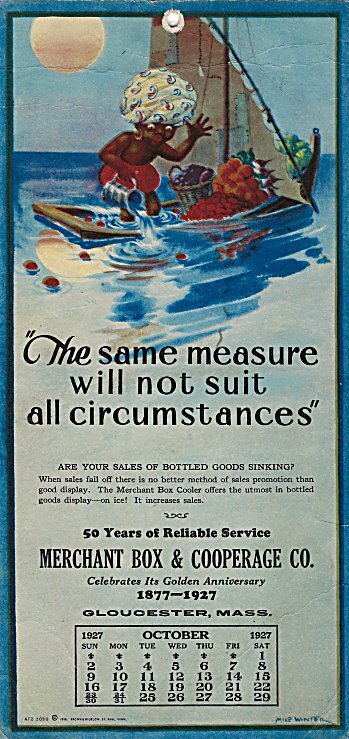 Merchant Box and Cooperage Company of Gloucester, MA1927 Merchant Box and Cooperage Company of Gloucester, MA. Brown and Bigelow calendar for October, 1927 with illustration by Milo Winter. $16.99 from The Jumping Frog through Ebay, Jan., '25. The formatting and approach of this blotter is remarkably similar -- and by the same artist -- as our various calendars designed by Winter and printed by Brown and Bigelow. The design has a boat operator emptying water out of his boat. After the highlighted maxim, the calendar asks "Are your sales of bottled goods sinking?" I have trouble identifying a known image or story.
-
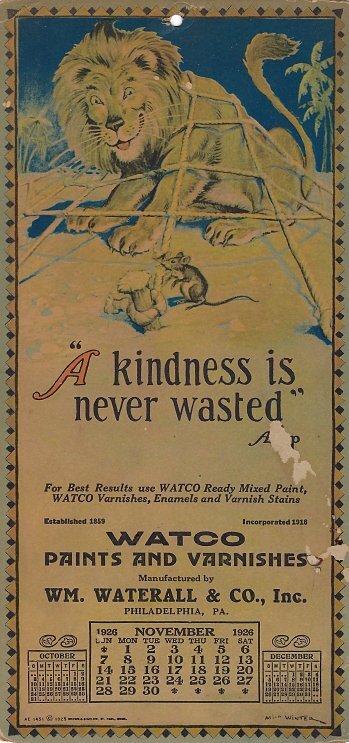 Watco Paints and Varnishes1926-27 Watco Paints and Varnishes. Five calendars from November, 1926 through December 1927 quoting Aesop. Designed by Milo Winter. $60 from snydersjunkyard, Pennsburg, PA, through Ebay, Dec., ’24. These five calendars are well weathered. One is missing its lower right corner. Those in this group raise the question “What constitutes a series for these calendars?” I ask the question because these five span 14 months from November, 1926 to December, 1927 (with January, May, and October as the other months here). It is easy to recognize LM as a fable in the first of these. In the others, the scene itself suggests a fable, not necessarily among the traditional Aesopic stories. The fox on January is hiding a chicken under his coat. The rabbit on October is doing something, while the roosters only crows. The hunter on December is coming home with lots of ducks. Are May’s beavers simply “eager beavers”?
-
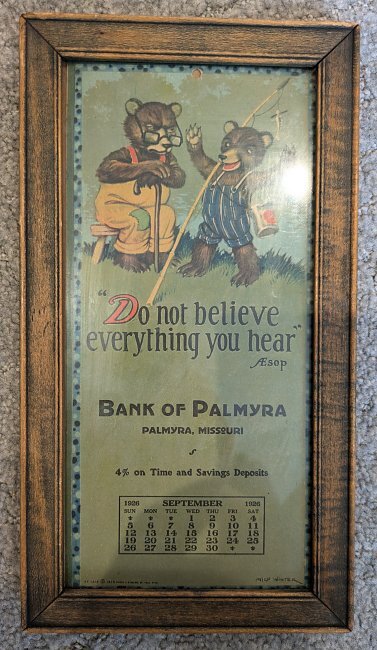 Bank of Palmyra, Palmyra, Missouri1926 Bank of Palmyra, Palmyra, Missouri. Milo Winter. 6" x 11". Calendar for September, 1926. Framed behind glass. Gift of Susan Carlson, Dec., '24. This great find by Susan relates to the calendar above. They are in the same style. They quote Aesop similarly, with two of the same resulting questions, whether the attribution to Aesop is warranted and what fable it might have come from. A third question above is answered in this case. The bear cub is lying about how big the fish was that he almost caught. Of course I am now determined to find the other ten in the series? And does this find indicate that there was also a set in 1927?