Card Games
Card games include not only standard playing cards of various sorts but also the traditional French game of "Families" (close to what we know as "Go Fish"), a special "Aesop Game," a La Fontaine game, and several other card games. Play away!
-
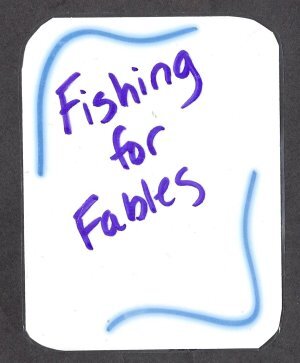 "Fishing for Fables."2010? "Fishing for Fables." Card game after the pattern of "Go-Fish." 13 quartets of identical fables. 3½" x 4½". Anonymous student creative work. Three features impress me with this student's work. First, it's a great idea. Secondly, the cards are well made. Thirdly, the designs for the individual cards are well chosen. They seem to be stickers applied to card stock before it was encased in double layers of covering. Three samples and the universal verso are pictured above.
 -
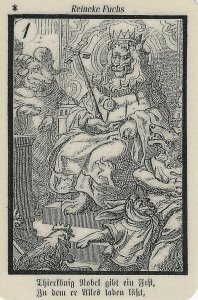 "Reineke Fuchs."1992? "Reineke Fuchs." 32 plastic-coated cards featuring a backing, numbering system, Kaulbach image, and two or three lines from Goethe's text. There are eight "quartets," each presenting a phase of Reynard's story. The numbering system assigns a numeral in a circle within the black-and-white image on each page for the quartet—from "1" to "8." Above this, outside the image, is a set of from one to four symbols like asterisks. So each card is unique: the second card, e.g., of the fifth quartet. The backing of each card presents the same set of six fox images in a checkerboard pattern balancing light and shadow. I believe that Herr von Fuchs arranged for the production of these lovely laminated cards himself. I am sorry that my favorite image of the cat attacking the local priest is not here. Perhaps the most graphic of the cards here is the third card of the sixth quartet, in which the severed head of the rabbit is brought forth from the wallet.
 -
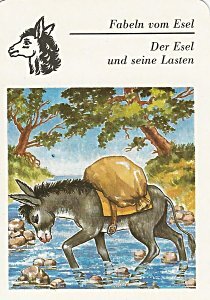 "Deutsche Tierfabeln: Quartettspiel für Kinder von 10 Jahren an."1989 "Deutsche Tierfabeln: Quartettspiel für Kinder von 10 Jahren an." Auswahl und Text: Karlheinz Rahn. Gestaltung: Sigrid Geisler. Pössneck: Verlag für Lehrmittel. There are eight "quartets," each presenting the fables of one animal family: fox, wolf, lion, bear, hare, horse, ass, and birds. There are also two cards listing the eight quartets and each card within the quartet. There is also a booklet of the texts that accompany the thirty-two fable pictures here. I imagine the game could be played like our "Authors." The colored illustrations are naïve and lively. My favorites include "Der Tanzbär," "Die mutlosen Hasen," and "Das Kutschpferd." This gift is especially treasured because it comes from the old German Democratic Republic.
 -
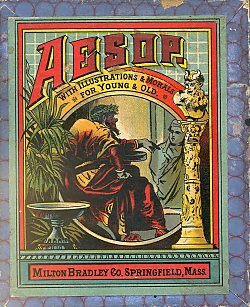 "The Game of Aesop"1940? "The Game of Aesop." Boxed as "Aesop" from Milton Bradley Company. Seventeen pairs of cards (text and illustration, respectively), lettered alike A through Q, and one odd card with a picture of Aesop. Springfield, MA: Milton Bradley Co. These cards are identical in print and image with those from the Artcraft (?) "The Game of Aesop" with several modifications. Here the backing of each card is orange-brown, and the ink used for both text and image is brown. And this set comes in a beautiful, if very well used, box giving the game the simpler name "Aesop."
 -
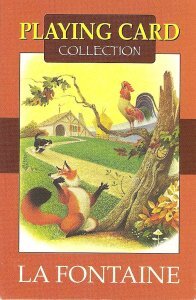 La Fontaine Playing Card Collection2004 La Fontaine Playing Card Collection. Art by Dante Moglisi. Turin: Lo Scarabeo. €10 at Variantes, Paris, Dec., '04. Two extra copies. "54 cards dedicated to some of the most famous tales." The 54 full-color illustrations here are small but delightful. Variantes was a store I came to love for its various puzzles and games. These cards were a great find on my way to Africa, when I wisely took an overnight in Paris along the way.Click on a card to see a larger version of it.
 -
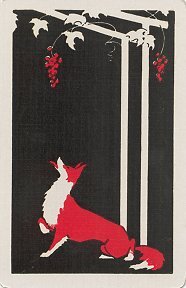 Two individual FG playing cards1970? Two individual playing cards showing FG on the backs. One image is entirely in black and red; the other is in black and blue with a red stripe around the outside. $8 from Dany Wolfs, Roesalare, Belgium, August, '00. Actually the FG image in the blue card is reduced to include the red stripe inside the white margin, which occupies the same space as on the red card. The only identifying mark is "Grapes" on the 4 of spades on the red card. The blue card is the 2 of clubs. If I keep this up, will I be able to put together a whole deck of individual cards with different fable images?
 -
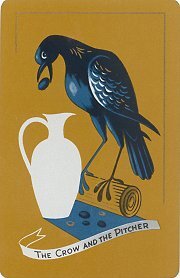 Two decks of playing cards showing FG and CP1950? Two decks of playing cards showing FG and CP, respectively, on their backs. The fox is as above in the three-deck Canasta set. For CP, against a tan background, a black crow stands over a white pitcher. A banner in white and blue-gray proclaims the title underneath the scene. In the sturdy original 3¾" 5" slipcase. Cel-U-Tone Finish. Congress Playing Cards. $6 from Harry Glogower, New York, NY, through Ebay, June, '00. The style and artistry of the two cards make them a nice complement to each other. I am especially pleased that someone had sense enough to put two fables together in one set.
 -
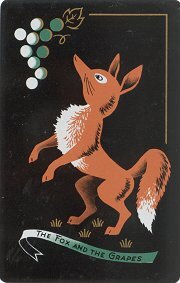 Three decks of playing cards showing FG on the backs1950? Three decks of playing cards showing FG on the backs. Against a black background, a brown fox stands up towards some white and green grapes. A banner in white and green proclaims the title underneath the fox. In the sturdy original 3¾" x 7½" slipcase, stamped with "For Samba or Bolivia" on its felt bottom. Cel-U-Tone Finish. Congress Playing Cards. $4 from John Verderame, Morgantown, PA, through Ebay, Sept., '00. The set comes with a small brochure that helps to explain why three decks come together, for the brochure contains official rules for Canasta, "Incorporating the Latest Changes Made for 1950." The cards are in very good condition. See the adjoining item for a companion deck.
 -
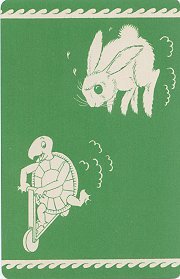 Two matching decks of TH playing cards1940? Two matching decks of TH playing cards. The design shows white characters against a green and a black background, respectively. Self sorting club playing cards. "Deck Copr. 1932." In the sturdy original 3 7/8" x 5" box. NY: Bid-Rite Playing Card Corp. $12.99 from Louie and Annette Fotinatos, Norwalk, CA, through Ebay, March, '01. The card that comes along with the deck proclaims "Self-Sorting Cards—First Change in over Three hundred years." Wow! I received these cards with the original cellophane still around each deck. Each deck also still has its original inspection notice. In the design the tortoise on a scooter moves to the bottom left corner of the card, while a hare (in mid-air?) bounds after him.
 -
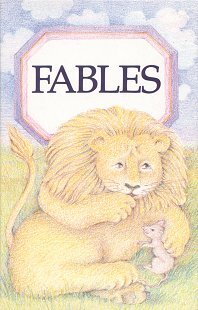 Other Card Games1986. "Fables." Learn As You Play. Illustrations by Gesine Mahoney. Fax-Pax. Great Britain. Thirty-six cards, each with a fable printed on one side and a titled colored picture on the other. The style of the illustrations is soft and cute. How one "plays" is not clear. The best illustrations include: "The Wolf in Sheep's Clothing," "The Trees and the Axe," and "The Stork and the Farmer." The lion has not bad breath but the smell of a skunk from a fight. WC adds a phase: "You only saved me for a reward." The spilt milk is kicked over by a cow; the point is that tomorrow is another day. The FS illustration misses the point by having the fox serve solid chunks of food on plates. The cards' packaging changes slightly in the new edition, apparently from 1989.
 -
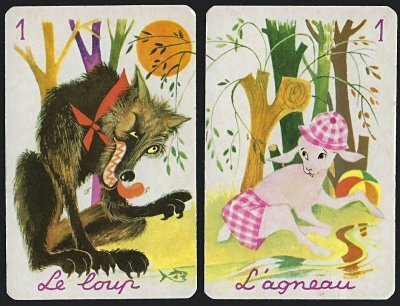 Mistigri Fables de La Fontaine1975? Mistigri: Fables de La Fontaine. Deisgned by Monique Berthoumeyrou. Made in France. Card game with 15 pairs corresponding to 15 well known fables of La Fontaine. The fable characters and their artistic illustrations are well matched. "Mistigri" is a generic name for card games of this sort; one of many other names is apparently "pouilleux." It also seems to be a name for a cat popular in French pop culture.
 -
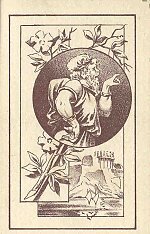 The Aesop Game1935? "The Game of Aesop." Seventeen pairs of cards (text and illustration, respectively), lettered alike A through Q, and one odd card with a picture of Aesop (right). Artcraft? The text-cards have plain light backing, while the picture-cards have a brown backing. The illustrations are simple and enjoyable. The human face of the lion on "D" is a clue that the illustrations are done after the work of an early artist. The fox on "M" only looks at the grapes. A text card explaining the game is the companion to the card bearing Aesop's portrait. The texts do not seem to come from a version I am aware of. The point of the game is for each contestant to get the most matches between text and picture. The image of "I" has a corner torn off, and the texts of "O" and "Q" show a crease. The cards came with a standard deck of Artcraft cards in an Artcraft box. Who knows whether they are really from Artcraft?!