Fables on Exhibit
In the early 2000's, I had another challenging administrative post within the Jesuit order in Berkeley, California. Again, some of my fun was to enjoy this area's many bookshops and the bookshops I found in professional travels to the Philippines, Asia, and Africa.
As I returned to Creighton, I was happy to have more time for the collection and to be close to it. I looked for opportunities to invite people into my enjoyment of fables. One of those became particularly fruitful. Creighton offered a series of Sunday afternoon lectures at the excellent Joslyn Art Museum, just a few blocks from campus. I was aware of a fascinating painting there, Jean-George Vibert's "La Cigale et la Fourmi."
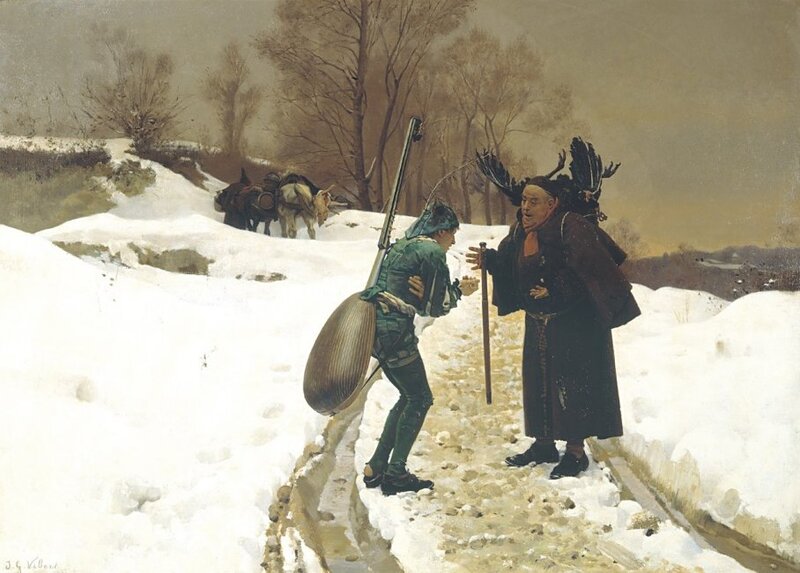
The more I came to know about French presentations of this fable, the more surprising this painting became. Just as La Fontaine changed this tradition of the fable, Vibert was changing its application. La Fontaine, I believe, presents the cicada as himself, the artist asking for recompense for enchanting anyone who will listen. Vibert presents the miserly ant as a well-fed monk, with game on his back and more on his horse, rejecting an artist's plea for a bit of food. He further transfers the scene from the normal household to a road, where the monk ant will leave him, as the good Samaritan did not, half-dead on the road. What a stroke of luck that our own Omaha art museum has this fascinating anti-clerical reinterpretation of a key fable!
In 2011, I offered one of those Sunday lectures. The curator asked afterwad "Do you exhibit?" My reaction included a bit of surprise and more thatn a bit of desire. She cautioned that the Joslyn was undergoing a change of directors. Would I wait and offer a proposal for an exhibit in the future? In the midst of a busy life, I noted the suggestion and went on.
A few years later, the on-campus Lied Art Gallery in the Fine Arts building made an invitation that I consider offering a fable exhibit. I not only agreed. I went back to the Joslyn and made inquiries. In hopes of landing an exhibit, I offered a tutorial in 2016 to three outstanding fine arts students to have them work through the highly disorganized fable objects I had acquired and to make suggestions about what might make for good exhibits. Soon enough, we made an appointment with the director and curator from the Joslyn for a visit. The students and I laid out promising works. Our guests worked through them with interest and said they would get back to us. A few months later, the happy message came that the Joslyn would sponsor an exhibit. To my surprise, we were to do the bulk of the curating! I had not expected that! To my delight, we were able to synchronize and interrelate the exhibits at the Joslyn and on campus.
CU Press Release insert here.
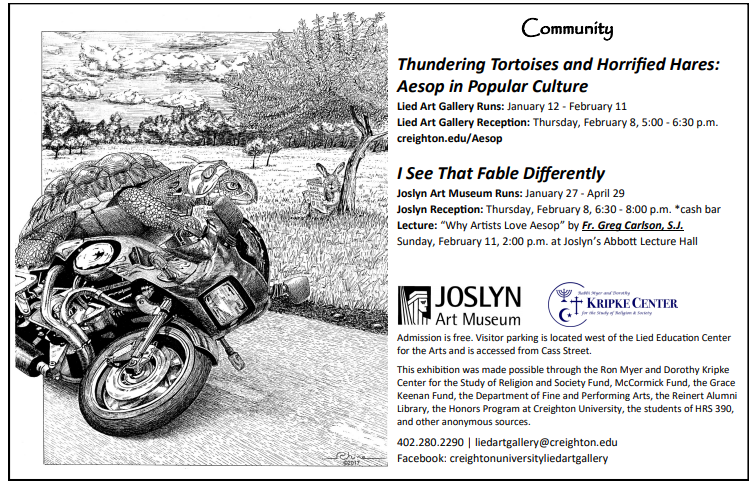
Part of the luck in this turning point was that, at a good liberal arts school like Creighton, one can engage colleagues and honor students in fascinatingly creative endeavors. A colleague in Fine Arts and I taught a group of honors students a seminar in which they researched the Joslyn Exhibit, titled "I See That Fable Differently." Readers of this article will not be surprised that I chose that title! For each of the thirteen fables in the show, we offered at least two different presentations, along with different texts. The honors students themselves developed the on-campus show, titled "Thundering Tortoises and Horrified Hares: Aesop in Popular Culture." They chose the artifacts, prepared them for presentation, wrote the labels, and designed the layout of the show.
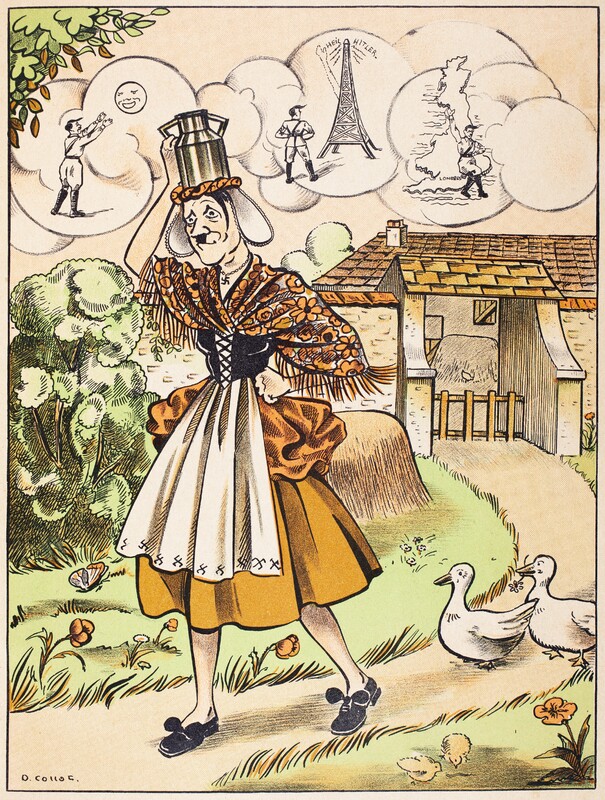
Histories of fable illustrations often turn to one ephemeral edition for an example of the political use of fables: Les Fables de La Fontaine et Hitler, published with illustrations by J. Y. Mass and D. Collot in 1939 before Hitler's invasion of France. The biting satirical illustrations -- like this of the milkmaid dreaming of her future acquisitions -- make such a difference!
I had never had it in my hand and had not seen it offered anywhere when I saw it on eBay. The week before the end of the eBay auction was a tense time for me! I immediately bid the minimum for the booklet, $195.50, but how much of our scarce resources was I willing to spend?
The auction would end around 3 A.M. on a Sunday. Bidding on eBay is usually fiercest during the last minutes and seconds. I could not bear to sit at 3 A.M. and watch this book go to someone else! I bid well over $1,000 and went to bed, expecting that I would get up to learn that someone had outbid me.
Surprise! No one else had bid. I won for the minimum bid! I had pleasant email conversations afterward with the seller. When he learned about the bidding history described above, he said, with good humor, "Oh, I wish I had put the minimum much higher!"