First Steps
One moment preceded the door-opening experience described previously. Among those first inexpensive books, two opened my eyes.
INCLUDE SCAN HERE FROM PAGES 36-37 OF JOHN MCKENDRY BOOK
The first was an exhibit catalogue from a 1964 show at the Metropolitan Museum of Art: Aesop: Five Centuries of Illustrated Fables, selected by John J. McKendry. The book selects forty fables and, for each fable, joins a text with an illustration from the period, as exemplified just above. As I visited and revisited these pages, I could not help but wonder at the creative array of approaches to simple stories! I was hooked!
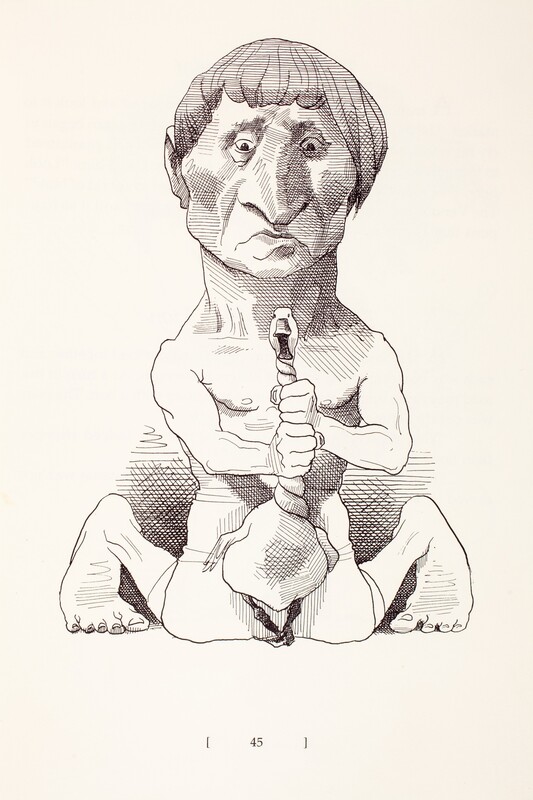
David Levine, The Fables of Aesop. "The Goose That Laid the Golden Egg."
David Levine's The Fables of Aesop in 1975, with texts by Justina and Patrick Gregory, offered the other first stimulus. This book showeve me a visual artist having fun with story after story. Who could see Levine's image and not laugh at the idiot silly enought to kill the goose who had been laying golden eggs? Levine was the longtime caricaturist for the New York Review of Books. His fifty illustrations int his volume reveal someone taking genuine delight in the fables. If a person does not have fun reading this book, there is something wrong!
Collector's Comment: I suspect many of our collecting habits have been touched by one book or one experience. The good news comes when the first enrapturing experience gets repeated in some form and further encouraged. McKendry's catalogue has been followed by others, like Anne Steveneson Hobb's Aesop, Ulrike Bodemann's Fabula Docet, Justin Schiller's Realms of Childhood, and the two-volume bible of fable collectors, Das Illustrierte Fabelbuch. As to the successors of David Levine, they are too many to mention. My hat is off to those creative artists that keep returning to Aesop, Jean de La Fontaine, Ivan Krylov, and others, to find new sources of insight and humor, new sources of fun!
That mention of fun touches on my attraction for fables. I believe that fables pulled on various threads of my early life and even pulled those threads together. First, I am a player. My father ran the toy department in the biggest department store in Milwaukee, Wisconsin. I and my siblings had happy childhoos! Though I was also a serious young man, I have learned, partiuclarly through my father's generosity and occupation, to play.
I still play. Fables play. As we engage them, we play our way into understanding. The delight I found in those fables in teh 1980's remains these days, largely because the telling, moralizing, and illustrating of fables continues to be creatively diverse. Fables and I were made for each other.
Second, I have particularly enjoyed short literature. My doctoral dissertation at Heidelberg under Viktor Poeschl compared Virigil's similes in the Aeneid with those of Homer in the Iliad and Odyssey. During my seminary studies, I was particularly taken with the parables in the gospels. Friends tease me that I have a short attention span! Again, fables and I were made for each other.