Kempenaar Oriental French
We have cards from three distinct sets of trade cards from "Elixir De Kempenaar":
-
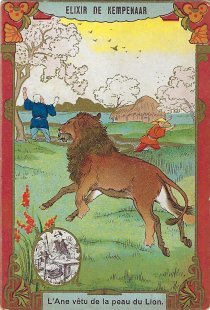 Kempenaar Oriental French C1900? 21 out of a series of 24 cards presenting fables of La Fontaine in an oriental style with French text of the fable on the verso. "Elixir De Kempenaar." Druk J.E. Goossens, Brussels. These cards, except for the change of language, are like the Kempenaar Dutch oriental cards of Series C. Like them, these cards are smaller versions in the style of the Bon Marché Oriental series. While those Bon Marché cards are 4" x 5½", these are 3¼" x 4 7/8". The cards are numbered "1" through "24" in "Serié C" on the bottom of the verso. "Elixir De Kempenaar" is on both sides of each card. The verso of each also has "Imp. J.E. Goossens, Brussels," and the text of its fable. These cards add an oval in the lower left or right of the picture side: apparently a man with a pitchfork and a seated woman are both drinking Elixir De Kempenaar. The border of each card has its own intricate oriental pattern. Now to find the last three in the series!
 -
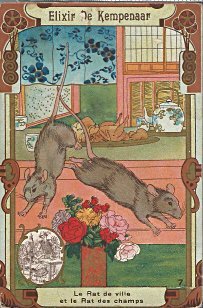 Kempenaar Oriental French B1900? Two cards from a series of 12 each presenting La Fontaine fables in an oriental style. Imp. J.E. Goossens, Brussels." These are 3¼" x 4 7/8". Like those in other Kempenaar series, they add an oval in the lower left: apparently a man with a pitchfork and a seated woman are both drinking Elixir De Kempenaar. The border of each card has its own intricate pattern. The cards of this "B" series are numbered "6" (Wagoneer in Mud) and "7" (TMCM) in the lower right of the picture side. "Elixir De Kempenaar" is on both sides of each card. The verso of each has "Imp. J.E. Goossens, Brussels," and the text of its fable. These cards, unlike those in Series A, have a differing formats for the boxes for the fable title on the front side. Both of these cards have "Serié B (12 fables) No. 2" on the verso!
 -
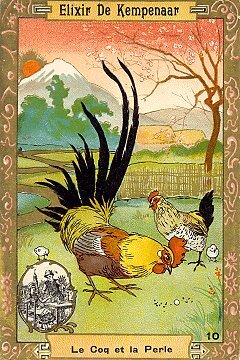 Kempenaar Oriental French A1900? Three cards from a series of 12 each presenting La Fontaine fables in an oriental style. Imp. J.E. Goossens, Brussels." These cards are as beautiful as their larger counterparts. Each the three in this Series A has a counterpart in the Bon Marché Oriental set that I have. While those cards are 4" x 5½", these are 3¼" x 4 7/8". These cards add an oval in the lower left: apparently a man with a pitchfork and a seated woman are both drinking Elixir De Kempenaar. The border of each card has its own intricate golden pattern. The cards of this "A" series are numbered "4" (WC), "9" (FC), and "10" (CJ) in the lower right of the picture side. "Elixir De Kempenaar" is on both sides of each card. The verso of each has "Imp. J.E. Goossens, Brussels," and the text of its fable. These cards, as opposed to those in the other two French series from Kempenaar, have consistently shaped boxes for the fable title on the front side. All three of these cards have "Serié A (12 fables) No. 1" on the verso!
 -
 Kempenaar Oriental French1900? Five cards from two series of 12 each presenting La Fontaine fables in an oriental style. Imp. J.E. Goossens, Brussels." These cards are as beautiful as their larger counterparts. Each of the first-set three has a counterpart in the Bon Marché Oriental set that I have. While those cards are 4" x 5½", these are 3¼" x 4 7/8". These cards add an oval in the lower left: apparently a man with a pitchfork and a seated woman are both drinking Elixir De Kempenaar. The border of each card has its own intricate oriental pattern. The cards of the first series are numbered "4" (WC), "9" (FC), and "10" (CJ) in the lower right of the picture side. Those of the second series are "6" (Wagon Driver in Mud) and "7" (TMCM). "Elixir De Kempenaar" is on both sides of each card. The verso of each also has series and number, "Imp. J.E. Goossens, Brussels," and the text of its fable.