Minton Tiles
We have a number of different series of tiles either from the Minton Company or after theirs.
-
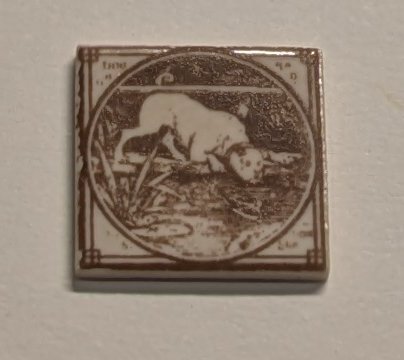 Minton Replica Mini-Tiles2000? Minton Replica Mini-Tiles. .5" square. Original set of 6 plus a duplicate set. Unknown source. These sets have experienced disintegration because the tiles are brittle. And they are so small! Four pairs remain intact, and a fifth single is still almost all there. Perhaps meant for a doll house?
 -
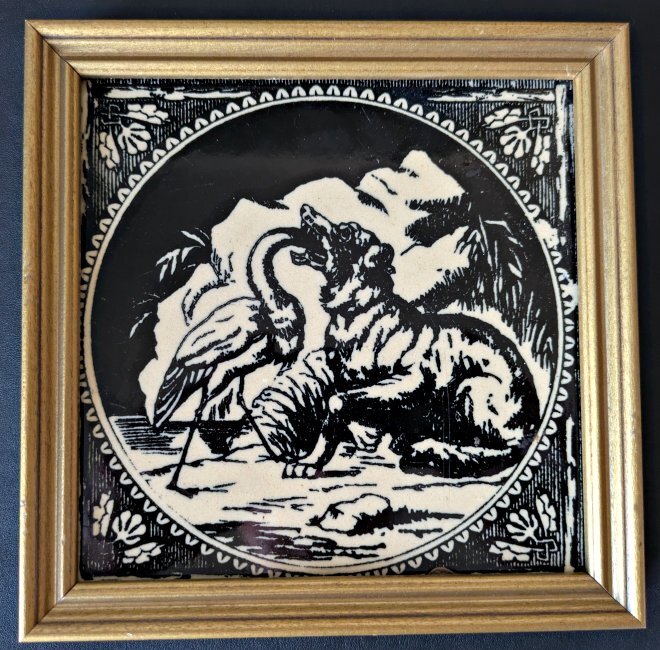 Framed Tile of WC1860? Framed Tile of WC. Stoke on Trent: Minton Hollins & C Patent Tile Works. Unknown source. This rendition of Samuel Howitt's WC from 1811 is very dark. The tile is loose in the frame. It was fascinating to piece together the printing on the "waffle" back of the tile. I am surprised that we have not yet found other such Minton tiles.
 -
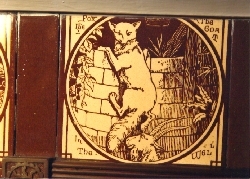 Minton PhotographsAround the second-floor fireplace in Cole Cottage, on the grounds of Nashotah House in Nashotah, WI, there are 13 tiles of fables. These photographs of them are a gift of Linda Schlafer: 1. DS 2. "The Fox and the Goat" (repeated) 3. WL (repeated) 4. TH (repeated) 5. LM 6. FK 7. FC 8. "The Lion in Partnership" 9. FS 10. "The Tortoise and the Eagle"
 -
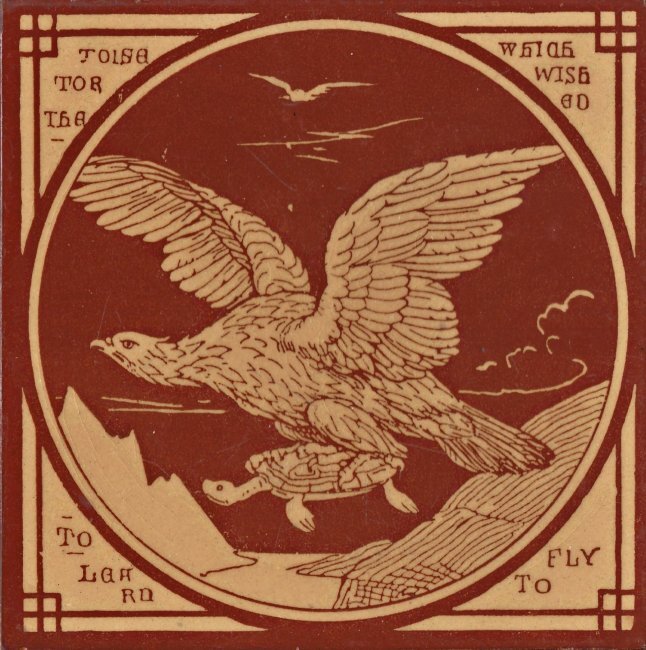 "The Tortoise Which Wished To Learn To Fly"1875? Six-inch square tile titled "The Tortoise Which Wished To Learn To Fly." Manufactured by Minton's China Works, Stoke on Trent. Designed by John Moyr Smith. $86 from Artifacts Gallery and Custom Framing, Trenton, NJ, through Ebay, March, '99. This is my first of Minton's series of twelve. Lovely brown and cream colors. The title is read in curious fashion, starting from nine o'clock and reading toward three o'clock, and then restarting from eight and reading toward four. The eagle looks serious and gruff, while the tortoise has his neck extended. Other birds fly elsewhere in the sky. The seller identifies the style as early Arts and Crafts.
 -
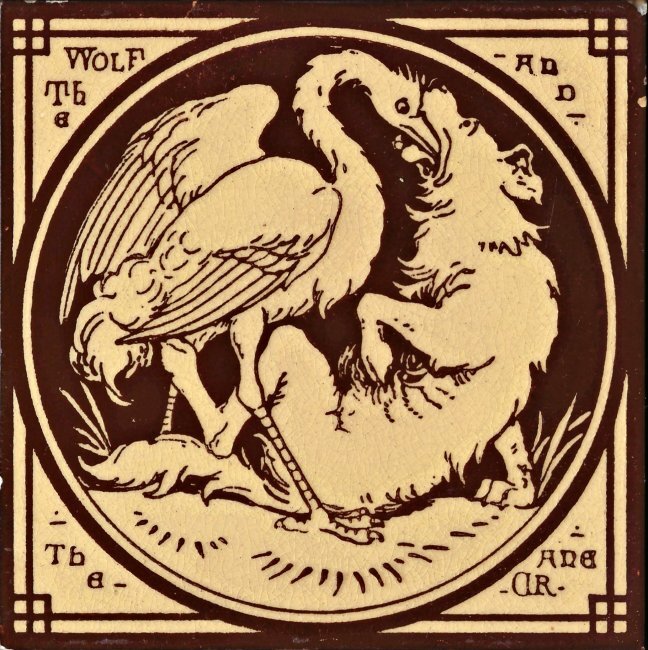 "The Wolf and the Crane"1875? Six-inch square tile titled "The Wolf and the Crane." Manufactured by Mintons China Works, Stoke on Trent. Designed by John Moyr Smith. Unknown source. In this lively scene, the two characters' forms fill out over 50% of the circle's circumference. Can we see in their faces the diligence of the crane and the (temporary) submissiveness of the wolf? Lovely brown and cream colors. The title is read in curious fashion, starting from nine o'clock and reading toward three o'clock, and then restarting from eight and reading toward four. In the upper left and lower right, one needs to read going up; the key is to start as far left as possible and always move right.
 -
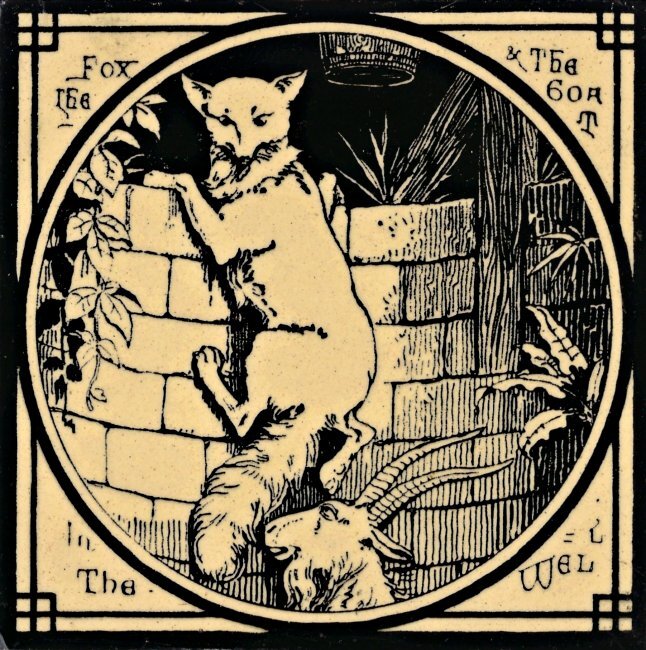 "The Fox & the Goat in the Well"1875? Six-inch square tile titled "The Fox & the Goat in the Well." Manufactured by Mintons China Works, Stoke on Trent. Designed by John Moyr Smith. Unknown source. In this lively scene, can we see in their faces the arrogance of the fox and the ignorance ofthe goat? Lovely brown and cream colors. The title is read in curious fashion, starting from nine o'clock and reading toward three o'clock, and then restarting from eight and reading toward four. In the upper left and lower right, one needs to read going up; the key is to start as far left as possible and always move right.
 -
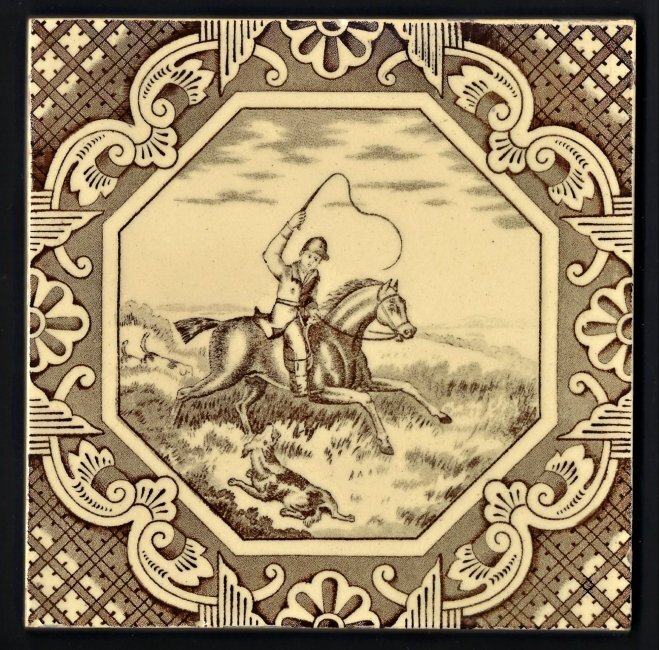 Minton Hollins 1870 Brown Series1870 Series of Three Brown Tiles. Minton Hollins Co. Patent Tile Works, Stoke on Trent. No. 2 RCW. $150 each from an unknown source. These three tiles are clearly in a series. A curious feature is that two of them have lettering on the back at a 90 degree angle from the image on the front. The lettering on the back of these tiles is clear. Two are in excellent condition, while one (The Sow and the Fox) has a chip off one corner. The Hound and the Hunter The illustration here seems to accord with a portion of Bewick's for the same fable. Other illustrators include the prey that the old dog is no longer able to hunt as once. The image here is identical with that on a colored Minton tile in our collection for which we have estimated a date of 1880. The Wolf and the Sow The pose of the wolf here is noteworthy. He leans into the pen as though he is concerned and eager to help. The artist emphasizes the sow's size and her udders. The wolf is offering help, sometimes identified as midwife or medical or baby-sitting help. The sow responds that he can best help by leaving. Watch out for an enemy offering help! The Boar and the Fox The artist's boar may be less successful than some of his other objects. He seems not presently to be sharpening his tusks. The fox, on the other hand, is a good representation of the curious bystander at a bit of safe distance. The time to sharpen tusks is not during battle but before.
 -
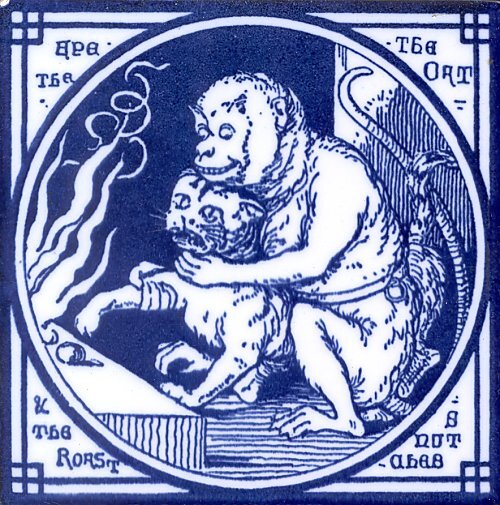 Mintons Blue Tiles1875? Twelve six-inch square tiles. Manufactured by Mintons China Works, Stoke on Trent. Designed by John Moyr Smith. The mark on each back includes "Walbrook, London." All twelve for $480 from Margery Northup through Fran's Estate Sales, Gilbert, AZ, March, 2001. Extra copies of FC and FS for $102.5 from Riverwalk, Hattiesburg, MS, through Ebay, Feb., '00. These blue tiles surprised me when I first discovered them. I did not know that Minton did blue as well as brown tiles. They are apparently exactly the same in design. Are the patterns here as crisp and clear as on the brown tiles? The titles are read in curious fashion, starting from eleven o'clock and reading toward three o'clock, and then restarting from eight and reading toward four. Do the twelve make up a complete set? Click on any tile to see it enlarged.
 -
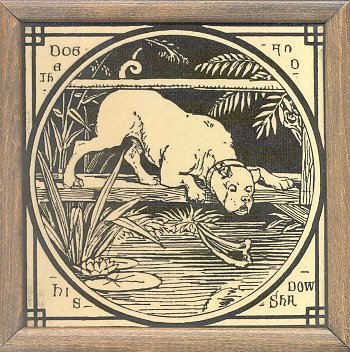 Six-inch square tile titled "The Dog and His Shadow."1875? Six-inch square tile titled "The Dog and His Shadow." Manufactured by Mintons China Works, Stoke on Trent. Designed by John Moyr Smith. Framed. $150 from The Jewelsmith, Tempe, AZ, through Ebay, Jan., '00. Again, lovely brown and cream colors. The title is read in curious fashion, starting from nine o'clock and reading toward three o'clock, and then restarting from eight and reading toward four. In the upper left and lower right, one needs to read going up; the key is to start as far left as possible and always move right. The dog has let go of his large piece of meat, the shadowy reflection of which falls just inside the image's circular frame. A railing on the bridge helps define the heavy horizontal framing of the scene, but leaves his tail above its line.
 -
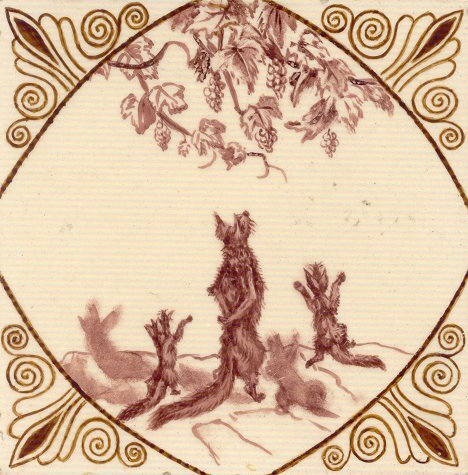 One tile, "The Foxes and the Grapes"1880? One tile, "The Foxes and the Grapes," produced by Minton, Hollins and Company. Stoke on Trent. 6" x 6". $29.95 from Steward Hoins, Nordland, WA, through eBay, Oct., '03. This particular illustration has long been a fascination for me. Is it likely that three foxes together would jump for grapes that they could not get? And would they concoct the same explanation of why they did not achieve what they wanted? And would they put up with each other's stories?
 -
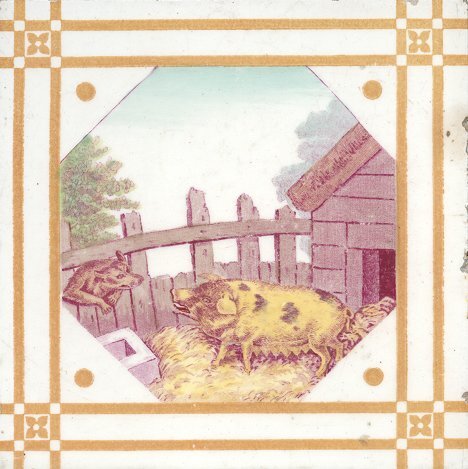 One tile, "The Sow and the Wolf"1880? One tile, "The Sow and the Wolf," produced by Minton, Hollins and Company. Stoke on Trent. Slight fritting on the edges. 6" x 6". $82 from Chris Hawkins Antiques, UK, through Ebay, Feb., '02. The design for this tile is apparently taken from the engraving done by Samuel Howitt—in fact page 14 of my copy of his 1811 A New Work of Animals Principally Designed from the Fables of Aesop, Gay, and Phaedrus. Though the piglets may not be clear, the sow's udder is. The wolf's pose is a surprisingly good mix of non-chalance and eagerness.