Postcards
Some of the postcards I have found come as part of a series, and some are single postcards, perhaps still looking for the other members of their postcard families!
-
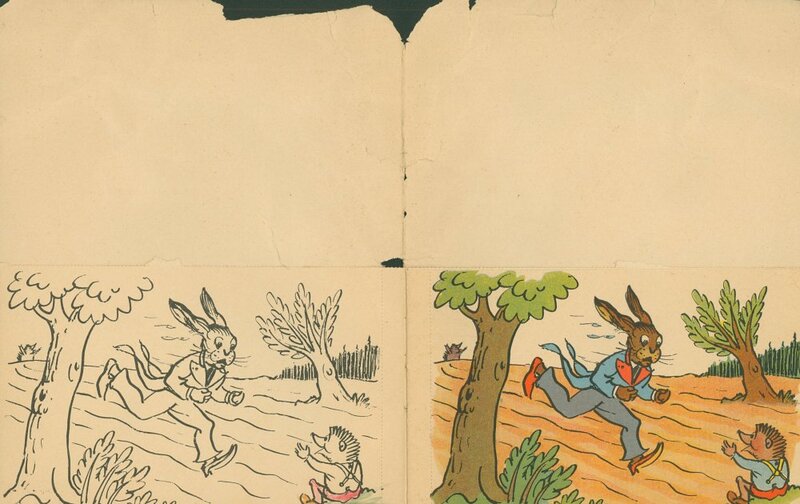 Märchen-Postkarten zum Ausmalen1950? Märchen-Postkarten zum Ausmalen. Pamphlet-portfolio with twelve cards, six as patterns and six to color. Only both "Tortoise and Hedgehog" cards and the colored version of Cinderella (?) remain. M. 1017. Offsetdruck Walter Mainz. Jos. Scholz Mainz Verlag, Wiesbaden. €5 in Dresden, July, '24. Another complete instance on the web of this set of postcards to color has convinced me that it includes fairy tales rather than fables. I have made an exception for "Tortoise and Hedgehog" and so I include what is left of this publication. The color work presented is strong. A former owner of this pamphlet started to color but got only as far as the hedgehog's red pants and the green grass upon which he is sitting.
 -
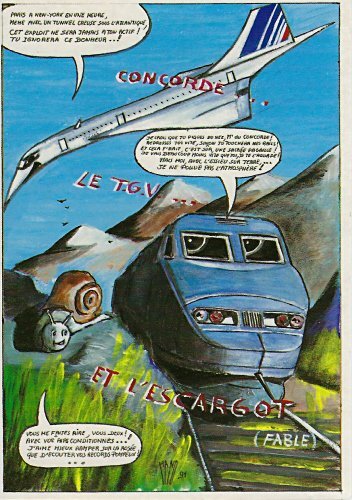 TGV Concorde Escargot1992 Large postcard " TGV. Concorde. Escargot," written and illustrated by Pierre Hano. Limited printing of 300. ©Edition des Escargophiles. £1.99 from auststamp, Australia, through eBay, May, '06. The proud concorde is put down by the TGV, who mentions that he himself does not pollute the way the concorde does. The snail rebukes them both for their claims. "I'd rather climb around on a rose than listen to your claims." The postcard's picture explicitates for us that this is a fable.
 -
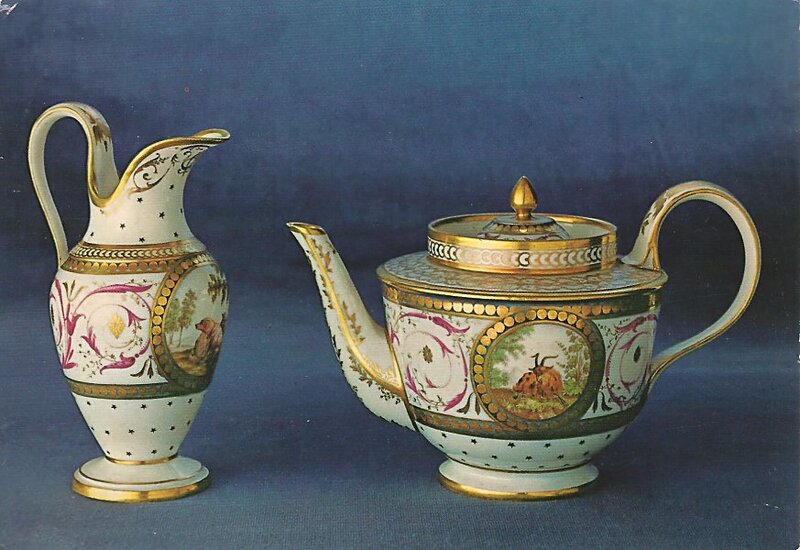 Porcelaine de Bruxelles, fin XVIIIe s2010? Photographic postcard. Mons. Musée du Centenaire. Porcelaine de Bruxelles, fin XVIIIe s. décor aux "Fables de La Fontaine" de L. Cretté. "18. Amis des musées." Edit. Thill. S.A., Bruxelles. From Gabriel Somogyi, Floresti, Romania. One views here a lovely pitcher and teapot. Unfortunately, the revealing image on the pitcher is half turned awayi. One dog looks off to the left, but that could pertain to several fables. On the teapot, an insect like a ladybug is front and center.
 -
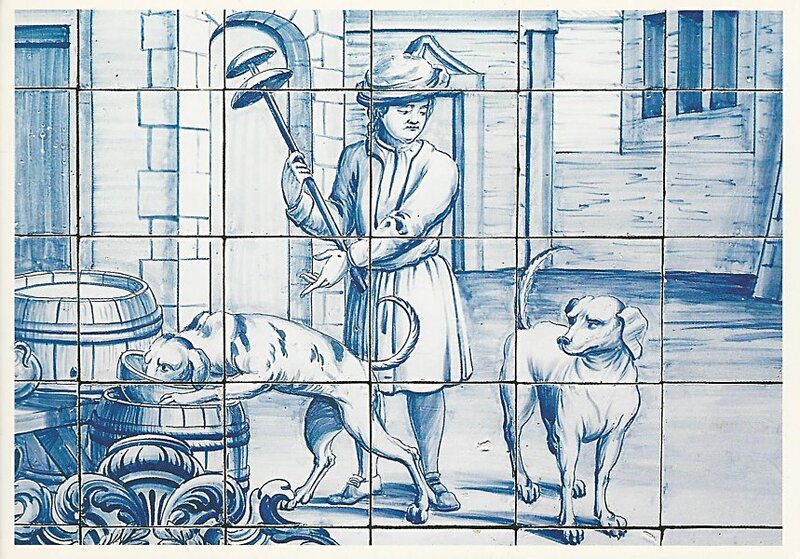 São Vicente de Fora2008 Mosteiro de São Vicente de Fora. Fabula de La Fontaine. "A Educação." Gabriel Somogyi, Floresti, Romania. Here is a detail of the glorious tiles in this monastery representing La Fontaine's fables. This particular fable seems to have a master teaching one dog by the example of the other.
 -
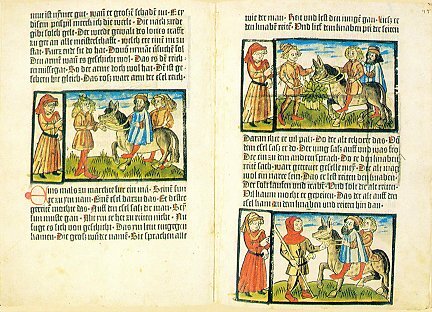 Wolfenbuttel1980? Photograph of a pair of manuscript pages from the Herzog August Bibliothek's copy of Ulrich Boner's Edelstein of 1461. Wolfenbüttel, Germany. DEM 1 from the library, July, '01. One extra copy at the same time. Here we see three phases of the delightful story of MSA: first the father rides, then the son, and finally both. Aesop, the wise story-teller, points to the scene (and to every scene) to direct us to pay attention to what we can learn. As the verso points out, this manuscript is 16. 1 Ethica 20 (1). It was unfortunately the only item not immediately available during my two-day visit to the library. Here is a reason to return!
 -
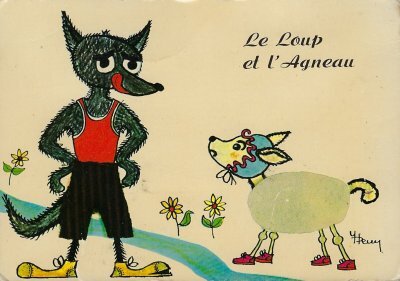 WL by La Rose1960? Colored cartoon postcard of WL. Artist “Y Heny” (?). “GP La Rose. 485/5.” $6 from Bertrand Cocq, Calonne-Ricouart, France, Sept., ’20. The design of this card’s illustration strikes me as unusually primitive. Might it have been done to imitate childlike art? I wish I could better decipher the artist’s signature. Apparently La Rose made cards of all sorts for a long time and through the 1960’s.
 -
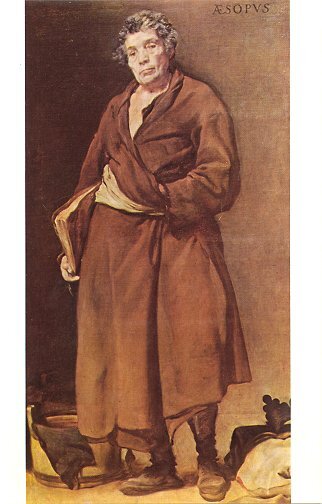 Velazquez Aesopus1977? Postcard reproduction of Velazquez' portrait of Aesop. Museo del Prado. Printed in Spain. Madrid: Ediciones Artisticas. $.50 at the Prado, July, '86. This is an evocative full-length portrait of "Aesopus." One hand holds a book, while the other is inside his very simple wrap-around cloak. He looks directly into the viewer's eye. His look scrutinizes. His face is anything but pretty!
 -
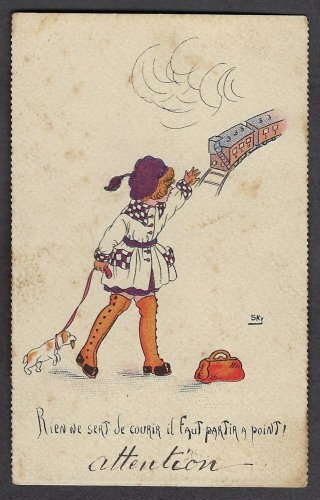 TH 5Ky1920? Colored cartoon postcard of TH. “Rien de sert de courir il faut partir a point!“ A girl with dog and satchel is late for the train disappearing in the distance. “5Ky.” $6 from Bertrand Cocq, Calonne-Ricouart, France, Sept., ’20. Despite the clearly printed “5Ky” (or perhaps “SKy”?), the lovely illustration here seems handmade. The checkerboard designs echoing the color of both cap and underskirt are well done! “Attention!” seems handwritten on the picture side of the card. The card’s left and right sides are unusual in being serrated. The only message is, I believe, “affectueuse bonjour.” There are mysteries here!
 -
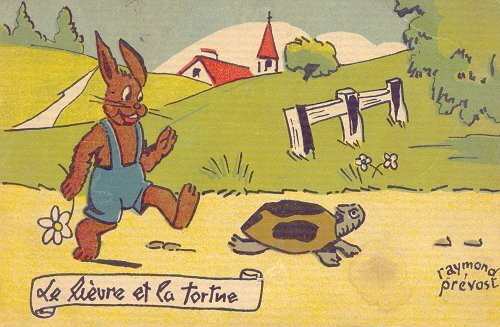 TH by Raymond Prevost1930? TH postcard by Raymond Prévost. €2 from M. et Mme Camus, Oullins, at the Paris Post Card Exhibition, Jan., '05. The hare walks behind the tortoise with a flower in his hand. Would this be the opening moment of the story? Strong, simple colors. The verso of this card has suffered, apparently from having been pasted into an album.
 -
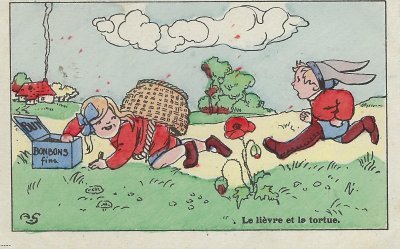 TH AS Candy As Prize1925? Full-colored cartoon card of TH. “AS” trademark presented as a wink and smile. No artist acknowledged. $8 from Bertrand Cocq, Calonne-Ricouart, France, Sept., ’20. Better copy found somewhere for $5, April, '22. Here is one of the poorest cut postcards in the collection! The cutter missed by quite a bit! Bertrand thought that this card may be an advertisement for candy, but I believe that the candy-maker would have identified itself in that case. Rather this is a simple joke: when it comes to getting candy, a tortoise can be cleverer than a fast hare. The artist’s focus here is on making the children with their apparel similar in form to a tortoise and a hare. I will leave it to viewers to judge how well the artist did. The verso is as simple as it gets. Enjoy, as I do, finding a better cut and better colored copy!
 -
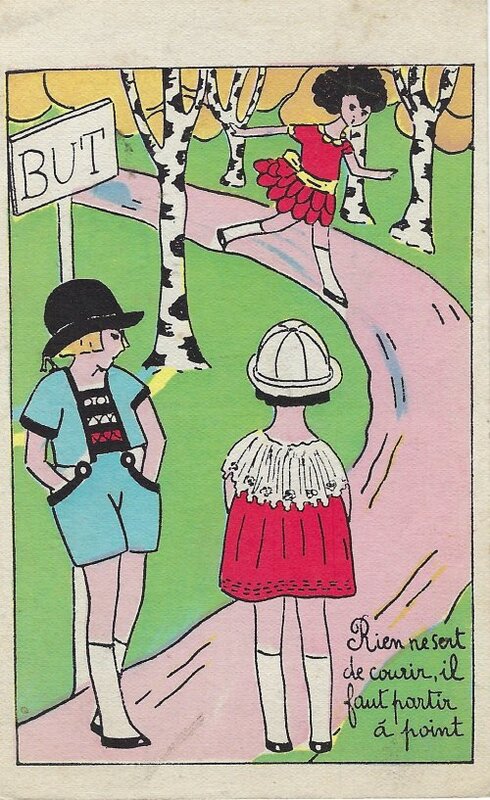 TH Children 19271927 Children present La Fontaine's moral from TH: "Running is not the issue. You need to start on time." $5 from an unknown source, Feb., '22. The verso seems to me more engaging than the illustration in this card whose message is dated in October, 1927. First, the young "Votre petite Lili" did not add an address to her card. Secondly, the card itself warns that not all countries accept the "correspondence au recto." I wonder what that means…. I tried my own translation against several of the traditional ones. Maybe best is Spector: "Rushing is useless; one has to leave on time. Moore has " If you don't start on time, you might as well not try." Wright: "To win a race, the swiftness of a dart Availeth not without a timely start."
 -
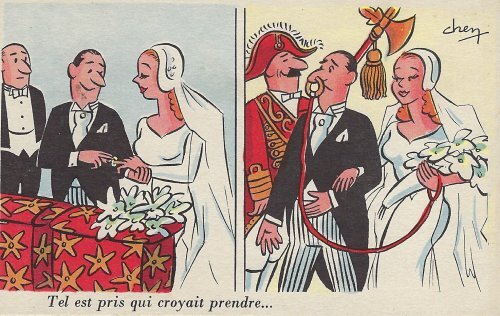 Tel est pris Wedding 1975?1975? Tel est pris qui croyait prendre. Wedding ceremony. Serie Chen. $5 from an unknown source, Feb., '22. The axiom comes from La Fontaine's fable of the rat who thought to devour an oyster. The oyster clamped down on his attacker. In this colorful scene, the groom thinks he is capturing the bride, but the second scene shows the reverse. As I looked through various translations of the axiom, I settled on this one as the best: "Now the hunted becomes the hunter." But should not the terms be reversed? The hunter has become the hunted!