Cards
I am amazed at how many different cards--and even kinds of cards--I keep finding. There are probably 2000 different cards represented here, many of which are pictured. Some categories require that you dig down a few levels. Go for it!
- Albums of Cards or Stickers
- Bonbon Cards
- Calendar Cards
- Calendar Wallet-Cards
- Chocolate or Chicoree Cards
- Cigarette Cards
- Disney Villains Cards
- Double-Vision Multiplication Card
- Fable Cards
- Game Cards
- Card Games
- Greeting Cards
- Gum Cards
- Hidden Picture Cards
- Note Cards
- Playing Card Decks
- Pop-Out Cards
- Postcards
- Prize Cards
- Proverb Cards
- Shadow Cards
- Stereopticon Cards
- Stitching Embroidery Cards
- Tarot Cards
- Tea Cards
- Telephone Cards
- Trade Cards
- Trading Cards
- Other Cards
-
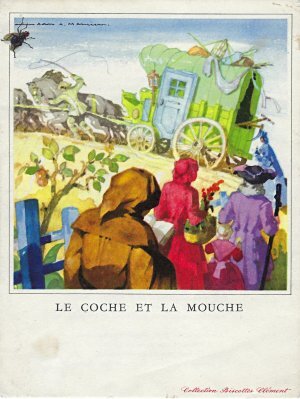 Colored fable card advertising "Collection Biscottes Clément"1960? Colored fable card advertising "Collection Biscottes Clément" and presenting "The Coach and the Fly" by Jean Mercier. I recognized this image immediately. It was done by Jean Mercier and appeared on menus for Compagnie General Transatlantique. In fact, that menu appeared in the Joslyn Museum exhibit of this collection in 2018. Its most unusual feature is the oversized fly apparently sitting on the paper. The fly is so insignificant, despite his own ideas of his accomplishment, that he does not appear otherwise in the image. One is tempted to whisk him away in order to look at the picture! The printer's name ends in something like "ugges" in Paris and Nantes. In an earlier existence this card lost that bit of its printer's name. The title and text of the fable make up the verso of the card.
 -
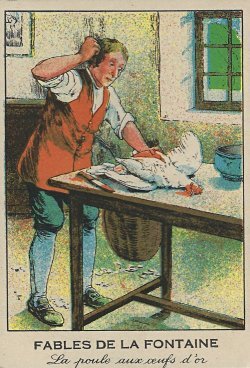 Chromo trade card of GGE1930? Chromo trade card of GGE. "Fables de La Fontaine. La poule aux oeufs d'or." This is one of those trade cards with lovely coloring and energetic action, here sadly that of killing the hen. There is nothing I can find on this card to identify who printed it or when.
 -
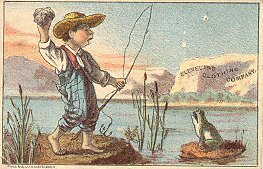 Two colored cards advertising the Cleveland Clothing Company1920? Two colored cards advertising the Cleveland Clothing Company and picturing a boy about to throw a rock at a frog. $1 from an unknown source, with the extra copy in poor condition at the same time. I enjoy the clever way in which "Cleveland Clothing Company" is worked into the curvature of the clouds on the picture side. The fable, not in Perry, is frequent in later editions as "The Boys and the Frogs." Here is James' version: "A TROOP of Boys were playing at the edge of a pond, when, perceiving a number of Frogs in the water, they began to pelt at them with stones. They had already killed many of the poor creatures, when one more hardy than the rest putting his head above the water, cried out to them: 'Stop your cruel sport, my lads; consider, what is Play to you is Death to us.'"
 -
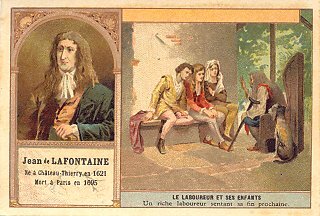 One colored card with a portrait panel of La Fontaine on the left and a picture panel on the right of "Le Laboureur et ses Enfants"1920? One colored card with a portrait panel of La Fontaine on the left and a picture panel on the right of "Le Laboureur et ses Enfants," including a moral. An apparent advertising panel above is empty. The verso contains again La Fontaine's name and dates and a paragraph on his work. The card seems to belong to something like a series of great French writers. The worker's sons pay more attention than I would have expected. Perhaps they have already heard the magic word "treasure"! It is surprising that the card bears no advertising at all.
 -
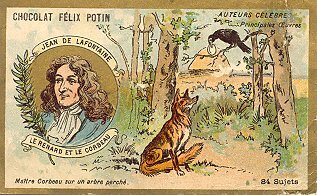 One colored card with a circular portrait of La Fontaine on the left and a picture of FC on the right1920? One colored card with a circular portrait of La Fontaine on the left and a picture of FC on the right. "Auteurs Celebres" with 84 subjects announced on the picture side, along with the opening line of the fable. One copy adds "Chocolat Félix Potin" on the picture side and verso. It was printed by F. Champenois in Paris. The other copy adds nothing on the picture side but its verso is an advertisement for François Ledouarec, a grocer in Saint-Brieuc. The card belongs to a series of great French writers, and thus, I suppose, it will always stay as a single in this collection. Perhaps at some point I will be lucky enough to find a Florian card in the set. The Potin card advertises the celebrity photographs and collectable stamps that one finds in 500 gram portions of Potin's chocolate.
 -
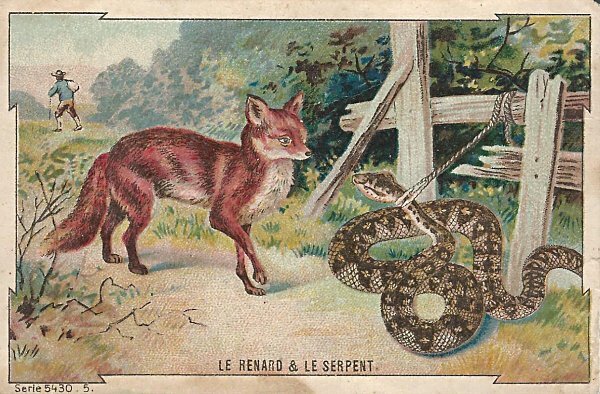 One colored French card illustrating "The Fox, the Traveller, and the Snake"1915? One colored French card illustrating "The Fox, the Traveller, and the Snake" and advertising on its verso Chicorée Extra and Daniel Voelcker-Coumes. From Boulevard des Ecritures, St. Ouen, August, '15. This card is curious in several ways. It has the same instepped borders and is in fact identical with the text and image of a stock trade card in the "5430" series. I also have other trade cards in a different format from Chicorée Extra and Daniel Voelcker-Coumes.
 -
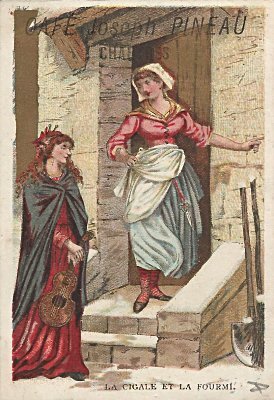 One multi-colored card featuring two women as the dismissing ant and the dismissed grasshopper1910? One multi-colored card featuring two women as the dismissing ant and the dismissed grasshopper. Café Joseph Pineau, Chartres. Lively presentation of the two women. In this case, the ant personage is as attractive and young as the grasshopper figure. Snow is visible around the two characters. "Specialitè de cafès."
 -
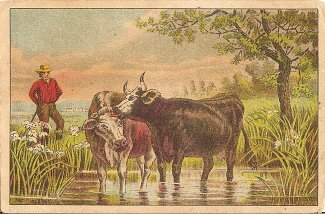 One multi-colored card featuring a cow and a bull in a swamp with a farmer1910? One multi-colored card featuring a cow and a bull in a swamp with a farmer watching them. 3⅜" x 5⅛". This card was billed as a fable on eBay, and it may be that, but I do not yet recognize which fable. It cannot be "The Frogs and the Bulls," since there is only one bull here, and he is not fighting. I will keep it in the collection in the hope that something will turn up to clarify whether this card represents a fable.
 -
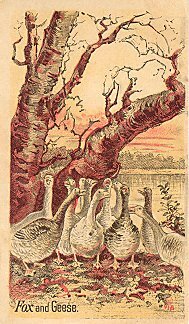 One colored "Fox and Geese" card advertising The Beaham Mfg. Co.1910? One colored "Fox and Geese" card advertising The Beaham Mfg. Co. of Kansas City, Mo., makers of "Faultless Starch." A bit less than 2½" x a bit more than 4". I doubt that this is really a fable card. It is a hidden-picture card, with a fox to be found by the clever observer. The back makes an offer "Mail us 10 for Comic Pictures, Mail us 25 for Beautiful Pictures." I take it this is one of the former, cheaper variety! Browns and reds. A small symbol at the lower right of the picture says "N 718."
 -
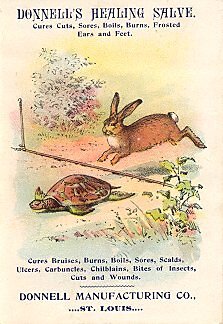 One colored TH card advertising the Donnell Manufacturing Co.1910? One colored TH card advertising the Donnell Manufacturing Co. of St. Louis. 3" x 4¼". A colorful scene of the finish line, approached by the hare while the tortoise is beyond it. Nothing on the reverse. The front promises: "Donnell's healing salve cures cuts, sores, boils, burns, frosted ears and feet. Cures bruises, burns, boils, sores, scalds, ulcers, carbuncles, chilblains, bites of insects, cuts and wounds." What does it not do?
 -
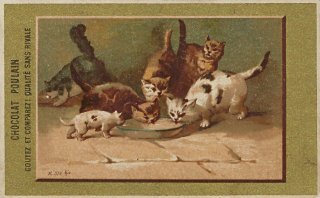 One colored card advertising Chocolat Poulain1910? One colored card advertising Chocolat Poulain and showing an image of cats around milk. On the verso is Florian's fable "Ivy and Thyme." This card is a curiosity. The image and the fable seem to have nothing to do with each other. The fable is a story of ivy's arrogance shown up by the thyme's humility: ivy needs to depend on others and cannot support itself. Poulain has a number of other sets of cards to see here, here, and here.
 -
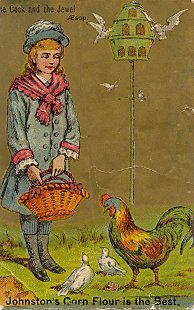 One colored CJ card advertising Johnston's Corn Flour1905? One colored CJ card advertising Johnston's Corn Flour. 2 5/8"x 4 1/8". The golden background distinguishes this card, which has been cropped, bent, and is in only fair condition. The choice of a girl to complement the rooster in the illustration is surprising. What might she have to do with the fable's story? The text is in fact James' version verbatim, where no particular human being is mentioned. That version is unusual because it actually ends up contradicting the fable: "The Cock was a sensible Cock; but there are many silly people who despise what is precious only because they cannot understand it." The verso quotes Augustus Voelcker, chemist of the Royal Agricultural Society, on the value of corn flour. I have found a whole booklet of 24 images in this style.