Other Printed Materials
The harvest of printed material other than books is abundant. From menus to bookmarks to notebooks that quote and feature Aesop, there is much here:
-
Metal printer’s block of TH1950? Metal printer’s block of TH. 1” x 5/8”. Wooden base. Unknown source. Unusual in that the hare seems to be watching the tortoise strain by. I wonder what a printer’s block like this might be used for.
-
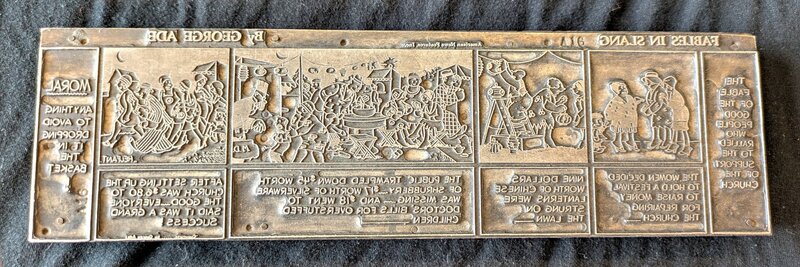 Printer’s Block of George Ade’s “The Fable of The Good People Who Rallied to the Support of the Church.”1940? Printer’s Block of George Ade’s “The Fable of The Good People Who Rallied to the Support of the Church.” Mounted on wood, with a hook for hanging. 9.7” x 2.7”. Unknown source. What fun! Our collection has a number of individual George Ade “Fables in Slang” cut out of newspapers – unfortunately not featuring this one. We have a number of his books. For those who do not want to read either forwards or in mirror-fashion, I lay out the text here. By the way, I was surprised how easy the printer’s block was to read when I flipped it in my computer!
 -
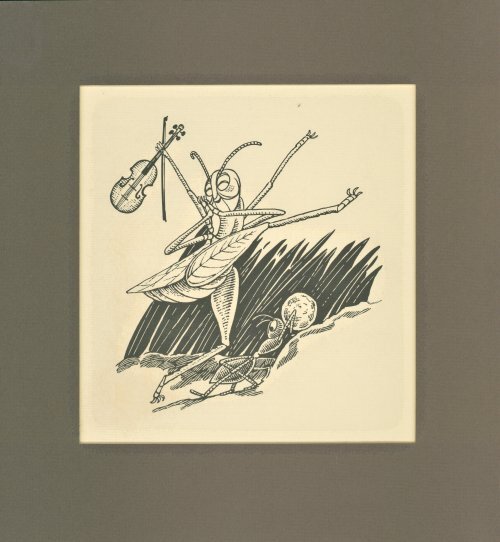 Four GA Prints Including Grasshopper Burning Violin1980? Four large matted prints of GA. Various sizes. Unknown source. I enjoy this creative approach to the story, particularly the scene in which the grasshopper is using his violin as firewood. So far I have not been able to uncover an artist. Of course I wonder if there are not more prints in the series, including perhaps a print of rejection by the ant. The prints range from 7.25” to 12” across, with matting bringing the total width to 11.25” to 12”.
 -
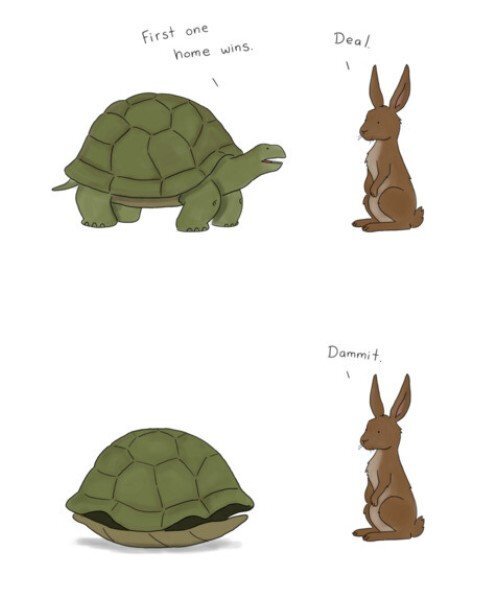 Liz Climo Print of TH2020? TH Art Print by LizClimo. 12” x 16”. This simple print has fun with the hare’s reaction to the race.
 -
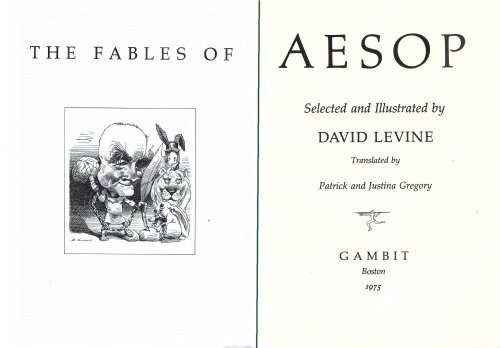 Galleys of “The Fables of Aesop, Selected and Illustrated by David Levine.”1975 Galleys of “The Fables of Aesop, Selected and Illustrated by David Levine.” Translated by Patrick and Justina Gregory. Boston: Gambit. Our first galleys! From one of my earliest and most favorite fable books! The set is complete, 8 numbered signatures, each with a progressive mark of its place in the text and all with the number “2082. Notice these markings in the photo below. Each signature has 4 large pages folded in half to produce 16 pages 7” x 9.7”.
 -
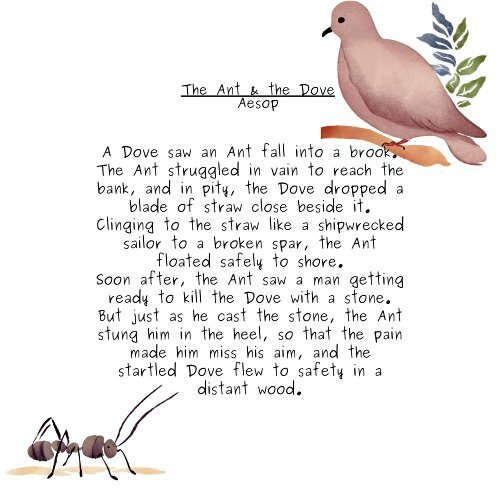 MuggersKnowBest Series of Digital Prints2015? Aesop's Fables Watercolor Print Set, Nursery & Classroom Decor (Digital Download). Created by MuggersKnowBest. Each of 6 prints tells the story well and adds watercolors of the creatures involved. "The Young Crab & His Mother" adds a pleasant last turn of events as the mother crab tries to "turn her toes out," she trips and falls on her nose. The crow in FC is female. The hare wants to "make the tortoise feel very deeply how ridiculous it was for him to try a race with a Hare," and so he lies down to nap until the tortoise catches up. The laughing lion in LM may be the best of the animal pictures.
 -
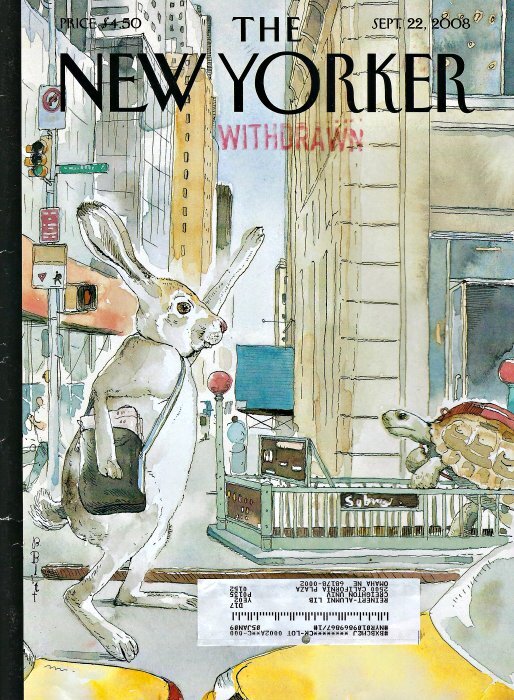 The New Yorker Cover for Sept. 22, 2008: “The Race Is On” by Barry Blitt2008 The New Yorker Cover for Sept. 22, 2008: “The Race Is On” by Barry Blitt. Gift of Jeanette Hilton, found as Creighton weeded its library materials. Do I understand the cartoon correctly, that racing slow and steady means taking the subway, while hailing a cab is the hare’s way? And will the hare sleep in the cab? Or will a cab never come?
 -
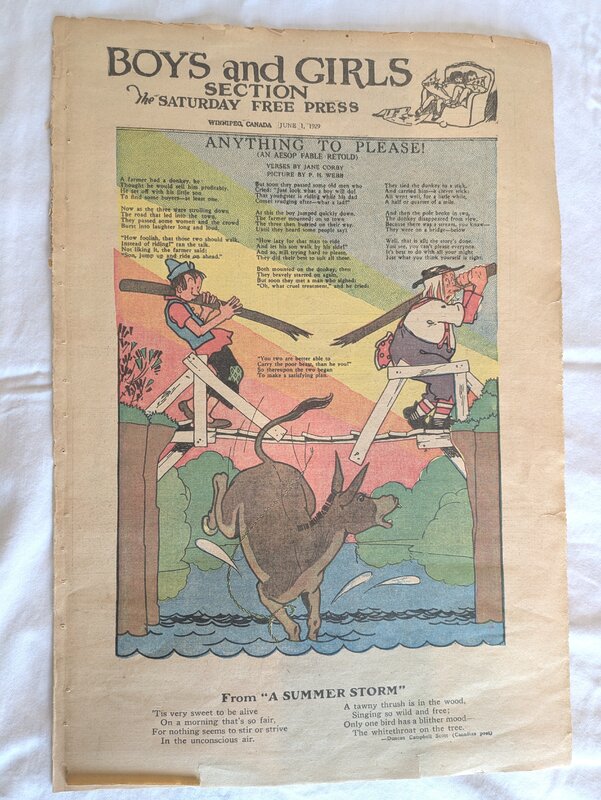 “Anything to Please! (An Aesop Fable Retold)"1929 “Anything to Please! (An Aesop Fable Retold)”. Verses by Jane Corby. Picture by P.H. Webb. Boys and Girls Section, “Saturday Free Press,” Winnipeg Canada, June 1, 1929. Unknown source. This is a dramatic one-picture presentation of a great story! There are surprise and wonder on the humans’ faces; there may be a trace of animosity and anger on the donkey’s face. The rainbow background fits the loud presentation well. The rhythms and rhymes in the couplets are sometimes forced, but the story goes through a good progression. Here the son is the first rider, and that opens up a chance for him to jump down generously when he is criticized. This version ends with a moral: “Well, that is all; the story’s done. You see, you can’t please everyone. It’s best to do with all your might Just what you think yourself is right.”
 -
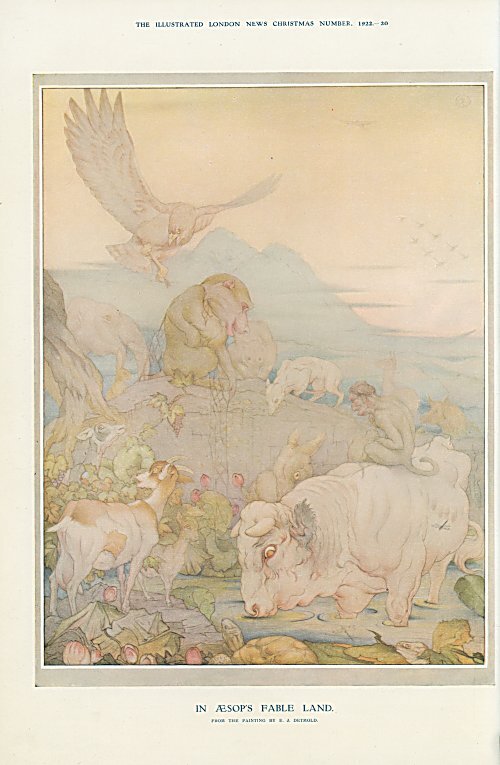 “In Aesop’s Fable Land.”1922 “In Aesop’s Fable Land.” From the painting by E.J. Detmold. The Illustrated London News Christmas Number, 1922. Printed on stiff board. Image 8.6” x 11.4”. Board 9.7” x 14.5”. Unknown source. The group presentation is typical of Detmold’s more specific fables as I am aware of them. As in those illustrations, the artist is less interested in the fable than he is in the animals.
 -
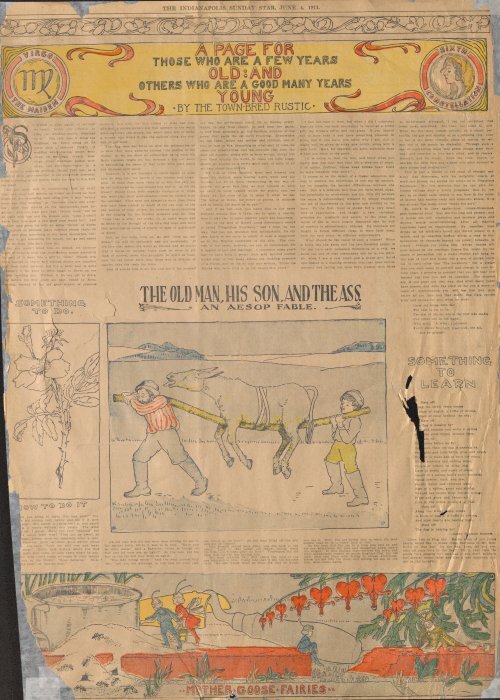 “The Old Man, His Son, and the Ass: an Aesop Fable.”1911 Newspaper illustration and text: “The Old Man, His Son, and the Ass: an Aesop Fable.” Indianapolis Sunday Star. June 4, 1911. In this version, “the old man, mad and tired with trying to please everybody, threw the ass into the river.” Were these colors originally sharper?
 -
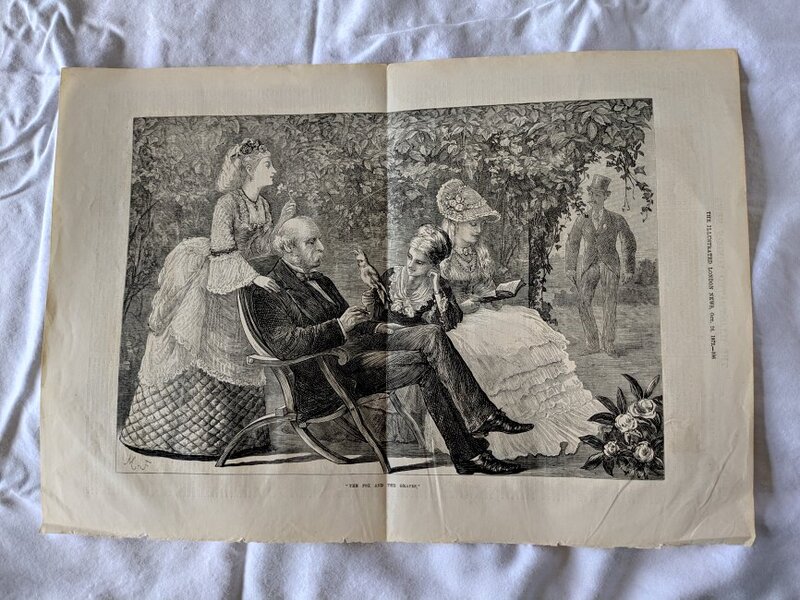 “The Fox and the Grapes.”1872 “The Fox and the Grapes.” Illustration in “The Illustrated London News” for Oct. 26, 1872. (Page 396). F. Wentworth. With accompanying text on 395. Image 12.2" x 8.5". Page 14" x 11". Unknown source. The accompanying text helps interpret the scene. It begins “The young coxcomb who lurks in the background of this scene, with his glass stuck in his right eye for a seemingly indifferent look at the girls, seated with their papa under the leafy vine, may affected to hide his disappointment at not finding one or other alone. But we shall not be deceived by this flippant behaviour on his part….”
 -
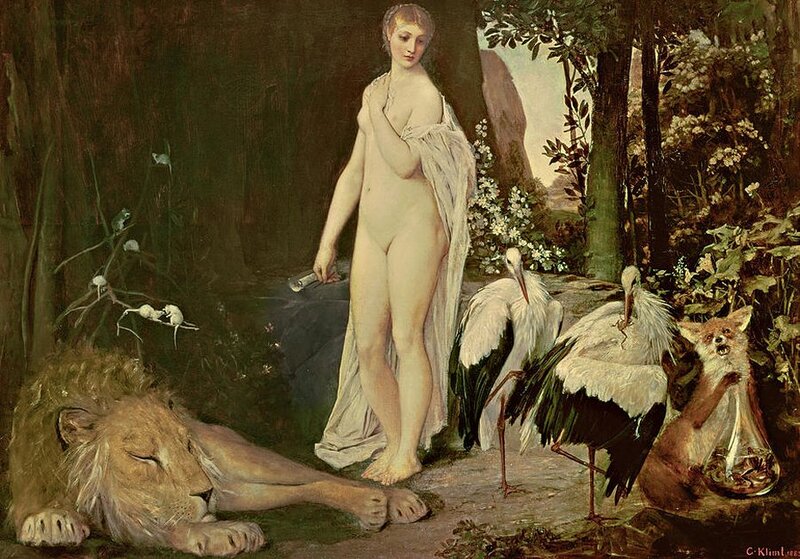 Gustav Klimt’s “Fable.”1916? Photograph of Gustav Klimt’s “Fable.” Image 12.2” x 8.7”. Overall 16.5” x 11.6”. Perhaps from fineartamerica. Starting from the right, we find here FS; FK; perhaps “Heron”; perhaps “Lion in Love”; and perhaps TMCM. There may well be other fables hidden in the painting. d